
By the Wolontek Engineering Team | Data Center Maintenance & SOPsWhen you mate two high-density MPO or MTP® connectors, the internal spring mechanism applies up to 20 Newtons of physical force to keep the glass fibers perfectly aligned. If a microscopic 5-micron dust particle, or a smear of skin oil, is trapped between those two ferrules during mating, that mechanical pressure turns the debris into a chisel.
It will instantly pit, scratch, and permanently shatter the glass matrix of the optical core. You have just destroyed a high-value trunk cable and potentially the transceiver port.
Cleaning protocols are only fully effective if you are deploying high-quality optical components to begin with. To understand the mechanical superiority of genuine US Conec connectors (such as floating ferrules and elliptical guide pins that reduce debris), read our definitive [MTP Cable Engineering Guide].
This is why mastering Mpo fiber cleaning is not optional; it is the most critical maintenance skill in a 400G/800G data center. Here is the definitive Standard Operating Procedure (SOP) for protecting your infrastructure.
The Unique Challenge of the MT Ferrule
Cleaning a standard single-fiber LC connector is relatively simple. Cleaning an MPO connector—which relies on a rectangular MT (Mechanical Transfer) ferrule—is a geometric challenge.
1.Massive Surface Area: The polymer surface of an MT ferrule is significantly larger than a ceramic LC ferrule. This large surface acts like a magnet for static electricity, literally pulling airborne dust particles onto the glass array.
2.The Pin Trap: Male MPO connectors feature two steel guide pins, while female connectors have two guide pin holes. These physical structures act as perfect traps for debris, making standard wiping motions difficult and often pushing dirt directly into the holes.
The Golden Rule: Inspect Before You Connect (IBYC)
There is one unbreakable law in fiber optic deployment: IBYC (Inspect Before You Connect).
Even though our 400-plus technicians at Wolontek’s three manufacturing facilities operate in strict cleanroom environments to test, clean, and cap every MPO trunk and SFP Module before shipping, field conditions are entirely different.
Never trust a dust cap. A dust cap protects the ferrule from physical impact, but it is not a hermetic vacuum seal. Static electricity during shipping and unpacking can easily attract micro-debris. You must inspect the end-face with a digital fiber microscope before it ever touches a switch port.
The SOP: How to Clean MPO Connectors Correctly
If your inspection scope reveals contamination, you must clean it. There are two primary tools for this: Click-Cleaners and Cassette Cleaners.
1. The One-Click Cleaner (Dry Cleaning)
Best for: Quick cleans and reaching into adapter panels. The click-cleaner uses a mechanical push-action to advance a micro-woven cleaning ribbon across the ferrule.
-
The Process: Insert the cleaner into the MPO adapter or place the guide cap over the connector. Push until you hear a loud “click.”
-
The Limitation: Click-cleaners are excellent for female (unpinned) connectors. However, they often struggle to clean the edges around the steel guide pins on male connectors.
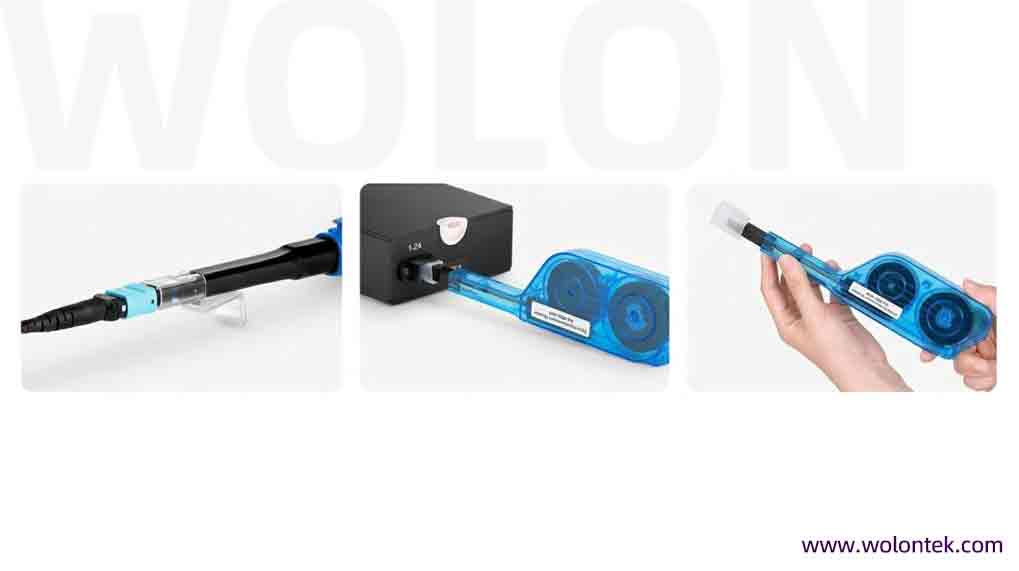
💡 Engineer’s Tool Kit: > Don’t compromise your optical budget with substandard cleaning tools. Equip your field technicians with the Wolontek MTP/MPO Cleaner Pen. Engineered with anti-static micro-fiber, it delivers over 600 precise, lint-free cleans per unit for both PC and APC ferrules.
2. The Cassette / Reel Cleaner (Dry Cleaning)
Best for: Male (pinned) connectors and heavy debris. Cassette cleaners expose a strip of densely woven, anti-static micro-fabric.
-
The Process: Squeeze the trigger to expose a clean section of cloth. Hold the MPO connector perfectly perpendicular to the surface. Swipe the ferrule in a single, smooth “Figure-Eight” motion or a straight line in one direction.
-
Crucial Rule: Never swipe back and forth. Scrubbing will grind the dirt into the glass.
3. The “Wet-to-Dry” Method (For Stubborn Contamination)
If dry cleaning fails to remove baked-on oils or stubborn residues, you must escalate to the Wet-to-Dry method.
-
Step 1: Apply a minimal amount of optical-grade cleaning solvent to a lint-free wipe or the specialized wet zone of a cleaning stick.
-
Step 2: Swipe the MPO ferrule across the wet area to break down the oil.
-
Step 3: Immediately swipe the ferrule into the dry area of the wipe in one continuous motion to lift the solvent and the suspended dirt.
-
Step 4: Re-inspect with your digital scope.
The Absolute “Do Not” List
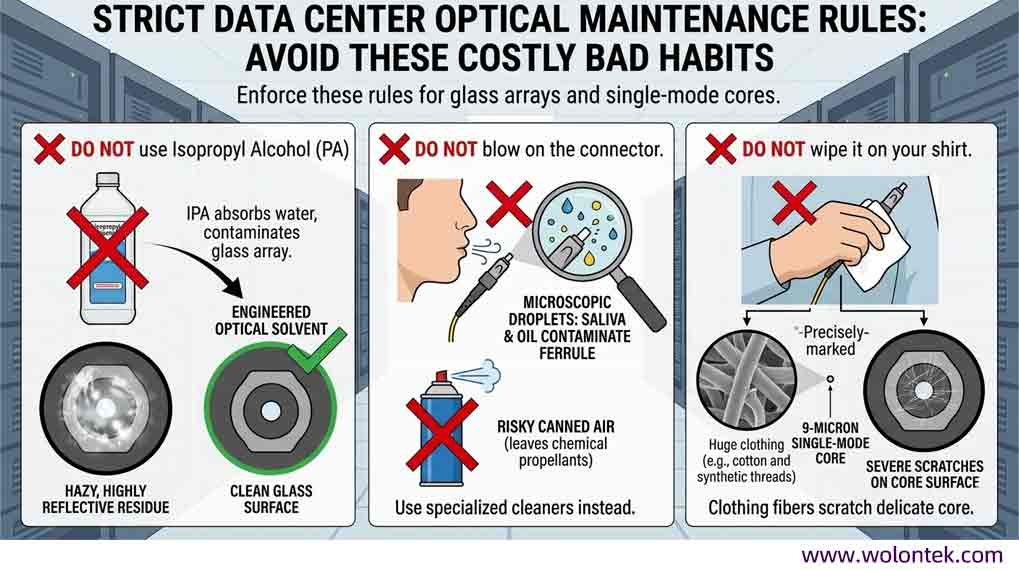
In optical maintenance, bad habits cost thousands of dollars. Enforce these rules strictly on your data center floor:
-
❌ DO NOT use Isopropyl Alcohol (IPA): Standard rubbing alcohol absorbs water from the air and will leave a hazy, highly reflective residue on the glass array. Use only engineered optical solvents.
-
❌ DO NOT blow on the connector: Your breath contains microscopic droplets of saliva and oil. You are actively contaminating the ferrule. Canned air is also risky, as it can spray chemical propellants onto the glass.
-
❌ DO NOT wipe it on your shirt: Clothing fibers are massive compared to a 9-micron single-mode core. You will severely scratch the surface.
By enforcing the IBYC rule and utilizing the correct MPO fiber cleaning tools, your technicians will eliminate the #1 cause of network downtime and Transceiver failure.
Q1: How often should I clean an MPO connector?
A: You should only clean an MPO connector if a digital inspection scope shows that it is dirty. Over-cleaning or cleaning a perfectly clean ferrule simply introduces unnecessary risk of static charge and contamination. Always Inspect first.
Q2: Why does my MPO link fail even after I used a click-cleaner?
A: Click-cleaners primarily clean the center fiber array. If debris is packed tightly around the guide pins (on a male connector) or inside the pin holes (on a female connector), the click-cleaner may miss it. This debris prevents perfect physical mating, causing high insertion loss. Use a cassette cleaner or specialized cleaning sticks for the pin areas.
Q3: Can a dirty MPO cable damage my SFP MODULE or QSFP transceiver?
A: Yes. If you plug a heavily contaminated MPO cable into a clean transceiver port, the physical spring pressure will transfer the dirt and potentially scratch the sensitive lenses inside the transceiver, permanently damaging the hardware.