
By the Wolon Engineering Team | Data Center Strategy & ROI
For Chief Technology Officers and Infrastructure Directors, optimizing a data center is fundamentally an exercise in asset efficiency. Every dollar spent on physical infrastructure must yield maximum data throughput.
However, as enterprise networks scale to 40G and 100G speeds, a silent CAPEX leak is occurring in the physical layer of many facilities: dark fiber within legacy Base-12 cabling systems.
The architectural shift from Base-12 to Base-8 MPO/MTP cabling is not just a minor technical update; it is a financial necessity driven by the mechanics of modern optical transceivers. Here is why the world’s most efficient data centers have made the switch, and how you can migrate your existing infrastructure without stranding historical investments.

The Financial Drain of Base-12 in Modern Networks
For over a decade, the 12-fiber MPO connector (Base-12) was the undisputed backbone of data center cabling. It served perfectly when networks relied on legacy 10G architectures.
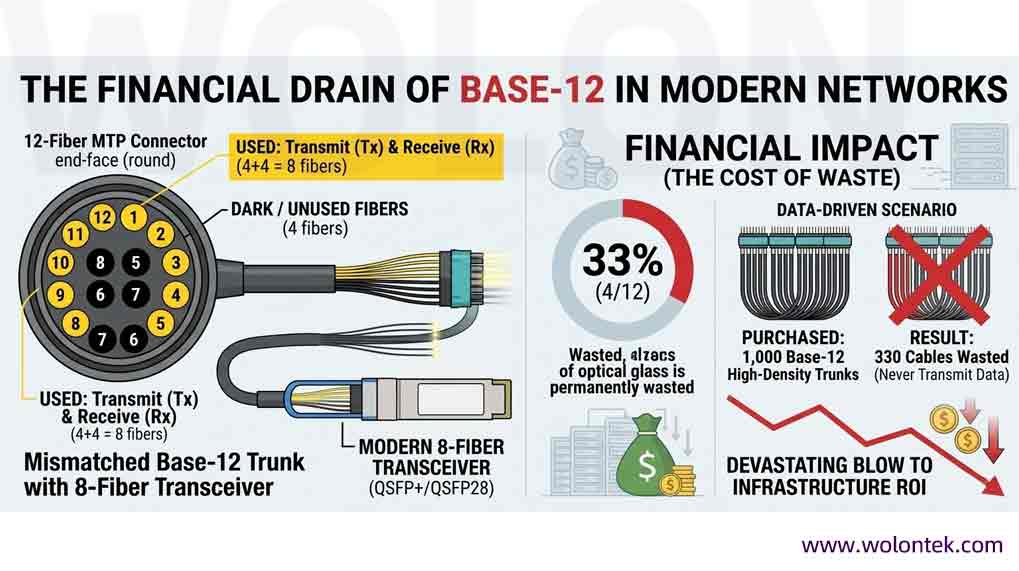
But transceiver technology evolved. Today, if you deploy a standard Qsfp+ transceiver for 40G (SR4) or a QSFP28 for 100G (SR4), the optics utilize a parallel transmission method. They require 4 fibers to transmit and 4 fibers to receive.
This totals 8 fibers.
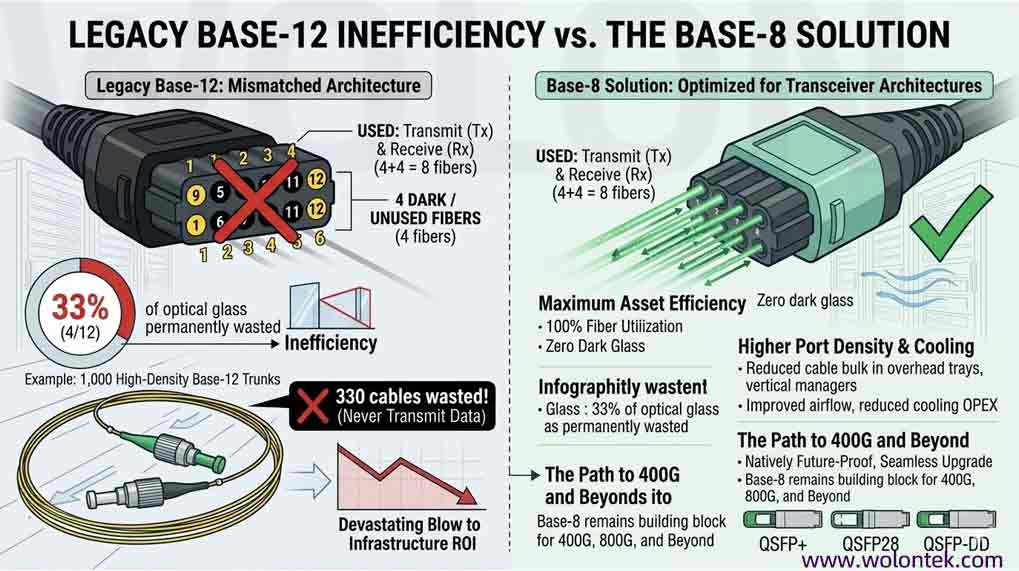
If you plug an 8-fiber transceiver into a legacy 12-fiber MTP trunk, the central 4 fibers remain completely dark. They carry no data. This means 33% of your optical glass is permanently wasted.
To put that in financial terms: if you purchase 1,000 high-density fiber trunks for a new data hall using a Base-12 architecture, you have effectively paid for 330 cables that will never transmit a single packet of data. That is a devastating blow to your infrastructure ROI.
The Base-8 Solution: 100% Fiber Utilization
The industry’s response to this inefficiency is the Base-8 MTP architecture.
By standardizing trunks, cassettes, and harnesses on 8-fiber increments, the physical cabling perfectly matches the Transceiver architecture.
-
Maximum Asset Efficiency: 8 fibers in the transceiver map directly to 8 fibers in the MTP connector. You achieve 100% fiber utilization with zero dark glass.
-
Higher Port Density: Base-8 reduces cable bulk in overhead trays and vertical managers, improving airflow to critical routing hardware and reducing cooling OPEX.
-
The Path to 400G and Beyond: Base-8 is natively future-proof. When you upgrade to 400G using QSFP-DD (DR4) transceivers, the Base-8 infrastructure remains untouched. Even 800G deployments using octal configurations heavily favor Base-16 (two rows of 8), making Base-8 the foundational building block for the next decade.
The “Gentle” Migration: Protecting Legacy Assets
A common anxiety among infrastructure directors is the “rip and replace” dilemma. If you have already invested millions in a Base-12 backbone, tearing it out to install Base-8 is financially unviable.
Fortunately, physical layer engineering provides a seamless migration path. You do not need to abandon your existing cabling.
By deploying MTP Conversion Cassettes or Modules, you can bridge the gap between legacy trunks and modern switches. A standard conversion module takes two 12-fiber MTP trunks (24 fibers total) in the rear and converts them into three 8-fiber MTP ports (24 fibers total) in the front.
This routing magic ensures that 100% of your legacy Base-12 glass is utilized, while presenting perfect Base-8 ports to your modern 40G/100G switches. It is the ultimate asset protection strategy, allowing you to phase in Base-8 organically as you upgrade specific halls or rows.
Scaling with a Strategic Manufacturing Partner
Whether you are migrating core spine switches or upgrading access layers with advanced SFP Module deployments, optical efficiency dictates your operational success. Executing a massive infrastructure upgrade requires a supply chain that can deliver precision at scale.
With three dedicated manufacturing facilities in Wuhan, China, and a workforce of 400-500 optical specialists, Wolon engineers both native Base-8 MTP systems and customized conversion modules. Supplying high-density data centers across over 80 countries, we understand the critical balance between uncompromising optical performance (guaranteed by 3D interferometry) and aggressive CAPEX optimization.
Stop paying for dark fiber. If you are planning a 100G or 400G rollout, aligning your physical layer with your active equipment is step one.
 Planning a Base-8 Migration?
Don’t leave rack density to chance. We will help you design a Base-8 migration strategy that maximizes density and strictly protects your budget.
 Request a Free BOM Analysis
Q1: Can I plug a Base-8 transceiver directly into a Base-12 trunk?
A: Yes, physically it will plug in if the genders and polarities match, but doing so leaves 4 fibers (33% of the trunk) permanently dark and unused, wasting your infrastructure investment.
Q2: Are Base-8 MTP connectors physically smaller than Base-12 connectors?
A: No. The footprint of the MTP connector itself is identical. A Base-8 connector simply uses the standard 12-fiber ferrule but leaves the central four positions unpopulated (empty). This is why it remains backward compatible with standard MPO adapter panels.
Q3: How does the MTP Conversion Cassette work for legacy systems?
A: A conversion cassette acts as an optical traffic cop. It accepts two fully populated 12-fiber trunks (24 fibers) from your legacy backbone and internally re-routes them to three 8-fiber ports on the front panel. This ensures zero dark fibers while allowing you to plug in three 40G/100G transceivers perfectly.
Q4: Does Wolon support Base-16 for 400G and 800G upgrades?
A: Yes. We manufacture Base-16 MTP assemblies specifically designed for high-density 400G (using QSFP-DD) and 800G networks. Base-16 essentially stacks two rows of Base-8 architecture into a single ferrule, perfectly aligning with your Base-8 migration strategy.