
MPO trunk cables are a key component of high-density fiber infrastructure, particularly in modern data centers where large numbers of optical fibers must be deployed within limited rack and pathway space.
An MPO trunk cable consolidates multiple optical fibers into a single factory-terminated cable assembly, allowing high-density connections between distribution areas, fiber panels, cassettes, and equipment.
However, selecting the right MPO trunk cable requires more than choosing a fiber count and cable length. Fiber type, connector configuration, polarity, connector gender, insertion loss, and cable construction must all match the network architecture.
This guide explains the main MPO trunk cable types, fiber-count options, polarity, connector configurations, and common data center applications.
What Is an MPO Trunk Cable?
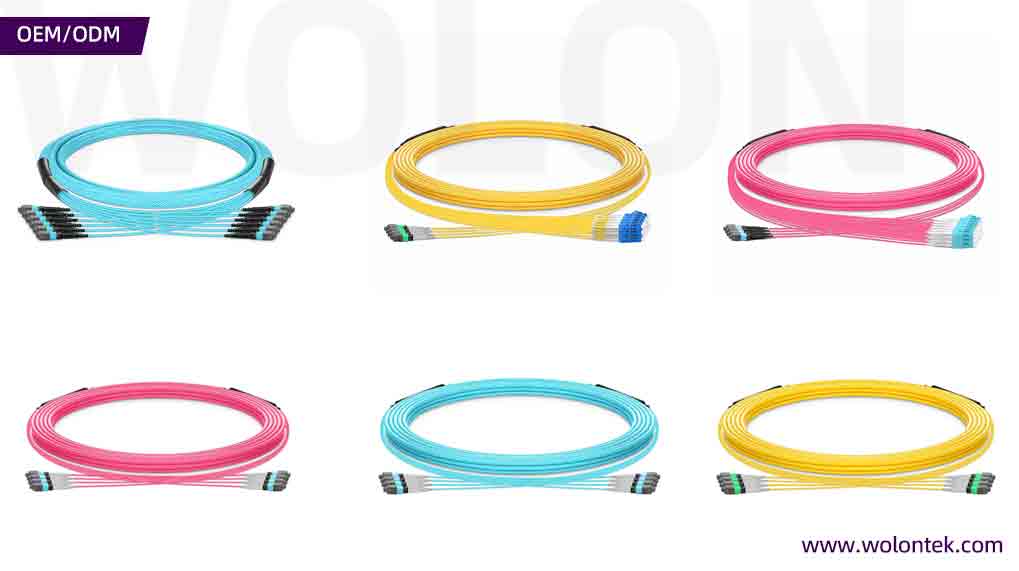
An MPO trunk cable is a factory-terminated multi-fiber optical cable assembly designed primarily for high-density backbone and structured cabling connections.
A typical configuration is:
MPO/MTP® → Multi-Fiber Cable → MPO/MTP®
Common configurations include 8, 12, 16, and 24 fibers.
MPO trunk cables are typically used between distribution points, patch panels, MPO cassettes, and other high-density fiber interfaces.
For example:
MDA → MPO/MTP® Trunk → HDA
or:
Fiber Panel → MPO/MTP® Trunk → MPO Cassette
Unlike an MPO breakout cable, a trunk cable normally maintains the multi-fiber architecture from one end to the other rather than splitting the fibers into multiple individual connectors.
In simple terms: an MPO trunk cable provides the high-density backbone connection within a structured fiber cabling system.
For a broader comparison of trunk, breakout, harness, and patch-cord assemblies, see the [WolonFiber MPO/MTP Cable Types Guide].
MPO Trunk Cable vs MPO Breakout Cable
Although both may use MPO or MTP® connectors, their functions are different.
| Feature | MPO Trunk Cable | MPO Breakout Cable |
|---|---|---|
| Primary purpose | Backbone interconnection | Fiber/interface breakout |
| Typical configuration | MPO/MTP® to MPO/MTP® | MPO/MTP® to multiple connectors |
| Fiber architecture | Maintained end-to-end | Divided into multiple paths |
| Typical deployment | MDA, HDA, panels, cassettes | Equipment and port breakout |
| Fan-out | No | Yes |
In simple terms:
Trunk = high-density backbone
Breakout = multi-fiber-to-multiple-interface transition
For a complete explanation of MPO/MTP cable types, see the [WolonFiber MPO/MTP Cable Types Guide].
MPO and MTP® Trunk Cables
MPO refers to the standardized multi-fiber connector interface, while MTP® is a registered trademark of US Conec for its high-performance MPO connector solution.
MTP® connectors are designed to comply with applicable MPO interface requirements while incorporating design features intended to improve mechanical and optical performance.
Therefore, when a project specifically requires MTP® components, the procurement specification should state MTP® rather than assuming that every MPO connector is an MTP® connector.
MPO Trunk Cable Types by Fiber Count
Common MPO trunk cable configurations include:
- 8 fibers
- 12 fibers
- 16 fibers
- 24 fibers
The appropriate fiber count should be determined by the optical architecture and transceiver requirements.
8-Fiber MPO Trunk Cable
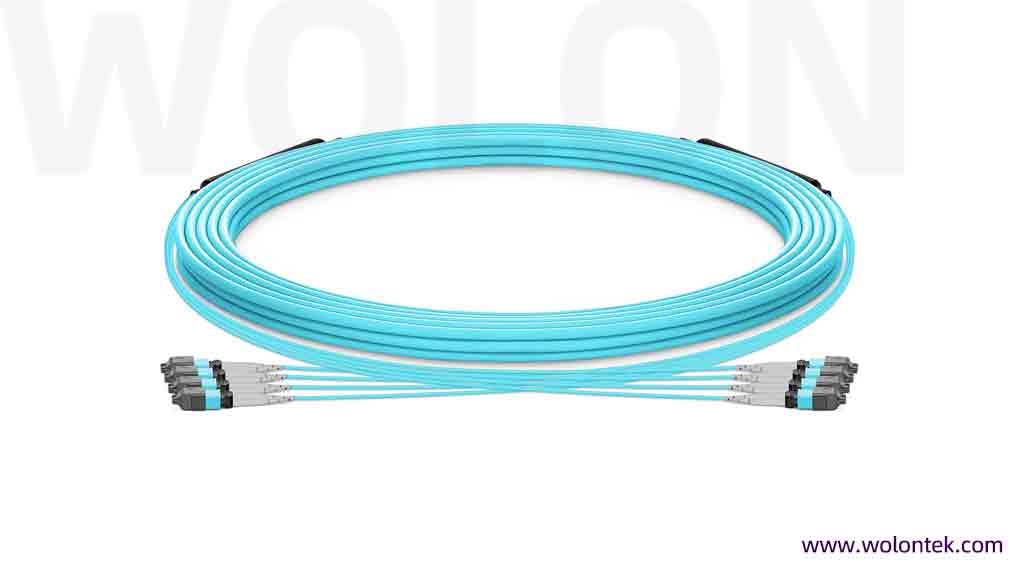
An 8-fiber or Base-8 configuration is commonly used for parallel-optics architectures requiring eight active fibers.
A typical arrangement is:
4 Tx + 4 Rx = 8 fibers
Base-8 is commonly associated with applications such as certain 40G SR4 and 100G SR4 links.
12-Fiber MPO Trunk Cable
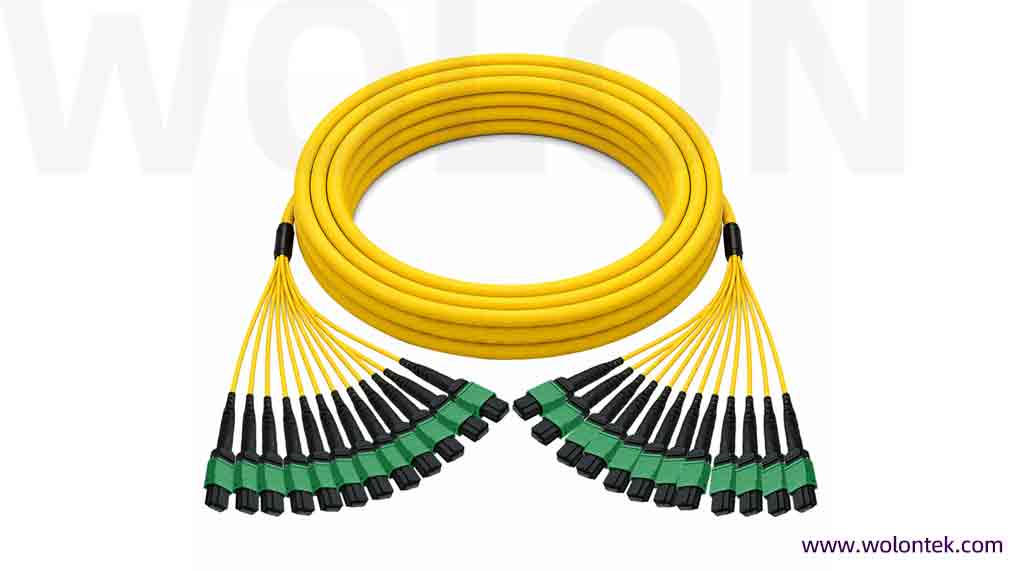
MPO-12 is widely used in structured data center cabling and MPO cassette systems.
A 12-fiber assembly can support multiple applications, but not all twelve fibers are necessarily active in every optical architecture.
For example, an eight-fiber optical interface may leave four fibers unused within a 12-fiber assembly.
16-Fiber MPO Trunk Cable
MPO-16 is increasingly relevant to high-density parallel-optics applications.
A typical architecture may use:
8 Tx + 8 Rx = 16 fibers
This makes Base-16 suitable for certain high-speed applications, including some 400G parallel-optics architectures.
24-Fiber MPO Trunk Cable
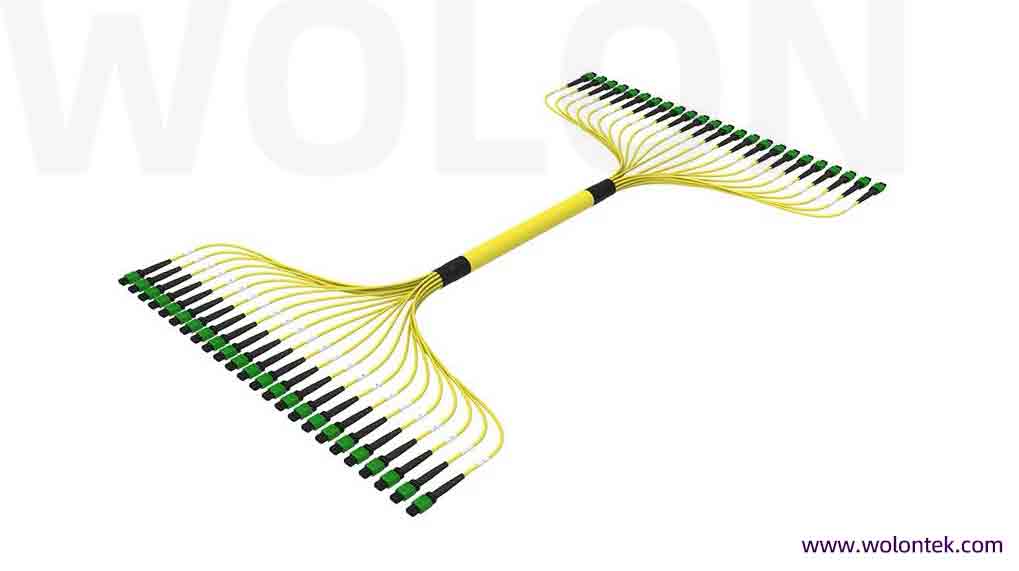
MPO-24 provides 24 fibers within a single high-density connector interface.
It can be used for:
- High-density backbone cabling
- Fiber aggregation
- Distribution-area interconnection
- High-count structured cabling
The higher fiber count can reduce the number of individual cables required, although cable diameter and bend-management requirements must also be considered.
MPO Fiber Count Comparison
| Fiber Count | Typical Architecture | Common Application |
|---|---|---|
| 8F | Base-8 | 40G/100G parallel optics |
| 12F | Base-12 | Structured cabling, MPO cassettes |
| 16F | Base-16 | High-density parallel optics |
| 24F | Base-24 | High-density backbone and aggregation |
For a detailed comparison of Base-8, Base-12, and Base-16 architectures, see the [WolonFiber MPO Fiber Count Guide].
MPO Trunk Cable by Fiber Type
MPO trunk cables are available with both multimode and single-mode fiber.
MPO trunk cables are available with both multimode and single-mode fiber.
| Fiber Type | Typical Application |
|---|---|
| OM3 | Data center multimode links |
| OM4 | Higher-performance multimode data center links |
| OM5 | Selected wideband multimode applications |
| OS2 | Single-mode and longer-distance applications |
MPO Trunk Cable Polarity
Polarity is one of the most important MPO trunk cable specifications.
The fiber mapping must maintain the correct relationship between transmit and receive channels across the complete optical link.
The three traditional MPO polarity methods are:
- Method A
- Method B
- Method C
Method A
Straight-through mapping:
1 → 1, 2 → 2, 3 → 3…
Method B
Complete positional reversal:
1 → 12, 2 → 11, 3 → 10…
for a 12-fiber configuration.
Method C
Pair-wise reversal:
1 ↔ 2, 3 ↔ 4, 5 ↔ 6…
There is no universally “best” polarity method. The correct choice depends on the transceiver, cassette, adapter, patch cord, and complete fiber mapping of the optical channel.
MPO polarity must be designed at the system level, not selected independently.
For a detailed explanation, see the [WolonFiber MPO/MTP Polarity Guide].
MPO Trunk Cable Connector Gender
MPO/MTP® connectors are generally specified as:
- Male / Pinned
- Female / Unpinned
Male connectors contain guide pins, while female connectors do not.
The connector gender must match the mating interface, including:
- MPO adapters
- MPO cassettes
- Optical transceivers
- Patch panels
- Other MPO/MTP® assemblies
A complete specification should therefore identify connector gender at both ends.
For example:
24F OM4 MTP® trunk cable, Method B, male-to-female
is much more precise than:
24F MTP cable
MPO Trunk Cable Construction
A typical MPO trunk cable consists of several key components:
Optical Fiber
The cable may use OM3, OM4, OM5, or OS2 fiber depending on the application.
Strength Member
Mechanical reinforcement protects the fibers from tensile stress during installation and routing.
Outer Jacket
Common constructions include:
- LSZH
- OFNR
- OFNP
The appropriate jacket rating depends on the installation environment and applicable building codes.
MPO/MTP® Connector Assembly
The termination typically includes an MT ferrule, connector housing, and guide-pin system.
The connector assembly must maintain accurate fiber alignment and provide the required mechanical protection.
MPO Trunk Cable Insertion Loss
Insertion loss is an important specification for MPO trunk cables because every optical connection contributes to the total channel loss.
The complete link budget may include:
- MPO connector loss
- Adapter loss
- Cassette loss
- Patch-cord loss
- Fiber attenuation
- Splice loss, where applicable
For high-speed optical systems with tighter power margins, low-loss MPO/MTP® components can be particularly important.
When specifying a trunk cable, the required insertion-loss grade should be based on the complete optical link budget rather than the cable alone.
MPO Trunk Cable Applications in Data Centers
MPO trunk cables are commonly used within structured data center architectures.
MDA to HDA Backbone
A typical backbone connection is:
MDA → MPO/MTP® Trunk → HDA
The trunk cable provides high-density connectivity between distribution areas.
HDA to EDA
At the equipment level, the trunk may connect to MPO cassettes, breakout cables, harnesses, or patch cords:
HDA → MPO Trunk → MPO Cassette → Equipment
This approach allows high-density backbone infrastructure to transition into the interfaces required by active equipment.
Spine-Leaf Networks
MPO/MTP® trunk cables can also consolidate large numbers of high-speed optical links between network switches.
The exact configuration depends on the transceiver and optical lane architecture.
MPO Trunk Cables for 40G, 100G and 400G Networks
MPO trunk cable selection should begin with the optical transceiver.
| Application | Example Fiber Architecture | MPO Consideration |
|---|---|---|
| 40G SR4 | 4 Tx + 4 Rx | Base-8 |
| 100G SR4 | 4 Tx + 4 Rx | Base-8 |
| 400G SR8 | 8 Tx + 8 Rx | Base-16 |
| Higher-speed architectures | Application dependent | Architecture dependent |
These examples are not universal prescriptions. The transceiver manufacturer’s specifications should always determine the required fiber count, connector configuration, polarity, and fiber type.
How to Choose the Right MPO Trunk Cable
A practical selection process should follow these steps:
1. Identify the Optical Interface
Determine:
- Transceiver type
- Data rate
- Transmission distance
- Connector interface
- Number of optical lanes
2. Select the Fiber Count
Choose the appropriate configuration:
8F / 12F / 16F / 24F
based on the optical architecture.
3. Select the Fiber Type
Choose:
OM3 / OM4 / OM5 / OS2
according to the transceiver and transmission requirements.
4. Determine Polarity
Specify:
Method A / Method B / Method C
or provide the required fiber mapping.
5. Determine Connector Gender
Specify:
Male / Female
for each end.
6. Specify Length and Jacket
Determine the required:
- Cable length
- LSZH / OFNR / OFNP
- Cable diameter
- Routing environment
7. Verify Optical Performance
Confirm:
- Insertion loss
- Return loss
- Test requirements
- Total channel loss
MPO Trunk Cable Specification Example
A professional specification might look like:
24F OM4 MTP® trunk cable, Method B polarity, male-to-female connectors, LSZH jacket, 30 m, low-loss configuration.
| Parameter | Example |
|---|---|
| Cable type | MTP® trunk |
| Fiber count | 24F |
| Fiber type | OM4 |
| Connector | MTP® |
| Polarity | Method B |
| Gender | Male-to-female |
| Jacket | LSZH |
| Length | 30 m |
| Loss grade | Low-loss |
MPO Trunk Cable Installation Considerations
A few installation practices are particularly important:
- Maintain the manufacturer’s specified minimum bend radius.
- Keep pulling tension within the cable specification.
- Avoid crushing or excessive compression in high-density pathways.
- Do not pull directly on the connector unless the cable is designed for it.
- Label both ends with the cable ID and destination.
- Maintain consistent routing and cable management.
These practices help protect the optical performance and simplify future maintenance.
MPO Trunk Cable Testing and Quality Control
Before shipment, MPO trunk cables should be tested according to the product and project requirements.
Typical quality-control procedures include:
- Insertion-loss testing
- Return-loss testing
- Fiber continuity
- Polarity verification
- Connector end-face inspection
- Visual inspection
For multi-fiber assemblies, polarity verification is particularly important because a single mapping error can affect multiple optical channels.
Where required, test results should be traceable to the individual cable assembly.
MPO Trunk Cable FAQ
What is an MPO trunk cable?
What is an MPO trunk cable?
An MPO trunk cable is a factory-terminated multi-fiber optical assembly designed primarily for high-density backbone and structured cabling connections.
What fiber counts are available?
Common configurations include 8F, 12F, 16F, and 24F. Other configurations can be manufactured for specialized applications.
What is the difference between an MPO trunk cable and an MPO breakout cable?
An MPO trunk cable maintains a multi-fiber connection between two points, while a breakout cable divides one multi-fiber interface into multiple smaller connection paths.
Which MPO polarity should I choose?
The correct polarity depends on the complete optical channel, including transceivers, cassettes, adapters, and patch cords. There is no universally correct method.
Are MPO and MTP® trunk cables the same?
Not exactly. MPO refers to the standardized multi-fiber connector family, while MTP® is a specific high-performance MPO connector solution from US Conec.
What should I include in an MPO trunk cable specification?
At minimum, specify fiber count, fiber type, connector type, connector gender, polarity, cable length, jacket type, and insertion-loss requirements.
Final Takeaway
An MPO trunk cable provides a high-density backbone connection within a structured fiber network.
The most important selection parameters are:
Fiber count + fiber type + connector + gender + polarity + insertion loss + cable construction + length
For data center applications, the cable should be selected from the optical transceiver and network architecture backward—not simply by connector type or fiber count.
WolonFiber provides customized MPO/MTP® trunk cable assemblies for data center and high-density optical networking applications, with configurable fiber counts, fiber types, connector configurations, polarity, cable length, jacket construction, and optical performance.
For an overview of trunk, breakout, harness, and patch-cord configurations, see the WolonFiber MPO/MTP Cable Types Guide .