
By the Wolontek Engineering Team | Data Center Infrastructure & Deployment
When bidding on a 20-megawatt hyperscale data center fit-out, the largest variable on your spreadsheet is not the raw material cost. It is the skilled labor required to install it.
Deploying thousands of optical links across multiple data halls is a logistical massive undertaking. If a cabling contractor relies on traditional field splicing for high-density links, they are actively eating into their own profit margins and extending project timelines by weeks, if not months.
For modern Spine-Leaf architectures, the only scalable, financially viable solution for the main distribution areas is the pre-terminated MPO trunk cable.
Trunk cables form the physical backbone of your facility, but specifying them requires strict adherence to connector gender and fiber counts. For a complete breakdown of MTP engineering standards—including the crucial mechanical differences between MPO and MTP—read our [Ultimate Guide to MTP Cable Architecture].
Here is a brutal look at the operational math, optical physics, and architectural advantages of deploying factory-terminated fiber optic trunks instead of splicing in the field.
The Brutal Math: Field Splicing vs. MTP/MPO Trunk Cables
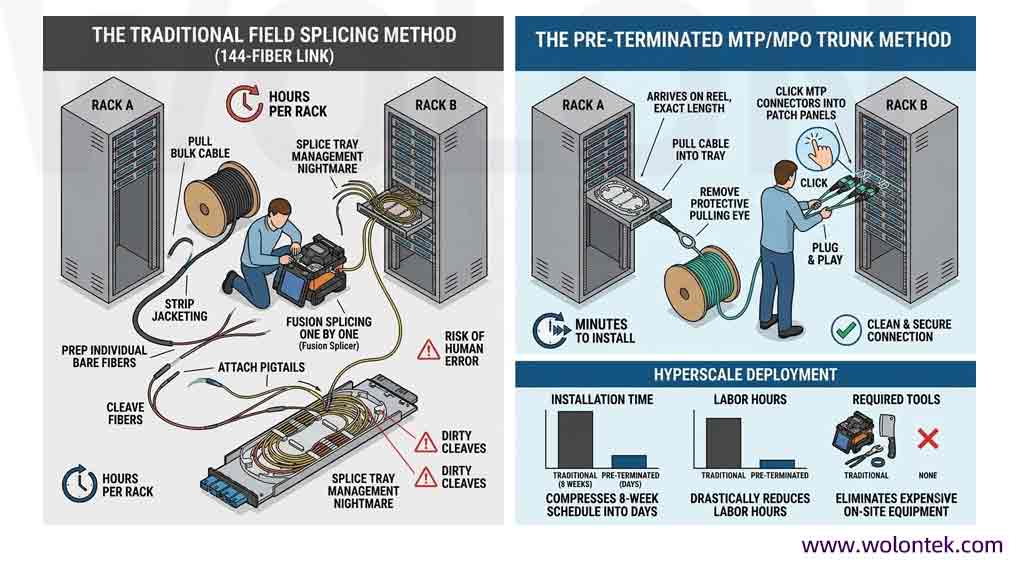
Let’s examine a standard deployment: connecting two network racks with a 144-fiber link.
The Traditional Field Splicing Method: To field-splice a 144-fiber trunk, an installer must pull bulk cable, strip the jacketing, prep the individual bare fibers, cleave them, and run them through a fusion splicer one by one to attach pigtails. Even with a highly skilled technician and a mass-fusion ribbon splicer, this process takes hours per rack. It also introduces the risk of human error, dirty cleaves, and splice tray management nightmares.
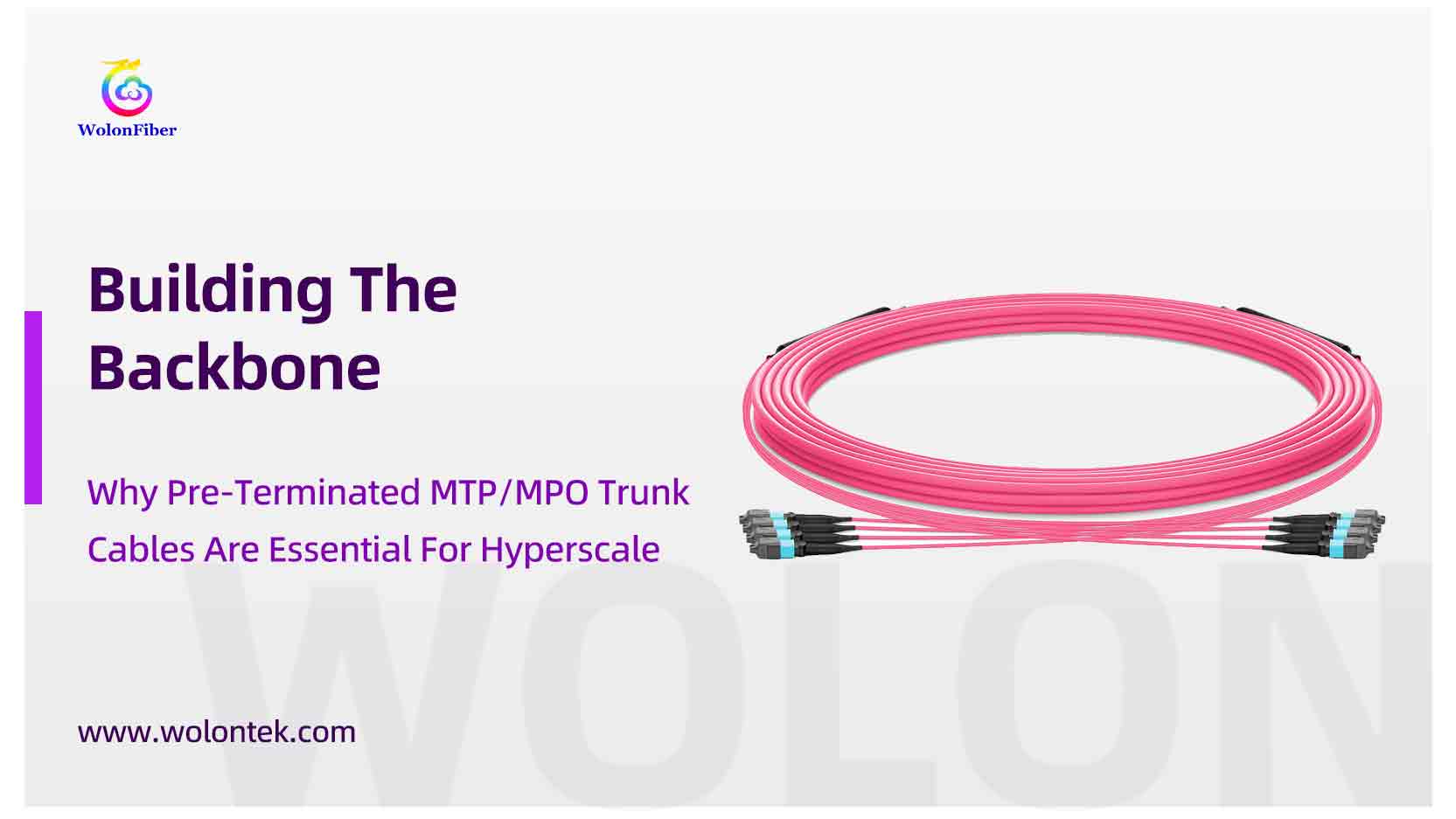
The Pre-Terminated MTP/MPO Trunk Method: A pre-terminated fiber optic trunk arrives on a reel, cut to the exact length required. The technician simply pulls the cable into the tray, removes the protective pulling eye, and clicks the MTP connectors directly into the patch panels.
- Time to install: Minutes.
- Tools required: None.
In a hyperscale environment where you are repeating this process thousands of times, pre-terminated trunks compress an eight-week cabling schedule into a matter of days. You eliminate the need for expensive splicing equipment on-site and drastically reduce your required labor hours.
The Cleanroom Guarantee: Why 3D Interferometry Matters
Beyond labor savings, field-terminating multi-fiber push-on (MPO) connectors is virtually impossible to do correctly on a construction site.
Unlike a simple LC connector, an MTP connector houses 12, 16, or 24 microscopic fibers inside a single ferrule. If the polishing angle is off by a fraction of a degree, or if one fiber protrudes slightly more than the rest, the physical contact is compromised. This leads to massive Insertion Loss (IL) and Return Loss (RL), causing bit-error rates on high-speed PAM4 signals.

High-performance MTP trunk cables must be manufactured in a strictly controlled cleanroom environment. At our production facilities across Wuhan, Huangshi, and Wutonghu, every MTP ferrule undergoes an aggressive multi-stage polishing process.
Crucially, every single connector is validated using a 3D Interferometer. This equipment scans the end-face geometry to measure:
- Radius of Curvature: Ensuring the ferrule shape allows for perfect mating force.
- Apex Offset: Verifying the highest point of the polish is perfectly centered on the fiber array.
- Fiber Height: Ensuring all 12 or 16 fibers protrude at the exact same microscopic height.
A construction site cannot replicate this level of optical precision. When you deploy a factory-tested trunk, you are guaranteeing the optical budget of the entire link before the cable even leaves the box.
Structured Cabling: The Modular “Lego” Architecture
A pre-terminated MTP trunk cable is not just a wire; it is the permanent backbone of your data center. It functions as a modular, high-speed highway.
In a true structured cabling design, the trunk cables are routed through the overhead trays and connected to MTP adapter panels or cassettes in the racks. This creates a “plug-and-play” architecture.
When it is time to upgrade the network from 100G to 400G or 800G, you do not touch the permanent trunk cables hidden in the ceiling. The backbone remains untouched. You simply swap out the short MPO to LC breakout cables or cassettes at the end of the line to match your new switch transceivers.
This modularity allows data center operators to migrate to higher speeds with zero disruption to the permanent physical plant.
Capacity Meets Execution
Securing a hyperscale contract means you need a supply chain that can keep pace with your aggressive installation schedule. Relying on distributors who import standard lengths and re-sell them leaves you vulnerable to massive delays when you need custom staggers or specific polarities.
Producing thousands of Fluke-tested, custom-length trunks requires serious manufacturing capability. With a dedicated workforce of nearly 500 optical specialists across our three manufacturing bases, Wolontek delivers the volume, the US Conec MTP® precision, and the strict quality control that hyperscale contractors demand.
Stop paying for unnecessary labor hours and start building a smarter backbone.
Stop Losing Margin on Field Splicing. Your hyperscale project demands precision, speed, and reliability. At Wolontek, we engineer custom-length, pre-tested MTP®/MPO trunk cables that arrive ready to deploy. By leveraging our massive manufacturing capacity across our three dedicated production bases, we ensure your fiber optic trunks are built to your exact BOM specifications—saving you thousands in on-site labor and eliminating project delays.
 Wolon Quality Guarantee
Every trunk cable you order includes full 3D Interferometer data and Fluke Insertion Loss test reports right in the box. No guessing, just verified performance.
 Submit Your BOM for a Factory-Direct Quote
Q1: How do I manage cable slack if a pre-terminated trunk is slightly too long?
A: It is a standard industry practice to order a fiber optic trunk 1 to 2 meters longer than the exact measured distance to account for unexpected routing changes. The excess slack is easily managed by spooling it in a “figure-eight” pattern within the overhead cable trays or zero-U vertical managers. This method prevents micro-bends and protects the optical budget.
Q2: How do I safely pull a pre-terminated cable with delicate MTP connectors attached?
A: We equip both ends of our MTP trunk cables with heavy-duty pulling eyes (pulling grips). This specialized mesh sleeve shifts the pulling tension onto the cable’s strength members (Kevlar/aramid yarn) and completely isolates the MTP connectors from crush forces and dirt while the cable is pulled through conduits, raceways, or under raised floors. Once routed, the pulling eye is easily cut away.
Q3: Can you manufacture high-density trunks, such as 144-fiber cables?
A: Absolutely. We manufacture high-fiber-count trunks using advanced micro-core cable designs. A 144-fiber trunk typically features 12 individual 12-fiber MTP connectors (or 9x 16-fiber MTPs for 400G architectures) at each end, consolidated into a single, thin, and highly flexible outer jacket to maximize your cable pathway space.
Q4: Do your trunk cables meet strict building fire codes?
A: Yes. Depending on your region, we manufacture MTP trunk cables with OFNP (Plenum) jackets for North American HVAC drop-ceiling regulations, or Low Smoke Zero Halogen (LSZH) jackets fully compliant with strict European CPR (Construction Products Regulation) Euroclass fire safety ratings.