
Let’s talk about the one feature in your optical network that you hope never activates—but you absolutely cannot afford to be without.
We all know that high-power optical amplifiers (like EDFAs) are the engines driving long-haul networks. But they also pose a serious risk. The invisible infrared light (typically 1550nm) pumping out of an EDFA can range from +20dBm to +27dBm.
To put that in perspective: That is enough power to instantly burn a technician’s retina or melt a dirty fiber connector face. And because the light is invisible, your natural blink reflex won’t save you.
This is where Automatic Power Reduction (APR) steps in.
At Wolon, safety isn’t just a checkbox; it’s a manufacturing standard. With over a decade of experience exporting to strict markets like Europe and the USA, we ensure every high-power device we build keeps your engineers safe.
What is Automatic Power Reduction (APR)?
Automatic Power Reduction (APR) is a safety mechanism built into high-power optical equipment, particularly Erbium-Doped Fiber Amplifiers (EDFA).
Think of APR as the “Circuit Breaker” or “Airbag” of the fiber world.
-
Normal Operation: The amplifier pumps out full power to transmit data over long distances.
-
The Incident: A fiber cable is accidentally cut, or a connector is unplugged by a technician.
-
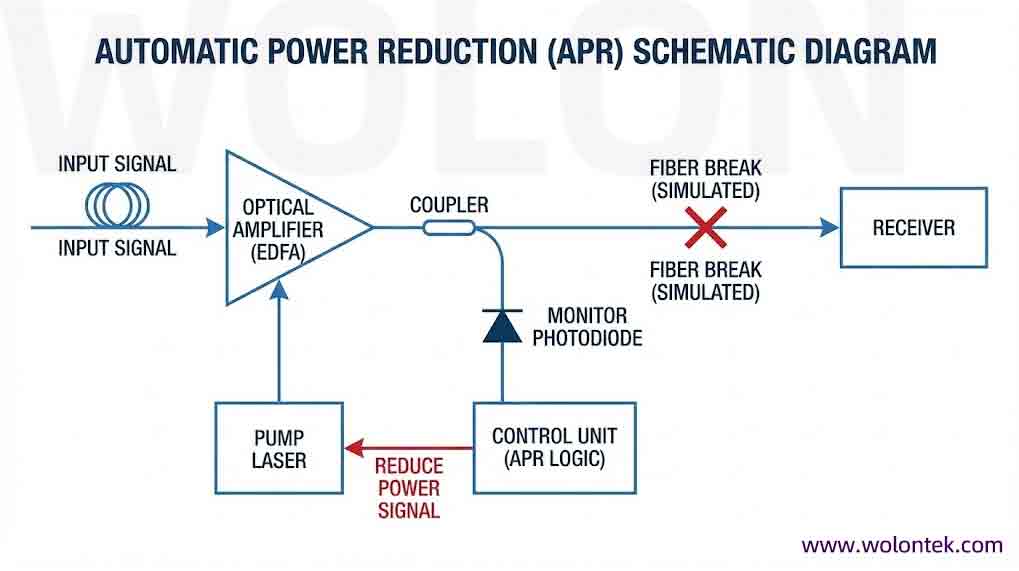
The Reaction: The APR circuit detects the “Loss of Signal” (LOS) at the input or a sudden drop in return loss.
-
The Action: Within milliseconds, it automatically reduces the output power to a safe level (usually below +10dBm or completely off).
This prevents the laser from escaping into the open air at dangerous levels.
Why Do You Need APR? (Beyond Just Safety)
You might think, “My technicians are trained; they wear safety goggles.” But APR is about more than just eye safety.
1. Compliance with IEC Standards (The Law)
If you are deploying networks in Europe or North America, strict laser safety standards apply (specifically IEC 60825-1). High-power EDFAs are classified as Class 3B or Class 4 laser products. To be legally sold and installed in many regions, these devices must possess an automatic shutdown or reduction mechanism.
At Wolon, all our optical amplifiers are designed to meet IEC Laser Safety Standards and are CE/RoHS certified.
2. Protecting Your Hardware
It’s not just eyes at risk. If a connector is unplugged while +23dBm of power is running, the intense energy density can physically burn the fiber core or melt the ceramic ferrule of the connector if there is even a speck of dust present. APR prevents this “Fiber Fuse” effect, saving you from expensive repairs.
How Does APR Work? (The “Restart” Logic)
The smartest part of APR isn’t shutting down—it’s knowing when to turn back on.
-
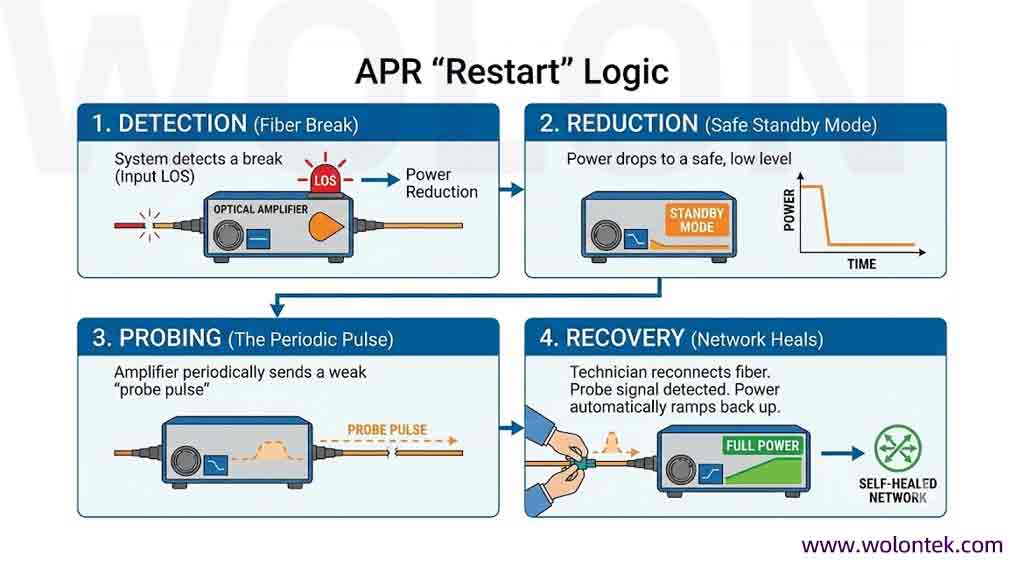
Detection: The system detects a break (Input LOS).
-
Reduction: Power drops to a safe “standby” mode.
-
Probing (The Restart): The amplifier doesn’t just stay off forever. It periodically sends out a weak “probe pulse” (a very low-power signal).
-
Recovery: Once the technician reconnects the fiber, the system detects that the loop is closed (the probe signal goes through). Only then does it automatically ramp back up to full power.
This means your network heals itself without needing a site visit to manually reset a switch.
APR vs. APC: Don’t Confuse Them!
We often hear customers mix these up. Here is the simplest way to remember:
| Feature | APC (Automatic Power Control) | APR (Automatic Power Reduction) |
|---|---|---|
| Goal | Performance Ensures Signal Stability |
Safety Protects Human Eyes & Equipment |
| When it works | All the time (Normal Operation) |
Only during emergencies (Fiber Break / Disconnect) |
| Action | Keeps power Constant regardless of fluctuations. | Drops power Low (or Off) immediately to prevent injury. |
| Analogy | Cruise Control “Maintains steady speed on the highway.” | Emergency Brakes “Kicks in only when you are about to crash.” |
Wolon: Safety-First Manufacturing
When you buy an amplifier from a generic supplier, you often don’t know if the safety circuits have actually been tested. AT WOLON,we take no chances.
-
3 Manufacturing Bases: We don’t outsource our core safety engineering.
-
Lab Tested: Every EDFA batch undergoes simulated “Fiber Break” tests in our Wuhan labs to ensure the APR triggers within the required milliseconds.
-
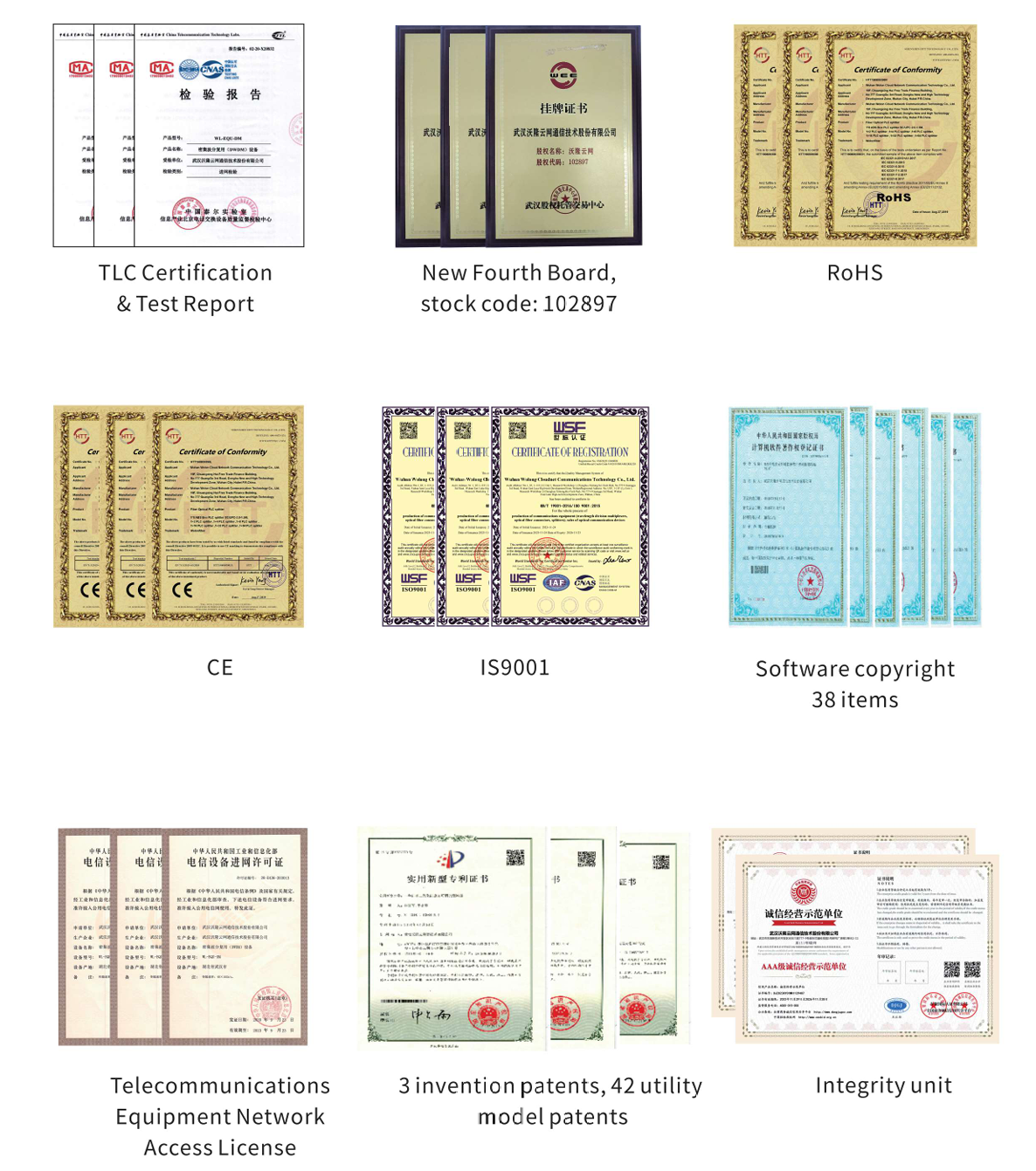
Global Certification: Our commitment to RoHS and CE means our products are safe for your environment and your people.
Whether you need a High-Power EDFA for a CATV network or a specialized amplifier for a DWDM long-haul link, we build them with safety as the priority.
Conclusion
In the world of fiber optics, performance gets all the glory, but safety keeps your business running. APR is the feature that ensures a simple cable break doesn’t turn into a medical emergency or a lawsuit.
Is your current equipment fully compliant with laser safety standards?
Don’t risk it. Partner with a manufacturer who understands the stakes.
Don’t risk your infrastructure with unverified gear. Our engineering team helps you select optical equipment that meets both your Link Budget and strict Safety Compliance requirements.
Frequently Asked Questions (FAQ)
Q1: Will my network remain down permanently if APR activates?
No. This is the smartest part of the APR system. Once the system reduces power due to a fiber break, it does not just stay off. It enters a “probing mode,” sending out a weak pulse every few seconds. As soon as your technician repairs the fiber and the loop is closed, the system detects the probe signal and automatically ramps the power back up to normal levels. No manual restart is required.
Q2: What is the difference between APC and APR?
The easiest way to remember is the “Car Analogy”:
APC (Automatic Power Control) is like Cruise Control. It works all the time to keep your “speed” (signal power) steady and smooth.
APR (Automatic Power Reduction) is like an Airbag. It only activates during an accident (fiber break) to protect people from injury. Most Wolon EDFA amplifiers come equipped with both features.
Q3: Why don’t my standard SFP modules have APR?
APR is mandatory for high-power devices (like EDFAs) because they emit Class 3B or Class 4 laser light, which can instantly damage the human eye. Standard SFP/SFP+ modules typically emit lower power (Class 1), which is considered eye-safe under normal usage, so they do not require this emergency shutdown feature. However, for our custom Long-Haul (80km+) high-power modules, we can integrate safety features upon request.
Q4: Which safety standards do Wolon devices meet?
Safety is our baseline. All Wolon active optical devices comply with the IEC 60825-1 international laser safety standard. Furthermore, they are fully CE and RoHS certified, ensuring you can deploy them in strict markets like Europe and North America without compliance risks.
Q5: Does enabling APR introduce latency to my data transmission?
Absolutely not. The APR detection circuit runs in parallel to your data path. During normal network operation, it sits in “standby monitoring” mode and has zero impact on your signal latency or data integrity. It only reacts in the millisecond a physical break occurs.