
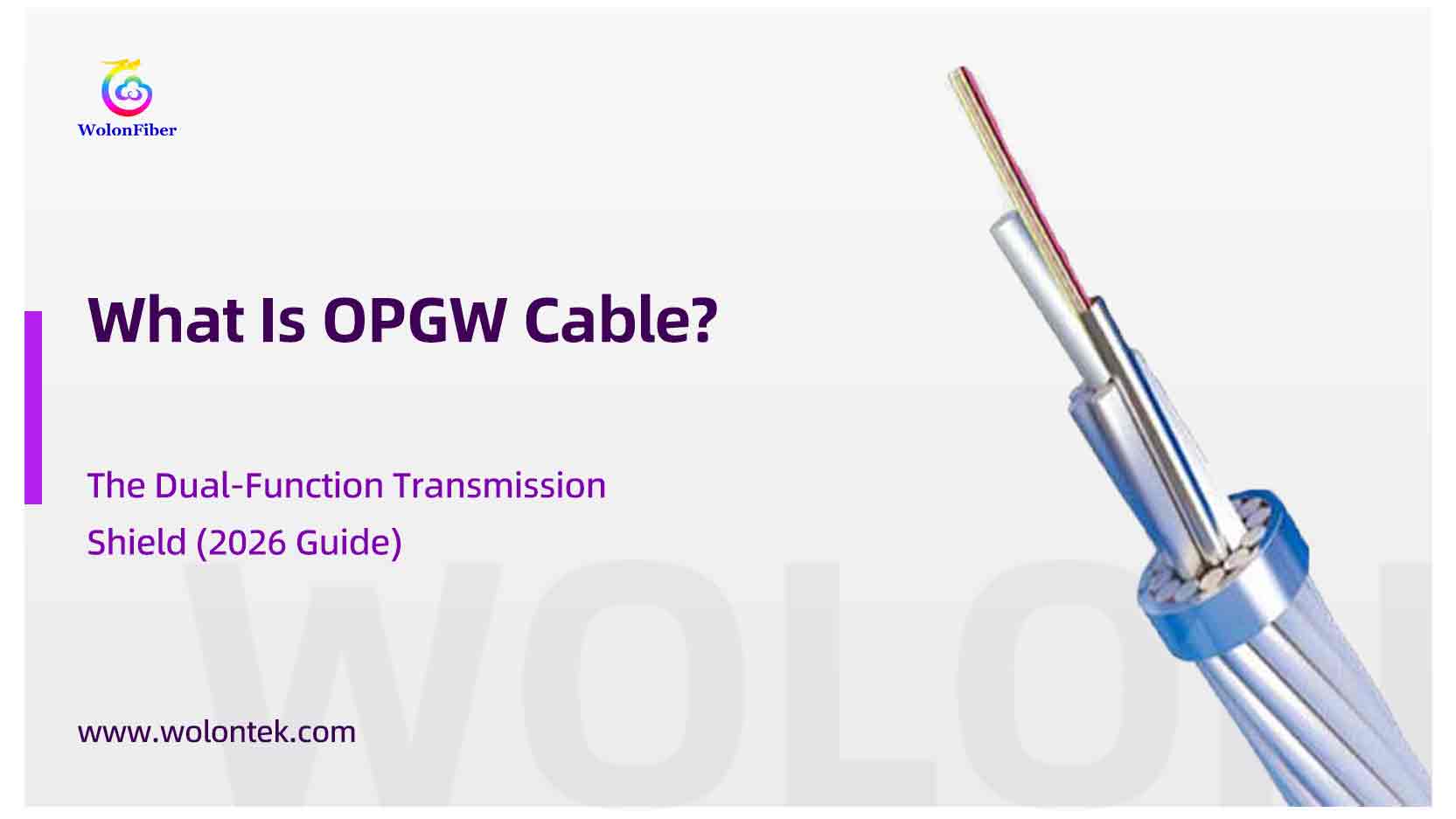
OPGW Cable (Optical Ground Wire) is the “Special Forces” of the aerial fiber world. Unlike standard Fiber optic cables, it performs two critical jobs simultaneously:
-
The Shield: It acts as a grounding wire to protect the power grid from lightning strikes and short circuits.
-
The Messenger: It carries up to 144 strands of optical fiber inside a hermetically sealed metal tube for high-speed data transmission.
But unlike the non-metallic ADSS Cable, the OPGW Cable is conductive. It heats up during an electrical fault. If you choose the wrong specification, a single short circuit can melt the delicate fiber inside.
In this guide, we break down the anatomy of OPGW, explain the critical “Short Circuit Capacity” rating, and show you how to specify the right cable for your grid.
Anatomy of an OPGW Cable: Metal Outside, Glass Inside
OPGW Cable is not a plastic cable. It is a metallic Armored cable designed to survive hellish conditions. As a manufacturer, we construct it in three main layers to balance strength and conductivity.
A. The Core: Stainless Steel Tube (The “Bunker”)
Unlike standard cables that use plastic loose tubes, OPGW Cable uses a laser-welded Stainless Steel Tube.
Why? It provides a hermetic seal against moisture and acts as a thermal barrier. When lightning strikes the outer armor, the steel tube keeps the delicate glass fibers cool and safe.
B. The Armor: ACS (Aluminum Clad Steel)
Surrounding the steel tube are layers of heavy wires made from ACS (Aluminum Clad Steel) or AA (Aluminum Alloy).
Steel Core: Provides tensile strength to hang across 1,000-meter spans.
Aluminum Cladding: Provides conductivity to drain lightning current to the ground.
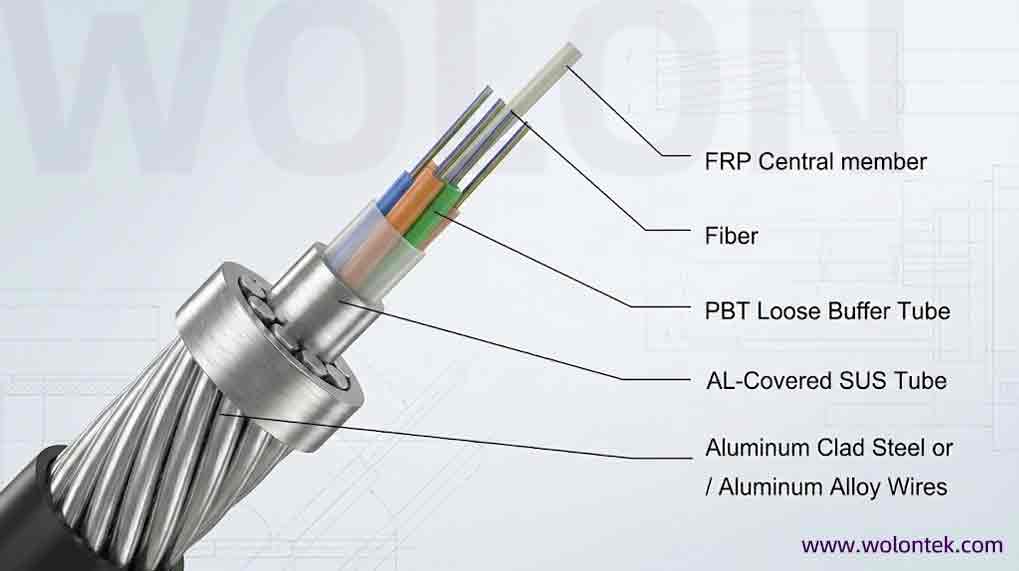
Watch: Inside the Steel Tube It can be difficult to visualize how we fit 144 delicate glass fibers inside a high-voltage grounding wire. In this breakdown from the AFL Classroom series, you can see the cross-section differences between “Central Tube” and “Stranded Tube” designs, and how the aluminum armor protects the core.
Note: While Wolontek manufactures to the same IEEE 1138 standards, looking at the internal structure helps you understand why “Short Circuit Capacity” matters so much.
Key Specification: Short Circuit Capacity of OPGW Cable
When buying OPGW Cable, your electrical engineer will ask one question: “What is the Short Circuit Capacity (SCC)?”
What does this mean? If a fault occurs (e.g., a tree falls on the power line), thousands of amps of electricity will rush through the OPGW Cable to the ground. This creates intense heat (up to 200°C) in milliseconds.
-
The Danger: If the cable’s SCC is too low, the heat will penetrate the core and melt the optical fiber coating.
-
The Fix: We increase the amount of Aluminum in the armor. Aluminum conducts heat and electricity better than steel. A “Heavy Aluminum” OPGW has a higher SCC rating, suitable for 500kV lines.
Wolon Rule: Never guess the SCC. Send us your System Fault Current (kA) and Duration (seconds). We will calculate the exact cross-section area (mm²) needed to survive.
Types of OPGW Cable: Central vs Stranded Tube
Not all OPGW Cables are built the same. We manufacture two primary designs to suit different tower loads.
Installation: How OPGW Cable Differs from ADSS
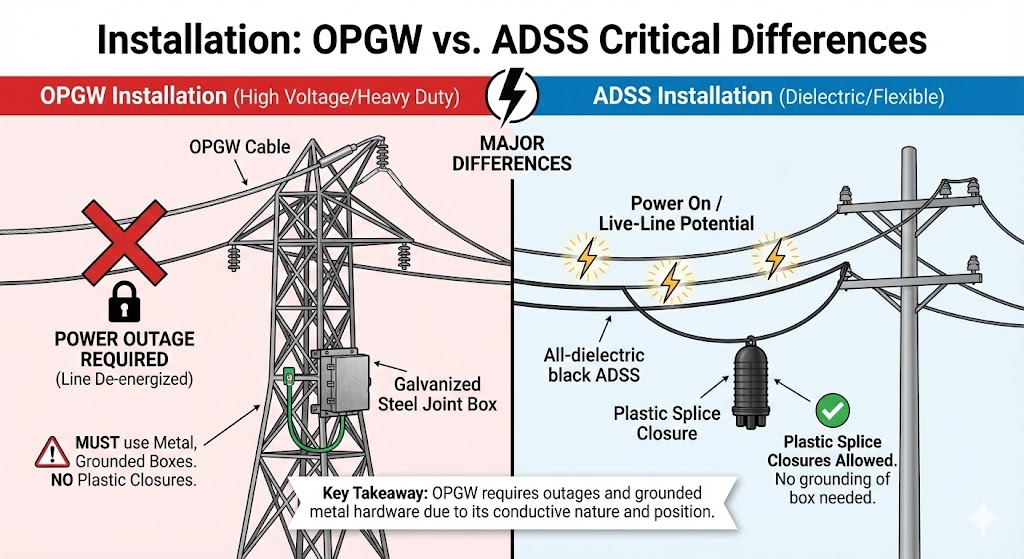
Installing OPGW Cable is nothing like installing ADSS.
-
Power Outage Required: Since it replaces the top earth wire, the line must usually be de-energized (unless using specialized robotic live-line methods).
-
Metal Joint Boxes: You cannot use plastic splice closures. You must use Galvanized Steel Joint Boxes mounted on the tower steelwork. These boxes are grounded to ensure safety.
Related Reading: Trying to decide between OPGW and ADSS for a retrofit project? [Read our Comparison Guide: ADSS vs OPGW Cable Costs & Applications]
Manufacturing Standards for OPGW Cable
At Wolontek, we don’t just “make” OPGW Cable. We engineer it strictly according to international standards. If a supplier cannot provide test reports citing these standards, do not buy from them.
1.IEEE 1138: The global standard for testing and performance of OPGW Cable for use on electric utility power lines.
2.IEC 60794-4-10: The International Electrotechnical Commission’s specific standard for aerial optical ground wires.
We test every drum for DC Resistance, Tensile Strength, and Water Penetration before it leaves our factory floor.
Conclusion: Engineering Your OPGW Cable Solution
OPGW Cable is the most complex cable in the fiber industry. It must be strong enough to hold up a tower, conductive enough to handle a lightning strike, and precise enough to transmit 800G data.
Buying OPGW is an engineering partnership. You provide the electrical data (Voltage, Fault Current, Span); we provide the physics (Aluminum/Steel ratio).
⚡ Will Your OPGW Survive the Next Fault?
Don’t settle for “off-the-shelf” specs. If the Short Circuit Capacity (kA²s) is wrong, the cable will melt during a surge.
Let our engineers design a custom structure that matches your grid’s exact fault tolerance.
Includes: Temperature Rise Curves & Sag-Tension Tables.
FAQ: OPGW Cable Technicals
Q1: Can I replace an old steel earth wire with OPGW Cable?
A: Yes. This is the most common use case. However, you must check the Tower Loading. OPGW Cable is often heavier than the old steel wire. A structural analysis is recommended to ensure the tower can support the extra weight and ice load.
Q2: What is the lifespan of OPGW Cable?
A: A high-quality OPGW Cable is designed to last 30 to 40 years, matching the lifespan of the transmission line hardware itself.
Q3: Does lightning damage the fiber inside OPGW Cable?
A: No. The outer aluminum-clad armor is designed to take the hit. While the outer strands might show small melt marks from a direct strike, the stainless steel tube inside protects the glass fibers from the heat and physical impact.