
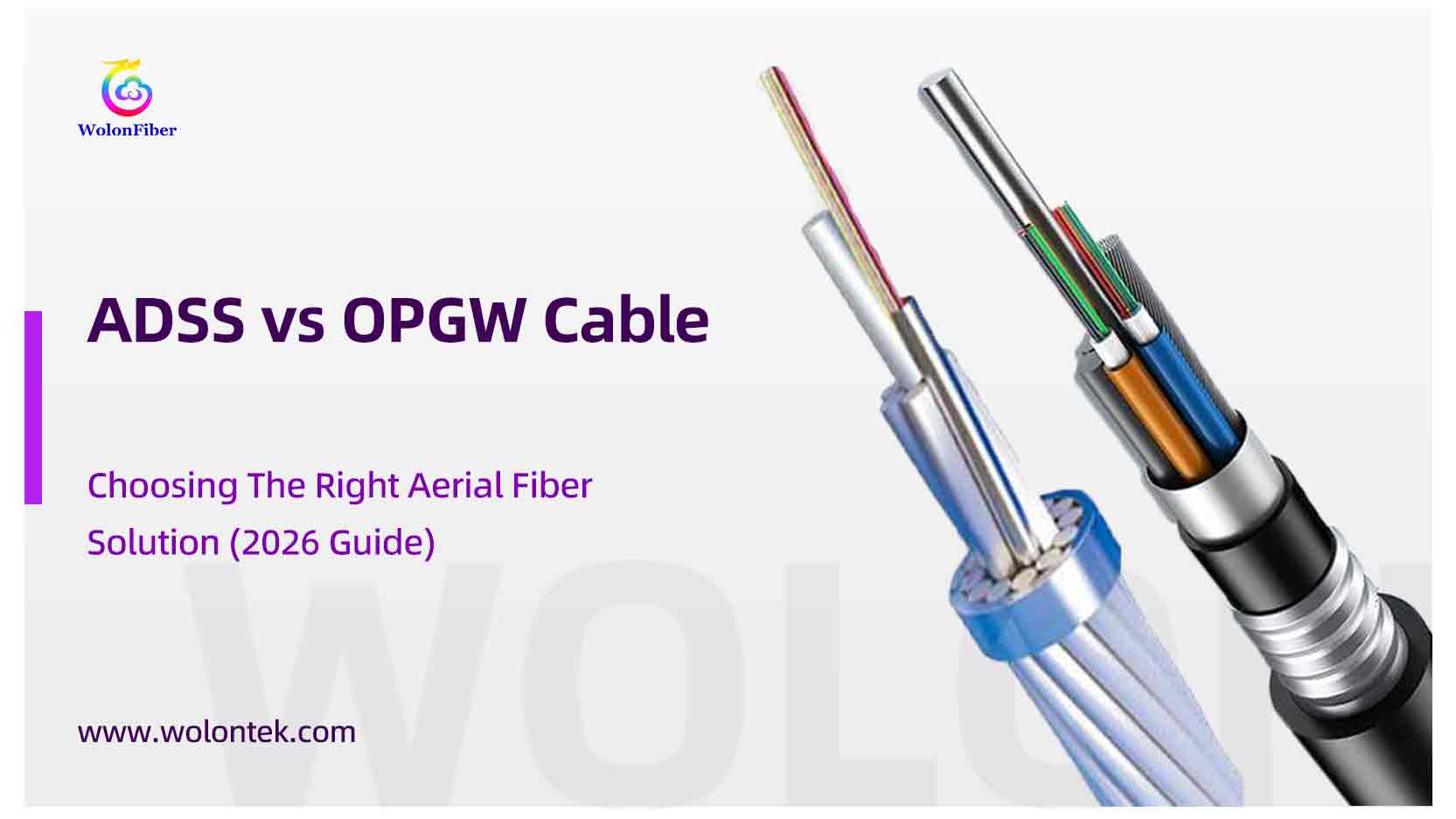
If you are planning to string fiber across utility poles or transmission towers, you are facing the classic “Fork in the Road”: ADSS vs OPGW cable?
From a distance, both look like black lines in the sky. But underneath the jacket, they are completely different animals:
-
ADSS (All-Dielectric Self-Supporting): The non-metallic, flexible problem-solver for existing lines.
-
OPGW (Optical Ground Wire): The heavy-duty, dual-function shield for high-voltage transmission.
Choosing the wrong one isn’t just a budget issue—it’s a safety risk. Putting ADSS on a tower with too high a voltage field can melt the jacket. Putting OPGW on an old tower can cause structural collapse due to weight.
In this guide, we break down the engineering, cost, and safety factors to help you make the right choice for your 2026 projects.
What is ADSS Cable? (The “Retrofit King”)
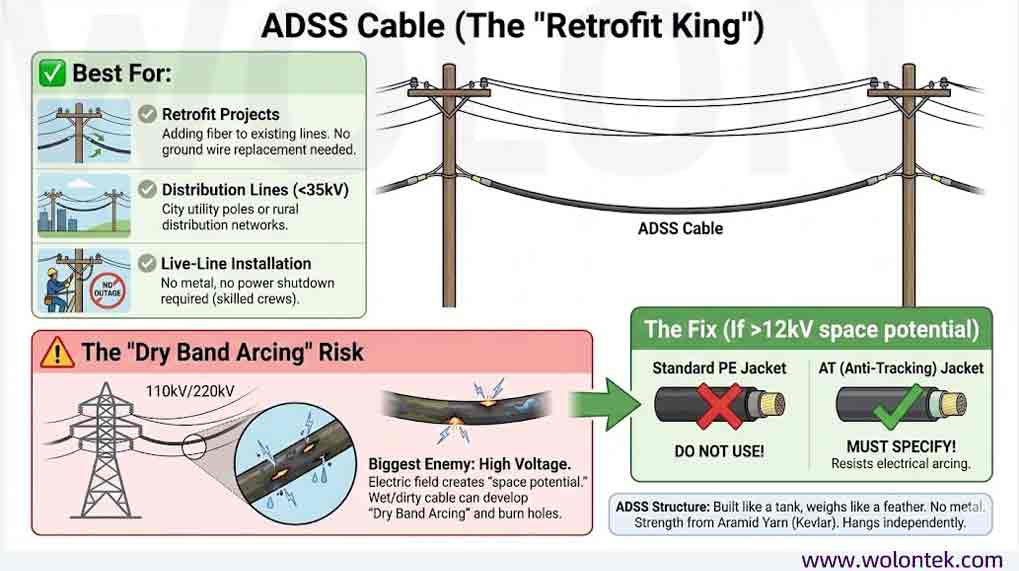
ADSS is built like a tank but weighs like a feather. It contains no metal. Its strength comes entirely from layers of Aramid Yarn (Kevlar), and it hangs independently on the tower, usually below the power conductors.
✅ Best For:
-
Retrofit Projects: Adding fiber to an existing power line where you cannot replace the ground wire.
-
Distribution Lines (<35kV): Running fiber along city utility poles or rural distribution networks.
-
Live-Line Installation: Because it has no metal, skilled crews can install ADSS without shutting down the power (no outage required).
⚠️ The “Dry Band Arcing” Risk
The biggest enemy of ADSS is High Voltage. When installed near 110kV or 220kV conductors, the strong electric field creates “space potential.” If the cable gets wet and dirty, tiny electrical arcs (“Dry Band Arcing”) can burn holes in the jacket.
The Fix: If the space potential is >12kV (usually on 35kV+ lines), you MUST specify an AT (Anti-Tracking) Jacket. Do not use standard PE jackets here!
Deep Dive: Confused about PE vs. AT jackets or Span calculations? [Read our complete guide: What is ADSS Cable? Structure, Spans & Jackets]
What is OPGW Cable? (The “Transmission Shield”)
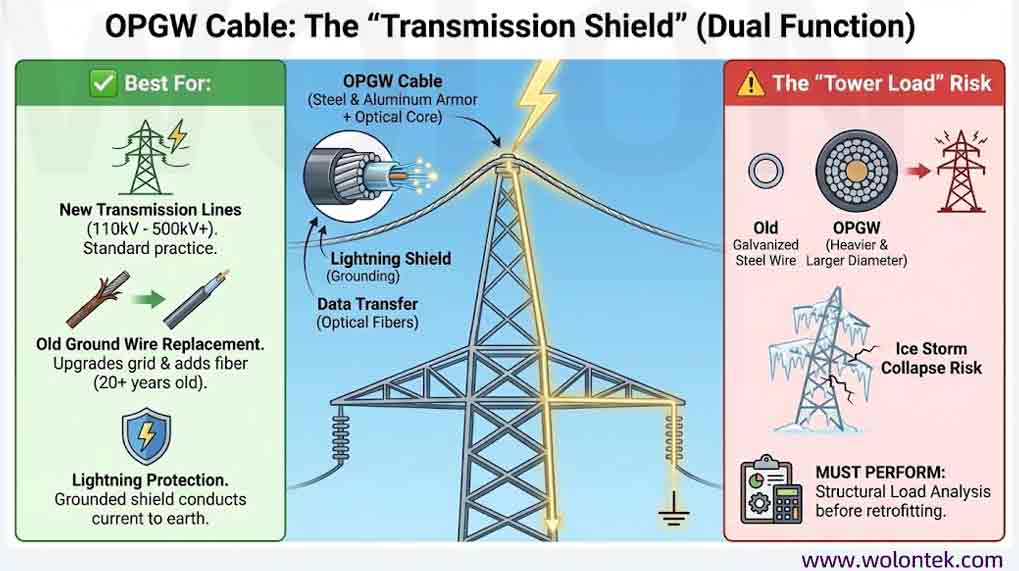
OPGW is a steel and aluminum cable that replaces the traditional “Earth Wire” at the very top of the transmission tower. It does two jobs: it protects the power line from lightning strikes and carries optical data inside.
✅ Best For:
-
New Transmission Lines (110kV – 500kV+): It is standard practice to install OPGW on all new high-voltage towers.
-
Old Ground Wire Replacement: If the existing earth wire is 20+ years old and rusting, replacing it with OPGW upgrades the grid and adds fiber in one go.
-
Lightning Protection: The metal armor acts as a grounded shield, safely conducting lightning current to the earth.
⚠️ The “Tower Load” Risk
OPGW is heavy. Before retrofitting an old line with OPGW, you must perform a Structural Load Analysis.
Why? OPGW is often heavier and has a larger diameter than the old galvanized steel wire it replaces. If the tower isn’t strong enough, an ice storm could collapse the structure.
Deep Dive: Need to understand Short Circuit Capacity (SCC) and internal layers?[Read our engineering guide: What is OPGW Cable? Anatomy & Specs]
Comparison Matrix: ADSS vs OPGW
Use this table to quickly filter your options based on project constraints.
The “Hidden Cost” Analysis
Don’t just look at the cable price tag. Look at the TCO (Total Cost of Ownership).
Scenario A: New 220kV Line Construction
Winner: OPGW.
Why? You need a ground wire anyway. A standard steel ground wire costs money. The incremental cost to upgrade from “Steel Wire” to “OPGW” is small compared to building a separate ADSS path. Plus, you save on tower wind load by combining two cables into one.
Scenario B: Adding Internet to an Existing 35kV Rural Line
Winner: ADSS.
Why? Installing OPGW would require shutting down the power grid (massive revenue loss) and re-engineering every tower top. ADSS can be strung below the live wires quickly and cheaply using simple tension clamps.
Maintenance: Shotguns vs Lightning
The maintenance headaches for each cable are different.
-
ADSS Vulnerability: Shotguns & Rodents. In rural areas, hunters sometimes shoot at birds on lines. A shotgun pellet can easily penetrate an ADSS jacket, breaking the fiber. Squirrels also love chewing the PE jacket.
-
OPGW Vulnerability: Lightning Strikes. While OPGW is designed to take lightning hits, a massive strike can sometimes melt a strand of the outer aluminum armor. However, the fibers inside the stainless steel tube usually remain safe.
Conclusion: Which One Should You Buy?
-
Choose ADSS If: You are retrofitting an existing line, cannot shut down power, or are working on distribution voltages (<35kV). Wolon Tip: Always calculate the “Space Potential” to decide between PE or AT jackets.
-
Choose OPGW If: You are building a new transmission line, replacing an old earth wire, or need extreme mechanical durability against ice and lightning.
At Wolon, we manufacture both. We don’t push you toward the most expensive option; we push you toward the one that won’t fail.
Need a Structural Analysis? It’s On Us.
Don’t risk a sag or a break.
Send us your Tower Span, Voltage, and Wind Zone. Our engineers will calculate the physics and recommend the exact ADSS Span or OPGW Cross-Section required.
Includes: Sag & Tension Charts + Hardware Matching.
FAQ: Aerial Fiber Selection
Q1: Can I use ADSS on a 220kV line?
A: Yes, but carefully. You must find a mounting position on the tower where the electrical field is weak (Space Potential < 25kV) and use a high-grade AT (Anti-Tracking) Jacket. If you mount it in the wrong spot, the jacket will burn off in months.
Q2: Does OPGW require special splicing boxes?
A: Yes. You cannot use a standard plastic dome closure. You must use a Metal Joint Box (Cap) that clamps onto the tower steelwork. This box is designed to ground the cable armor while protecting the fragile fiber splices inside.
Q3: What is the maximum span for ADSS?
A: Standard ADSS is good for spans up to 100m – 200m. However, Wolontek manufactures “Heavy Duty” ADSS with extra Aramid layers capable of spanning 1000m+ across rivers or canyons (often called “Long Span ADSS”).