
In the world of electronics sourcing, one question comes up on every Bill of Materials (BOM): “Industrial vs Commercial grade—is the extra cost worth it?”
You see two SFP+ modules. They look identical. They have the same metal casing, the same LC connector, and the same label speed (10G).
- Commercial Grade Optical transceiver: Costs $X.
- Industrial Grade optical transceiver: Costs $2X (or more).
If you are a Purchasing Manager, your instinct is to save money. If you are a Network Engineer, your instinct is to save the network. Who wins?
The difference isn’t just marketing hype; it is a matter of physics. Choosing the wrong one can lead to network blackouts during a summer heatwave or a winter freeze.
In this guide, we break down the Industrial vs Commercial battle specifically for optical transceivers, explaining why that temperature range matters more than you think.
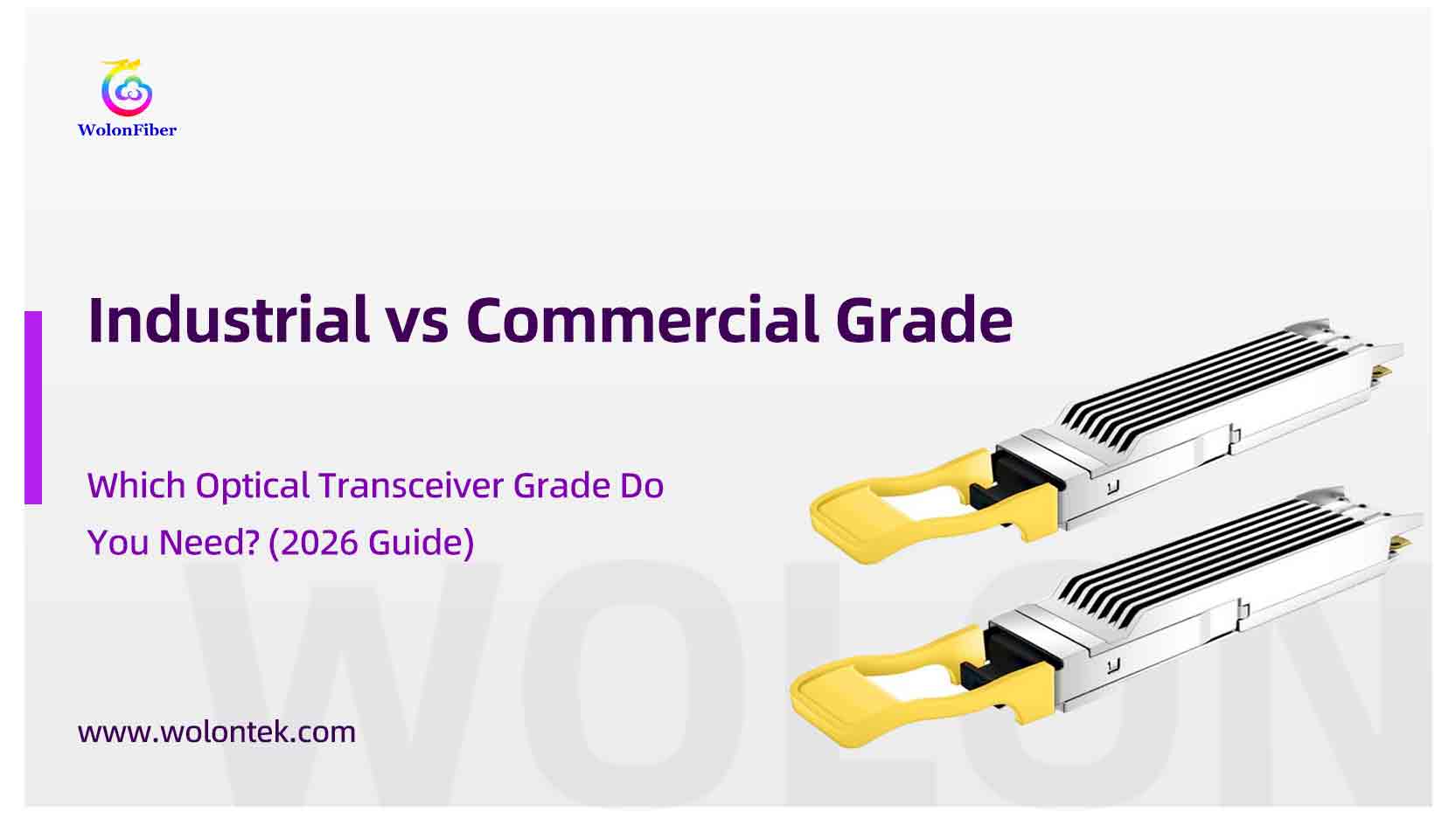
The Core Definition: It’s All About Temperature
When we talk about Industrial vs Commercial, we are primarily talking about the Operating Case Temperature. This is the temperature of the module’s metal shell while it is running.
⚠️ Warning: Don’t confuse “Ambient Temperature” (Room Temp) with “Case Temperature.” SFP modules generate their own heat. If the room is 40°C, the module inside the switch might be 65°C—dangerously close to the Commercial limit.
Under the Hood: Why Industrial Costs More
Why is Industrial hardware more expensive? It’s not just a sticker change. The internal components are physically different.
A. The Laser Chip (TOSA/ROSA)
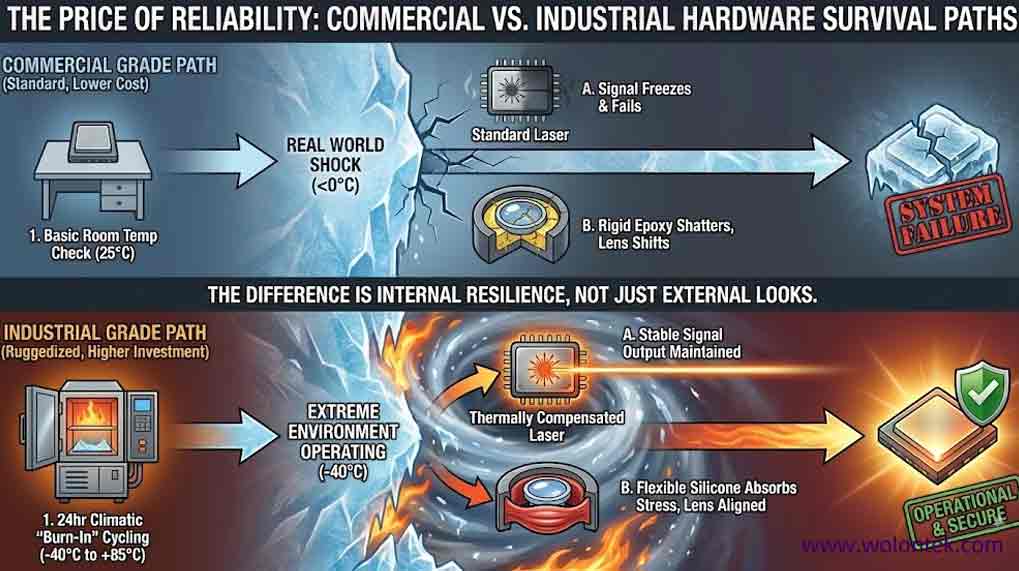
- Commercial: Uses standard laser diodes. If the temperature drops below 0°C, the laser’s “Slope Efficiency” changes, causing the signal power to drop. The link goes dark.
- Industrial: Uses Thermally Compensated laser chips designed to maintain stable light output even at -40°C.
B. The Glue and Packaging
- Inside the module, lenses and filters are glued in place.
- Commercial: Standard epoxy.
- Industrial: High-grade silicone or specialized epoxy that can expand and contract with extreme temperature swings without cracking or misaligning the lens.
C. The Testing Process (Burn-In)
- Commercial: Tested at room temperature.
- Industrial: Must undergo Temperature Cycling Testing (aging) in a climatic chamber for 12-24 hours to ensure it survives the “Industrial vs Commercial” stress test.
Scenario Guide: Where to Use What?
Choosing Industrial vs Commercial depends entirely on where your switch is located.
✅ Use Commercial Grade (0°C ~ 70°C) If:
Data Centers: The room is kept at a chilly 20°C year-round.
Enterprise Offices: The switch is in a ventilated closet.
Standard ISPs: Indoor CPE equipment.
Verdict: No need to overspend. Commercial grade is perfectly reliable here.
✅ Use Industrial Grade (-40°C ~ 85°C) If:
5G / Telecom Towers: Equipment sits in a metal box on a rooftop, baking in the sun (reaching +70°C inside) or freezing in snow.
Unheated Warehouses: No AC in summer, no heat in winter.
Traffic Control / Railways: Vibration and extreme weather are constant.
Passive Cooling Switches: Some fanless industrial switches get very hot. They need modules that can handle the heat.
The Risk: What Happens If You Cheat?
We see this often. A client buys Commercial modules for an outdoor street cabinet to save budget. “It works fine in testing,” they say.
Here is the failure timeline:
1.Winter Night (-10°C): The Commercial laser can’t start up (“Cold Start Failure”). The link is down until sunrise.
2.Summer Day (+45°C): The cabinet heats up. The module internal temp hits 75°C. The laser power degrades, causing Packet Loss and CRC errors.
3.Year 2: The thermal expansion cracks the internal glue. The module dies completely.
The Cost of Failure: Rolling a truck to replace a $15 module costs $500. It is never worth the risk.
Wolon’s Guarantee: True Industrial
Beware of “Fake Industrial” in the market. Some suppliers take a Commercial chip, change the label to “Industrial,” and sell it to you. It works… for a month.
How Wolon Ensures Quality: We use Keysight temperature chambers to verify every Industrial batch.
- We simulate a -40°C Cold Start.
- We simulate an 85°C High-Load Run.
- We use only Industrial-Grade BOM (Bill of Materials) from chip vendors like Semtech or Broadcom.
Conclusion: Don’t Let Temperature Kill Your Network
The debate of Industrial vs Commercial isn’t about quality; it’s about Environment. Commercial is great for the office. Industrial is mandatory for the wild.
Sourcing Rule of Thumb: If there is Air Conditioning, buy Commercial. If there is Weather, buy Industrial.
Still not sure which grade your project needs? Don’t guess. Send us your deployment environment details, and we will recommend the safe choice.
[Contact Wolon for an Industrial SFP Quote]