
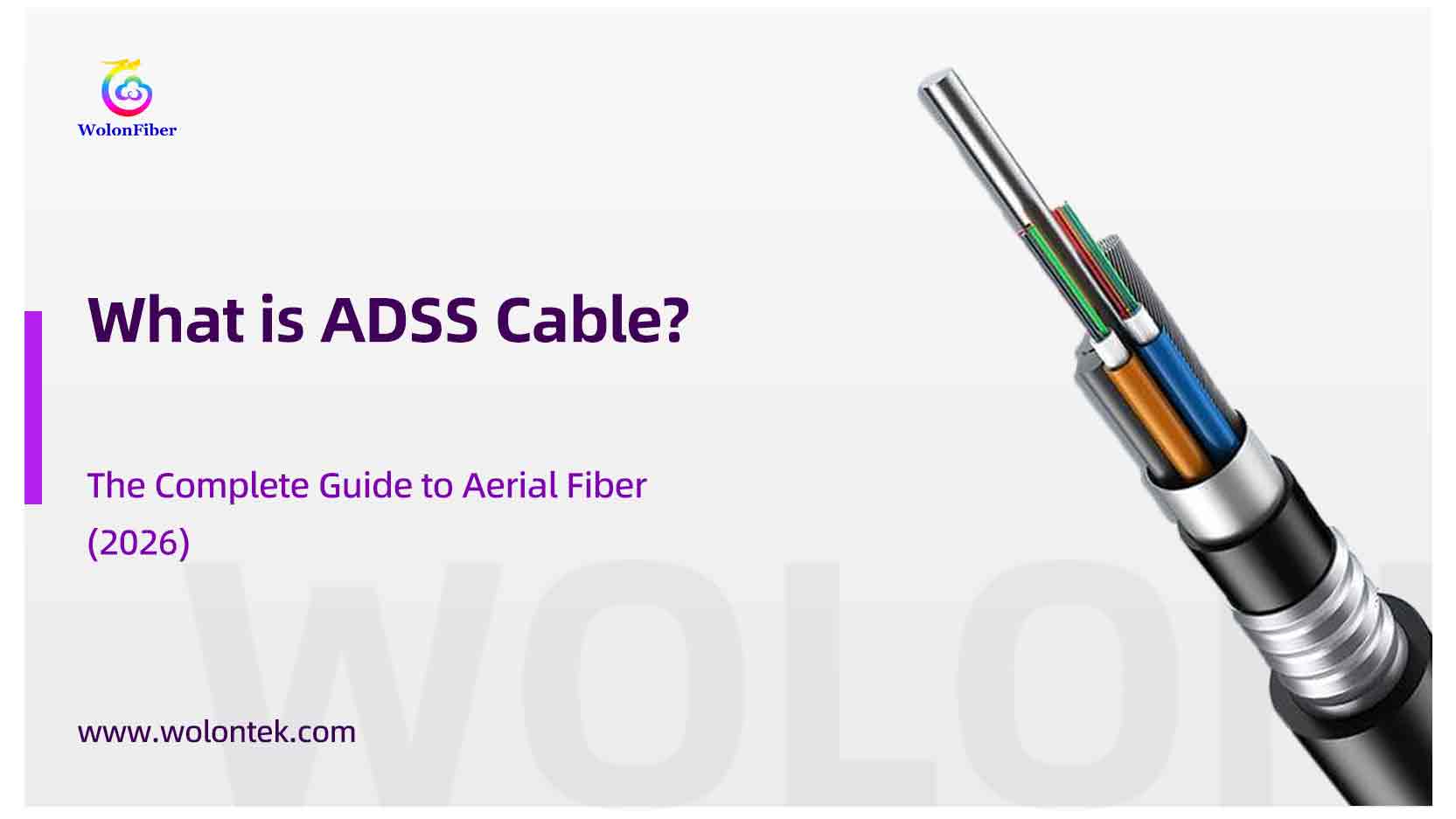
What is ADSS cable?If you drive down any rural highway or look up at high-voltage transmission towers, you will likely see a thick black cable hanging below the power lines. It looks like standard wire, but it’s not carrying electricity. It’s carrying the internet.
This is ADSS Cable.
For ISPs and Power Utilities, ADSS is the “Magic Cable.” Why? Because it allows you to string fiber optic data lines on existing high-voltage towers without shutting down the power and without worrying about lightning induction.
But what exactly is inside this cable that allows it to hang for 20 years without snapping? And how do you choose the right specs for a 500-meter span?
In this guide, we strip back the jacket and explain What is ADSS Cable, how it works, and why it is the dominant choice for aerial networks in 2026.
The Definition: Decoding the Acronym
ADSS stands for All-Dielectric Self-Supporting.
Let’s break that down, because every word matters:
-
All-Dielectric: It contains ZERO metal. No steel messenger wire, no aluminum armor. It is made entirely of glass, plastic, and aramid fibers. This means it is non-conductive. You can touch it (safely) even if it’s hanging next to a 110,000-volt power line.
-
Self-Supporting: It doesn’t need a “lashing wire” or a steel strand to hold it up. The cable itself is strong enough to support its own weight across huge distances (up to 1,500 meters) without snapping under ice or wind load.
Related Reading: Not sure if you need the non-metallic ADSS or the metallic OPGW (Optical Ground Wire)? [Check out our detailed comparison: ADSS vs OPGW Cable: Choosing The Right Aerial Solution]
The Anatomy: What’s ADSS Cable Inside?
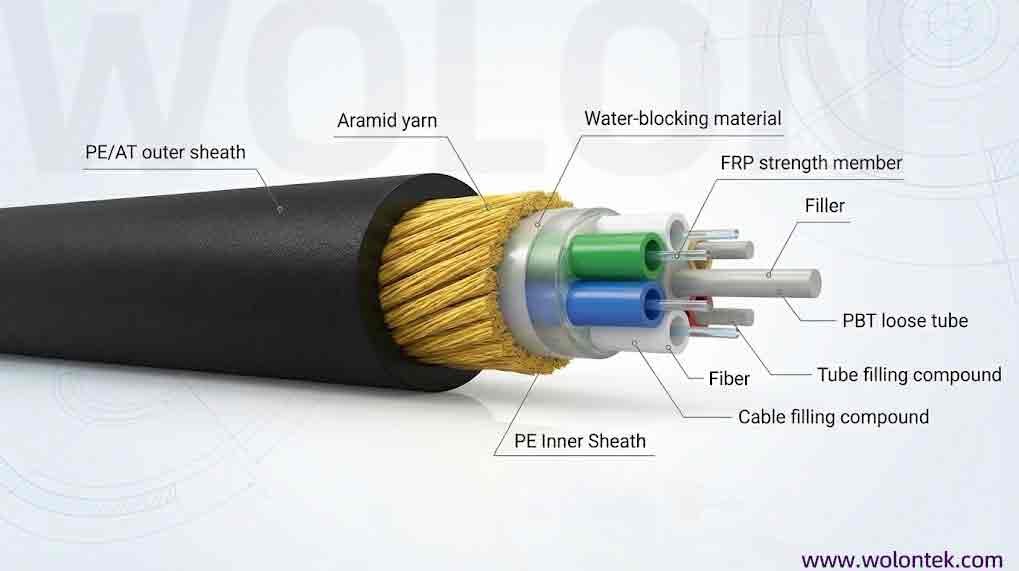
If you cut an ADSS cable open (don’t do this on a live line!), you won’t find steel. You will find Aramid Yarn (often known by the brand name Kevlar®).
-
The Muscle (Aramid Yarn): This is the secret weapon. We wrap layers of high-modulus Aramid Yarn around the inner tubes. This material is 5 times stronger than steel by weight. It takes all the tension, protecting the fragile glass fibers inside from stretching.
-
The Core (Loose Tube): The optical fibers float freely inside gel-filled plastic tubes. This “Loose Tube” design ensures that when the cable stretches during a storm, the fiber inside just straightens out instead of breaking.
-
The Jacket (Outer Sheath): The first line of defense against UV sun and rain.
Industry Insight: Understanding ADSS Mechanics Want to dive deeper into the physics of “Span vs. Sag”? This excellent explainer video by AFL (a global leader in fiber technology) visualizes why choosing the right jacket and tensile strength is critical for safety.
The Critical Decision: PE vs AT Jacket
This is the #1 mistake buyers make. ADSS comes with two types of jackets. Choosing the wrong one will burn your cable.
Span & Sag: The Engineering Math
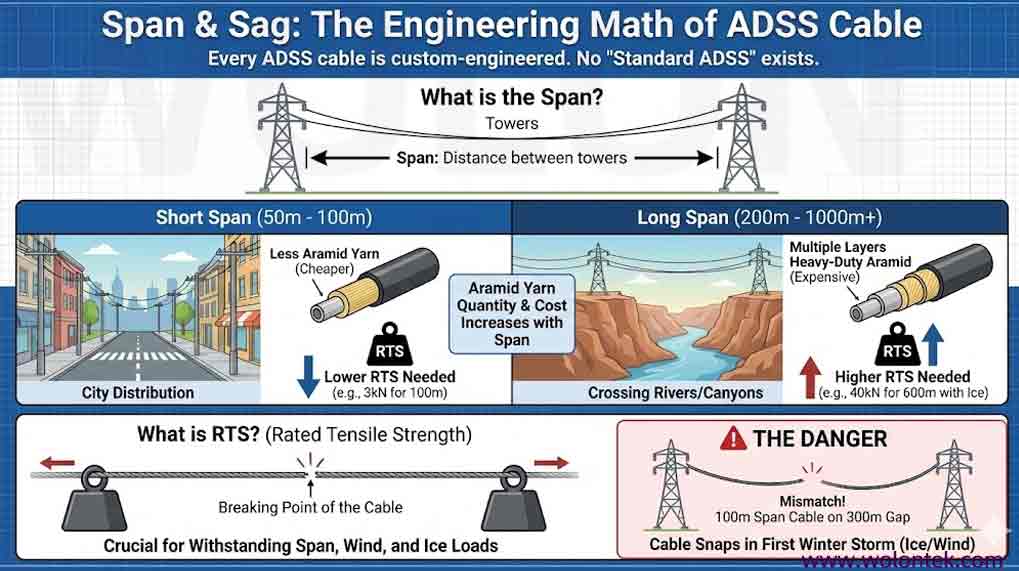
You cannot just buy “Standard ADSS.” It doesn’t exist. Every ADSS cable is custom-engineered based on the Span.
What is the Span? The distance between two towers.
Short Span (50m – 100m): Standard for city distribution. Uses less Aramid Yarn. Cheaper.
Long Span (200m – 1000m+): Used for crossing rivers, canyons, or highway transmission towers. Requires multiple layers of heavy-duty Aramid. Expensive.
What is RTS? (Rated Tensile Strength) This is the breaking point of the cable.
-
If your span is 100m, you might need an RTS of 3kN.
-
If your span is 600m with heavy ice load, you might need an RTS of 40kN.
The Danger: If you install a “100m Span” cable on a 300m tower gap, it will snap in the first winter storm.
Installation: Do Not Crush the Cable!
Since ADSS has no metal armor, it is essentially a hard plastic tube. You cannot use standard metal wedge clamps, or you will crush the optical fibers.
You must use Preformed Helical Fittings (Guy Grips). These look like spiral wire wraps. They gently grip the cable over a long length (often 1 meter), distributing the tension evenly so the jacket isn’t damaged.
Conclusion: Customization is Key
“What is ADSS Cable?” It is the most versatile aerial cable on the market, but it is also the most customizable.
Unlike standard duct cable where you just pick “24 Core,” with ADSS you need to specify:
1.Fiber Count (e.g., 48 Core).
2.Span Length (e.g., 200 Meters).
3.Voltage/Jacket (e.g., 110kV = AT Jacket).
4.Weather Conditions (e.g., Heavy Ice Zone).
At Wolon, we don’t just sell cable off the shelf. We engineer every drum to meet strict international specifications, specifically the IEEE 1222 Standard for all-dielectric self-supporting cable. This ensures we calculate the exact amount of Aramid Yarn needed to keep your network safe for 25 years.
⚠️ Is Your Tower Potential Above 12kV? Don’t Guess.
Using standard PE on high-voltage lines guarantees failure via Dry Band Arcing.
Send us your tower diagram. Our engineers will calculate the exact Space Potential to determine if you strictly need an AT (Anti-Tracking) jacket.
We guarantee 100% Matching for 10kV, 35kV, 110kV & 220kV Lines.
FAQ: ADSS Cable Basics
Q1: How long does ADSS cable last?
A: A properly manufactured ADSS cable using Virgin HDPE and premium Aramid Yarn should last 20 to 25 years, even in harsh weather.
Q2: Can I lash ADSS to a steel messenger wire?
A: You can, but it defeats the purpose. The whole point of ADSS (“Self-Supporting”) is that you don’t need a messenger wire. Lashing adds unnecessary weight and cost. Just hang the ADSS directly using suspension clamps.
Q3: Is ADSS cheaper than OPGW?
A: Yes, significantly. ADSS cable material is cheaper (no stainless steel or aluminum), and the installation is much faster because crews can often work while the power line stays live. OPGW is typically 2-3x the price of ADSS.