
When you are buying outdoor fiber optic cable by the kilometer, the Jacket (Sheath) is the only thing standing between your glass cores and the elements.
Get it right, and your network runs for 20 years. Get it wrong, and you’ll be digging up that trench again in 18 months because water got in.
We see a lot of RFQs come across our desks with a dangerous mistake: Project Managers specifying LSZH for outdoor use because they think “Safety” means “Better.”
It doesn’t. In the outdoors, LSZH is a liability.
In this guide, we’re going to break down the PE vs. LSZH debate from a manufacturing perspective. We’ll show you why PE is still king of the dirt, why LSZH belongs indoors, and how to spot “fake” materials before you sign the PO.

PE (Polyethylene): The Outdoor Beast
If your cable is going underground, in a duct, or hanging from a pole, you want PE. Period.
Why do we love extruding PE jackets? Because the material is naturally tough.
-
It Hates Water: PE is hydrophobic. It sheds water like a duck. You could leave a PE cable sitting in a flooded manhole for a decade, and the moisture won’t permeate the jacket.
-
It Eats UV for Breakfast: High-quality PE is loaded with Carbon Black. It’s not just black dye; it’s a UV stabilizer. The sun can beat down on it for years, and it won’t crack.
-
The Price is Right: PE resin is cheaper than LSZH compounds. You get better outdoor performance for less money.
The Only Downside? It burns. Like a candle. If you light a PE cable on fire, it drips molten plastic and fuels the flame. That’s why building codes (like NEC) forbid you from running it more than 50 feet inside a building.

LSZH (Low Smoke Zero Halogen): The Indoor Lifesaver
LSZH was invented for one reason: To stop people from choking in a fire.
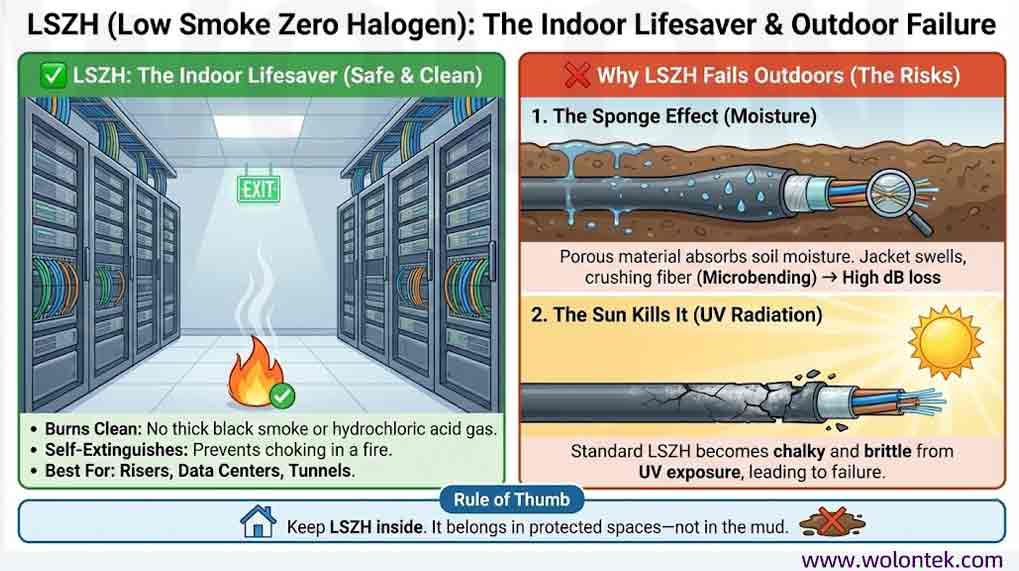
When standard PVC burns, it releases thick black smoke and hydrochloric acid gas (which turns into acid in your lungs). LSZH burns clean. It self-extinguishes.
So, why not use it outdoors? Because LSZH material is porous. It’s “thirsty.”
-
The Sponge Effect: If you bury LSZH cable, it will eventually absorb moisture from the soil. The jacket swells, crushing the fiber (Microbending), and your dB loss goes through the roof.
-
The Sun Kills It: Unless you pay extra for a very specific UV-stabilized LSZH blend, sunlight will turn a standard LSZH jacket chalky and brittle within a few years.
Rule of Thumb: Keep LSZH inside. It belongs in risers, data centers, and tunnels—not in the mud.
The “Cheat Code”: Dual Jacket (PE + LSZH)
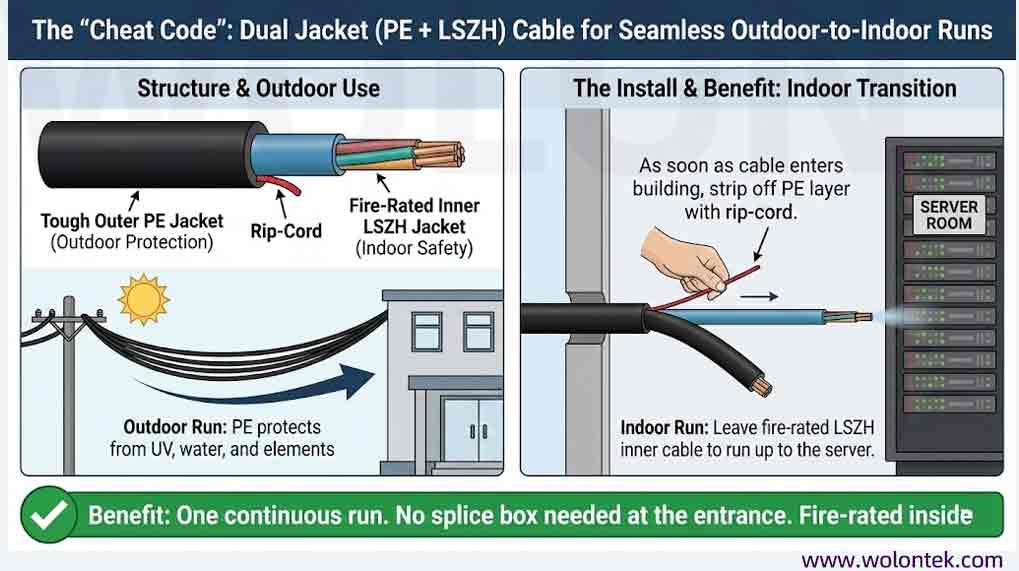
What if you need to run a line from a pole outside straight to a server room inside, without splicing at the door?
Ask us for “Dual Jacket” or “Universal” cable. This is a favorite for our ISP clients.
-
How it works: We extrude an LSZH inner jacket, and then put a tough black PE jacket on top of it.
-
The Install: The technician runs the cable outdoors (protected by PE). As soon as the cable enters the building, they use a rip-cord to strip off the black PE layer, leaving the fire-rated LSZH inner cable to run up to the server.
-
Benefit: One continuous run. No splice box needed at the entrance.
Quick Decision Matrix
Don’t overthink it. Here is how we advise our wholesale clients:
Factory Insider: Don’t Buy “Recycled” Trash
Here is a dirty secret some suppliers won’t tell you. To cut costs, some factories mix Recycled PE into their cable jackets.
Why is this bad? Recycled plastic has shorter molecular chains. It looks fine when it leaves the factory, but give it one cold winter or one hot summer, and it will stress crack. We’ve seen entire fiber runs fail because the jacket literally fell apart after two years.
How to check?
-
The Shine: Virgin HDPE should have a smooth, consistent semi-gloss finish.
-
The Bend: Take a sample and bend it sharply. If the jacket turns white at the stress point (crazing) or snaps, it’s likely loaded with cheap filler or recycled junk.
At Wolontek, we use 100% Virgin HDPE from major chemical suppliers like Borealis or Dow. We don’t risk your reputation (or ours) to save pennies on plastic.
Conclusion: Match the Jacket to the Job
Buying fiber cable isn’t just about single-mode vs. multi-mode. The jacket material determines if your network survives the environment.
-
Touching the sky or dirt? Buy PE.
-
Touching the ceiling or rack? Buy LSZH.
-
Need to cross the line? Buy Dual Jacket.
Don’t Let the Weather Kill Your Network.
Freezing winters? Tropical humidity? Or strictly indoor risers?
Stop guessing. Send us your project location. We will quote the exact jacket structure (PE, LSZH, or Dual-Jacket) that balances low cost with 100% survival.
We customize UV stabilizers for high-sunlight regions (e.g., Africa, Middle East).
FAQ: Questions from the Field
Q: Can I use LSZH outdoors if I put it inside a PVC pipe?
: I wouldn’t risk it. Even inside a PVC pipe, condensation forms. That water will pool at the bottom. Since LSZH isn’t hydrophobic, it will eventually soak up that moisture. If you must use LSZH outdoors, ask us for a “Water-Blocked” version with extra gel or swelling tape, but PE is always the safer bet.
Q: Is PE cable harder to strip than LSZH?
A: Yes, significantly. HDPE is tough stuff. Your technicians will need a good rotary stripper (and maybe some patience) to cut through a PE jacket compared to the softer LSZH. But that toughness is exactly why you buy it.
Q: What is the difference between MDPE and HDPE?
A: HDPE (High Density) is harder and slicker—great for pulling through long ducts because it has less friction. MDPE (Medium Density) is a bit more flexible and less prone to cracking if you have to bend it sharply. For most long-haul wholesale orders, we use HDPE.