
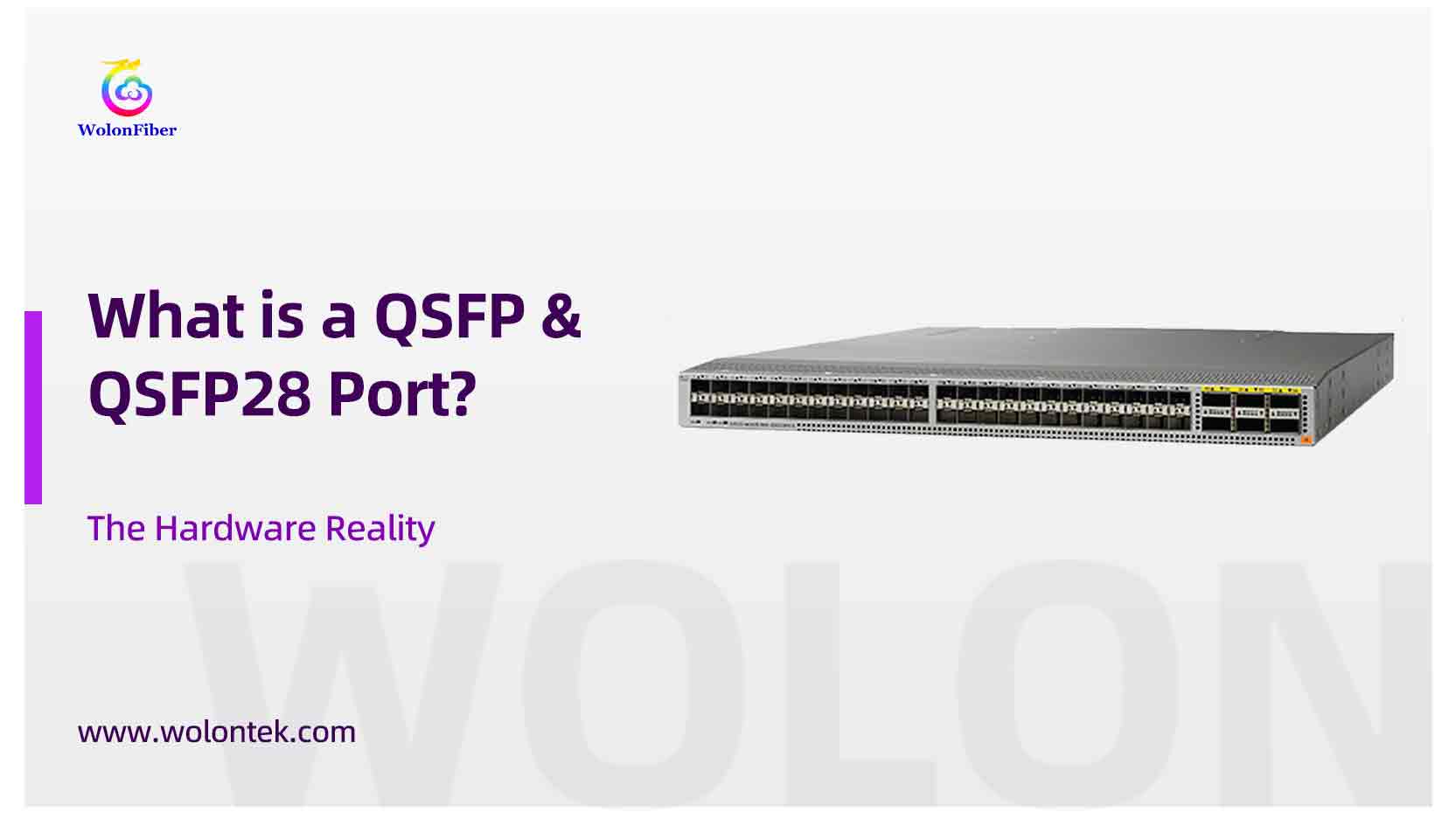
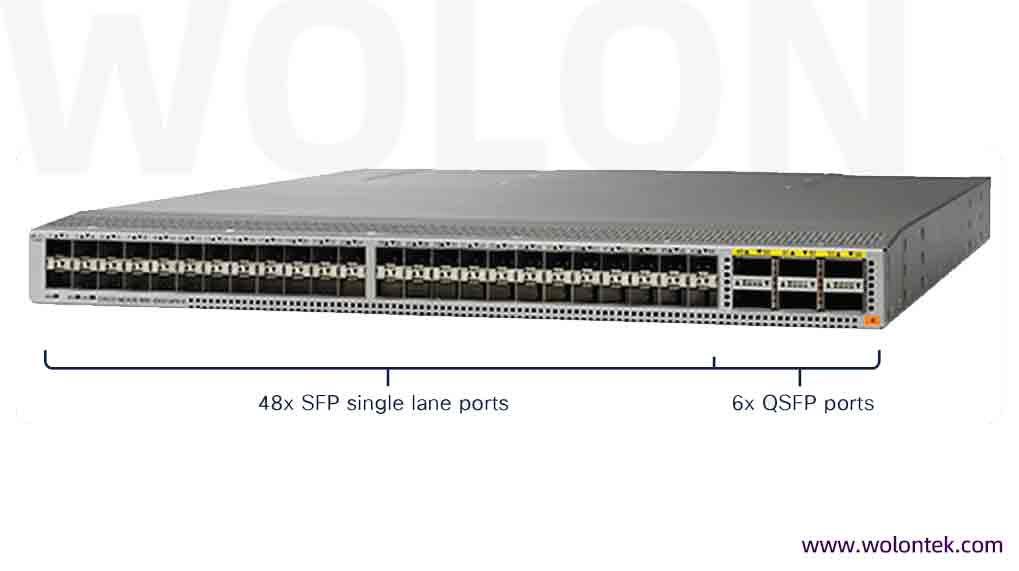
Look at the faceplate of any modern data center switch. Next to the standard SFP slots, you will notice a row of wider, rectangular openings. Those are Qsfp ports.
If you are buying hardware for a network upgrade, confusing a legacy 40G QSFP slot with a 100G QSFP28 slot is an expensive mistake. They look physically identical, but the silicon driving them is completely different.
Here is exactly what these ports are, how they handle parallel data, and the strict rules for plugging transceivers into them.
What is a QSFP & QSFP28 Port?
What is a QSFP Port?
The “Q” stands for Quad. That is the only thing you really need to know.
A standard SFP+ port uses a single electrical lane to push 10 Gbps. A QSFP (Quad Small Form-factor Pluggable) port is physically wider because it jams four of those lanes into a single module. Four parallel lanes running at 10G each gives you 40 Gbps of total bandwidth out of one physical slot.
Where is a QSFP port located?
You won’t find these in a standard office wiring closet. QSFP ports are designed for density. You find them on:
-
The faceplates of Spine and Leaf data center switches (like Arista 7050X or Cisco Nexus).
-
Core aggregation routers.
-
High-performance server Network Interface Cards (NICs) connected to storage arrays.
What is a QSFP port used for?
Network architects basically use them for two jobs:
Switch-to-Switch Uplinks: Running a single 40G fiber trunk between switches instead of lagging four separate 10G cables.
Port Breakouts (Density Hacks): Because the port is literally just four 10G lanes, you can use a breakout cable (like a QSFP to 4x SFP+ DAC). This splits the single 40G port into four separate 10G connections, letting you hook up four different servers to one switch port.
What is QSFP28 Port?
The QSFP28 port is the physical foundation of 100G networking.
It shares the exact same metal cage and physical dimensions as the older 40G QSFP port. The difference is the electrical traces on the motherboard. Instead of four 10G lanes, a QSFP28 port uses four lanes capable of pushing up to 28 Gbps each. (4 lanes x 25G actual data rate = 100 Gbps).
What is a QSFP28 port used for?
It is the industry standard for 100G Ethernet. You populate QSFP28 ports with 100G Optical Transceivers (SR4, LR4, CWDM4) or 100G DAC cables. If you are building an AI computing cluster, deploying NVMe storage, or just trying to clear a massive traffic bottleneck in your core network, you are using QSFP28 ports.
QSFP vs QSFP28 Port: What is the difference?
Visually? Nothing. Electrically? Everything.
-
Speed: QSFP handles 40G. QSFP28 handles 100G.
-
Backward Compatibility: You can usually plug an older 40G QSFP transceiver into a new 100G QSFP28 port. The switch ASIC will auto-negotiate down and run the port at 40G.
-
Forward Compatibility: You cannot plug a 100G QSFP28 Transceiver into an old 40G QSFP port. The old switch doesn’t have the hardware to read the 25G lanes. The link stays dead.
Skip the OEM Markup on Optics
Populating a 32-port 100G switch with OEM-branded optics will destroy your hardware budget. The major switch vendors don’t manufacture their own optics—they just lock the ports in software.
At WolonFiber, we build the physical layer directly out of our Wuhan Optical Valley facilities. Backed by a workforce of 400 to 500 optical technicians, we manufacture factory-direct QSFP+ and QSFP28 transceivers.
We flash the EEPROM on every module to perfectly match your switch’s signature. You get 100% plug-and-play compatibility on Cisco, Juniper, Arista, and Huawei gear, without paying the distributor tax.
 Scaling Up to 40G or 100G Networks?
Minimize your upgrade costs without compromising on performance. Explore WolonFiber’s Factory-Direct 40G (QSFP+) and 100G (QSFP28) Transceivers for reliable, high-bandwidth interconnects.
Explore 40G/100G Solutions
What is QSFP Port?
A QSFP (Quad Small Form-factor Pluggable) port is a high-density network interface on a switch. It contains four independent electrical lanes, typically used to transmit 40 Gbps of data (4 x 10G lanes) using a single transceiver.
Where is a QSFP port located?
You will find QSFP ports on the faceplates of enterprise-grade network hardware, including core routers, data center spine-and-leaf switches, and high-performance server NICs.
What is a QSFP port used for?
QSFP ports are used for high-speed switch-to-switch uplinks and port breakouts (splitting a single 40G port into four separate 10G connections to connect multiple servers).
What is QSFP28 Port?
A QSFP28 port has the exact same physical dimensions as a standard QSFP port, but it uses upgraded electrical traces. It uses four high-speed lanes capable of up to 28 Gbps each, delivering 100 Gbps of total bandwidth.
What is a QSFP28 port used for?
QSFP28 ports are the standard for 100G Ethernet deployments. They are used in hyperscale data centers and enterprise backbones to connect switches and servers at 100 Gbps.
QSFP vs QSFP28 Port: What is the difference?
The physical cage is identical, but the speed differs (40G vs 100G). A 100G QSFP28 port is backward compatible and will usually accept a 40G QSFP module, but an older 40G port cannot process a 100G module.