What Is a BiDi Transceiver?
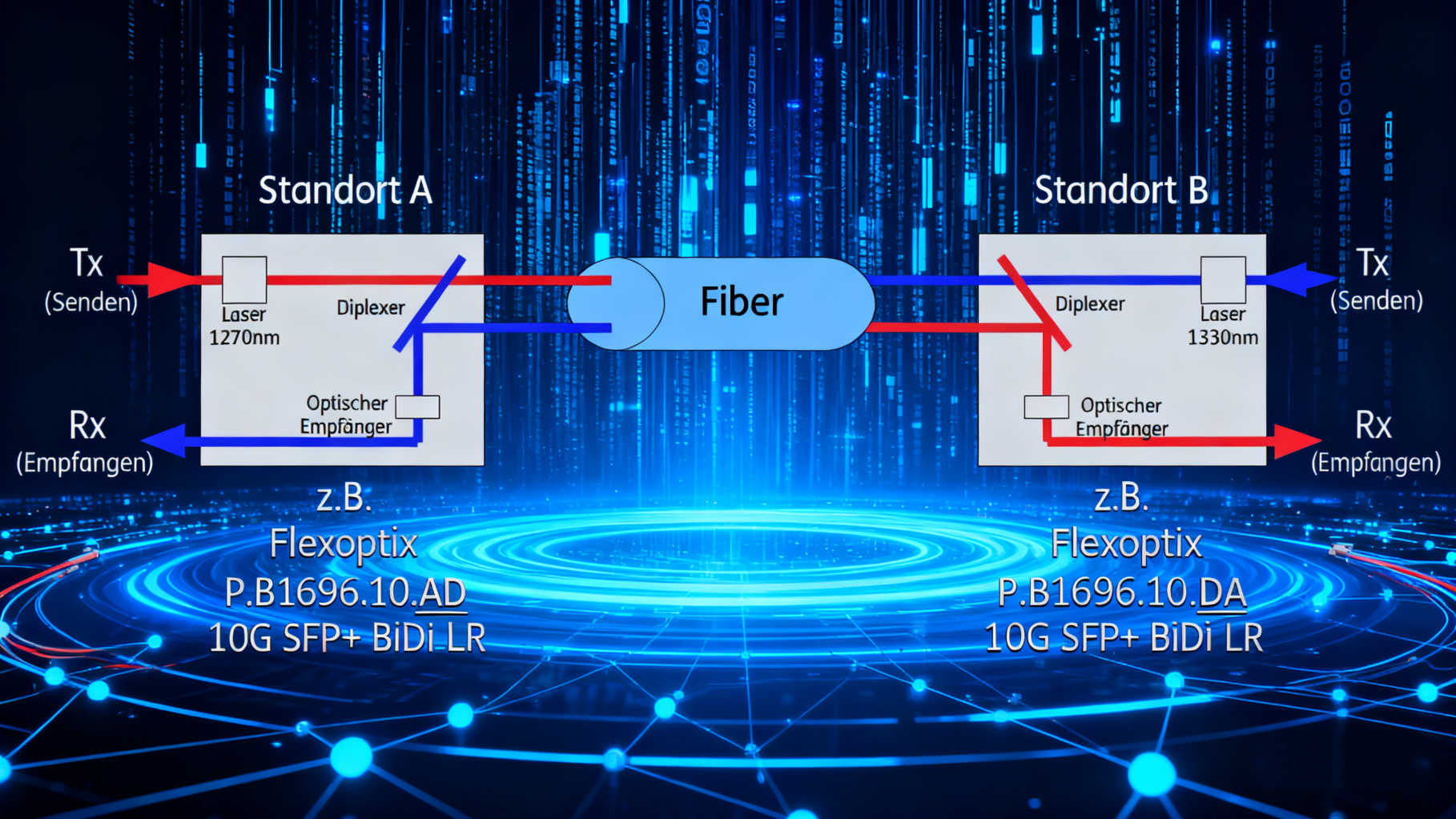
Traditional optical transceivers need two fibers. One fiber transmits data. The other fiber receives data. BiDi transceivers work differently. They use wavelength division multiplexing (WDM) technology.A BiDi transceiver is an optical module that enables full-duplex data transmission over a single optical fiber by using two different wavelengths. Instead of two separate fibers—one for transmit and one for receive—this device uses internal wavelength division multiplexing (WDM) to carry traffic in both directions on one strand. This design halves fiber usage for point-to-point links and offers a fast upgrade path when conduit or spare.
This technology allows each direction to use a different wavelength. For example, one direction transmits at 1310 nm. The other direction receives at 1490 nm. Or it can work the other way around.
How BiDi Transceivers Work
WDM Coupler & Duplexer: BiDi transceivers have a WDM coupler and duplexer built in. These parts combine two wavelengths. They also split the wavelengths apart. This makes full duplex communication possible in one fiber.
Paired Modules: BiDi modules always work in pairs. One module transmits on one wavelength. It receives on another wavelength. Its partner module does the opposite.
Core components:
Transmitter: Uses a Distributed Feedback (DFB) laser.
Receiver: Uses a PIN photodiode with a Transimpedance Amplifier (TIA).
WDM Filter: This filter separates each wavelength. It also directs them for sending and receiving.
Connectors: Most BiDi modules use LC simplex connectors for single fiber. For higher-speed multi-fiber setups, they use MPO connectors.
Key Technical Specifications
1.Supported Data Rates:
1G (SFP), 10G (SFP+), 25G, 40G (QSFP+), 100G, and 400G (QSFP-DD/CFP2)Single-fiber devices are available in common pluggable formats: SFP (1G), SFP+ (10G), SFP28 (25G), QSFP/QSFP28 (40/100G) and larger CFP variants. For long-reach deployments, Single-mode fiber (OS2) and LC simplex connectors are the norm. Short-reach multimode variants and lane-aggregated MPO solutions exist for high-density racks but are limited by multimode modal bandwidth. Verify platform compatibility and EEPROM/vendor coding before purchase—some vendors ship platform-locked SKUs that require specific switch validation.
2.Typical Wavelength Pairs:
1310/1490 nm, 1270/1330 nm, 1270/1310 nm, 1550/1490 nm
3.Maximum Transmission Distances:
1G BiDi: up to 40 km, sometimes 80 km (single-mode fiber)
10G BiDi: up to 80 km (single-mode fiber)
25G BiDi: up to 40 km (single-mode, 1310 nm/1270 nm pair)
40G BiDi: 300–500 m on OM3/OM4/OM5 multimode fiber
100G BiDi: 75–150 m (OM3–OM5)
400G BiDi: multiple 100G BiDi lanes using MPO connectors
4.Optical Sensitivity: Some 1.25 Gbps BiDi modules can detect signals as low as -25 dBm.
5.Output Voltage Swing: 600 to 1200 mVp-p differential.
6.Supported Wavelength Range: 1250–1370 nm, 1430–1550 nm.
Types and Form Factors of BiDi Transceivers
BiDi transceivers come in many form factors. Each supports different data rates. You pick the right one based on your bandwidth needs, distance, and equipment.
Common BiDi Transceiver Form Factors and Supported Data Rates
1.SFP (Small Form-factor Pluggable)
Data Rate: 1G BiDi
Wavelength Pairs: 1310nm/1490nm or 1310nm/1550nm
Typical Distance: Up to 40km; over 40km with 1550nm/1490nm
Typical Use Cases: Enterprise LAN, campus network, FTTH (Fiber to the Home), CCTV
2.SFP+
Data Rate: 10G BiDi, 25G BiDi
Wavelength Pairs: 1490nm/1550nm or 1550nm/1490nm
Distance: Up to 80km
Typical Use Cases: Data centers, metro Ethernet, backbone links, high-density switch connections, 5G front-haul
3.XFP
Data Rate: 10G BiDi, 25G BiDi
Use Cases: Telecom, carrier networks, long-haul transmission
4.QSFP+
Data Rate: 40G BiDi
Wavelength: 850nm (optimized for multimode fiber)
Distance: 300m (OM3), 400m (OM4), 500m (OM5)
Use Cases: High-performance computing, data center core, cloud networking
5.QSFP28
Data Rate: 100G BiDi
Distance: 75m (OM3), 100m (OM4), 150m (OM5), or up to 70km (single-mode)
connector: Duplex LC for short reach
Use Cases: Data center core, very high-speed interconnects, large campus networks
6.CFP2
Data Rate: 400G BiDi
Unique Features: Dual-laser design for single-fiber, bi-directional transmission
Use Cases: Hyperscale data centers, ultra-high-speed backbones

At-a-Glance: BiDi Transceiver Types and Applications
|
Form Factor |
Supported Data Rates |
Typical Uses |
Maximum Distance (nm/fiber) |
|---|---|---|---|
|
SFP |
1G |
Enterprise LAN, FTTH, CCTV |
40km (SMF), >40km (1550nm) |
|
SFP+ |
10G, 25G |
Data center, 5G RAN, metro/backbone |
80km |
|
XFP |
10G, 25G |
Long-haul telecom/carrier networks |
Long-haul |
|
QSFP+ |
40G |
HPC, cloud/data center core, short reach |
500m (OM5 MMF) |
|
QSFP28 |
100G |
Data center core, interconnects, 70km SMF |
up to 150m (OM5), 70km SMF |
|
CFP2 |
400G |
Hyperscale data center, ultra-high-speed |
Varies |
Typical Applications
Data centers and enterprise networks: BiDi transceivers help you use fiber more efficiently. I recommend them for high-density setups.
Upgrading existing fiber infrastructure: You don’t need to install new fibers. This cuts costs. It also reduces disruption.
Long-distance metropolitan and access networks: BiDi modules work great for these applications.
Advantages of BiDi Transceivers
Cuts fiber usage by 50%: This reduces cabling needs. It also lowers costs.
Simplifies network upgrades and design: Based on my experience, this makes planning easier.
Enables high-density deployment: BiDi transceivers fit well in environments that need a lot of bandwidth.
Example Scenarios
You connect two switches with a pair of BiDi SFP+ modules. One module sends on 1270 nm. It receives on 1330 nm. The other module does the reverse.
You deploy 10G BiDi SFP+ modules for connections up to 80 km. This works on a single existing fiber.
You use 100G BiDi in data center racks. This connects servers and switches. It reduces the number of fibers you need. You don’t sacrifice bandwidth.
Important Usage Note
BiDi transceivers must work in matched wavelength pairs. Each side of the link needs a module set to the correct transmit wavelength. It also needs the correct receive wavelength. If the wavelengths don’t match, communication fails. I suggest double-checking your module pairs before deployment.
Typical Wavelength Pair Usage
I recommend installing BiDi modules in matched pairs. Here’s how:
|
Location |
TX Wavelength |
RX Wavelength |
|---|---|---|
|
Site A |
1310 nm |
1490 nm |
|
Site B |
1490 nm |
1310 nm |
Benefits and trade-offs
Advantages
-
Fiber efficiency: A single strand supports full-duplex traffic, effectively doubling usable links in constrained ducts.
-
Lower civil cost: Avoids costly duct expansion and new fiber pulls.
-
Reduced panel congestion: Fewer fibers simplify patching and save tray space.
-
Rapid upgrades: Swap duplex optics for single-fiber parts to add capacity quickly.
Trade-offs
-
Modules must be deployed as matched wavelength pairs; a mismatch prevents link establishment.
-
Some optics are vendor-coded—plan for platform compatibility or request programmable SKUs.
-
Single-fiber WDM links can have tighter loss budgets; account for connector/splice loss and environmental drift.
-
Duplex fiber offers greater re-purposing flexibility and often simpler multi-vendor interoperability.
Key Differences: BiDi vs. Traditional Transceivers
Summary Table
|
Feature |
BiDi Transceiver |
Traditional Transceiver |
|---|---|---|
|
Fiber use |
Single strand per link |
Two strands per link |
|
Connector type |
Simplex (LC, SC) |
Duplex (LC, SC, MPO, etc.) |
|
Wavelengths |
Requires WDM, different for each direction |
Same both ways |
|
Pairing |
Must be matched pairs |
Interchangeable modules |
|
Capacity per fiber |
Doubled |
Single direction per fiber |
|
Installation/upgrade |
Best for fiber-limited scenarios |
Works for all general cases |
Key Takeaway
BiDi transceivers save you big money. They boost efficiency by giving full-duplex links over one fiber.
I recommend them for rapid scaling, high-density deployment, or upgrades where running new fiber is hard.
Traditional transceivers are compatible and simple. But they can’t match the resource savings BiDi tech gives in tight environments.
When Should You Use a BiDi Transceiver?
Choose single-strand WDM solutions when spare fibers or installation budgets are the gating factors. Typical scenarios:
-
Brownfield campus or building upgrades with limited ducts.
-
Metro or access links where maximizing fiber assets is essential.
-
Rack-to-rack or floor-to-floor links with constrained pathways.
-
CCTV/surveillance and remote-site backhaul where reduced cabling simplifies deployments.
When not to choose them
Avoid single-fiber WDM parts in environments that require frequent reconfiguration, broad multi-vendor interchangeability, or where very large optical margins are required (for example, long-haul DWDM backbones). For hyperscale data centers or long-haul links with complex channel planning, duplex optics or dedicated DWDM systems may be preferable.
Where BiDi Transceivers Work Best
BiDi transceivers work great when you need to save fiber. They also help when space is tight. I recommend them for short-distance data transmission. They work well in networks with limited fibers or crowded conduit space.
Key Application Scenarios
-
Point-to-Point (P2P) Fiber Links
These connect switches, routers, or servers directly. BiDi transceivers use just one fiber strand. They deliver high-speed, stable data transmission. I suggest them for campus corridors or network closets. -
Digital Video & CCTV Transmission
BiDi modules are common in surveillance systems. They transmit video feeds both ways over one fiber. I’ve seen them work well in campuses, office buildings, hotels, and logistics centers. They save space and provide reliable camera networks. -
High-Density Data Center Networking
BiDi transceivers connect switches port-to-port. They cut down on cable bulk. They reduce rack congestion. They support 1G to 200G speeds. I like them for multi-floor buildings where adding more cable is difficult. -
5G Radio Access Networks (RAN)
These support high-bandwidth backhaul in 5G infrastructure. 25G/50G BiDi modules connect base stations and cell sites. They reduce the number of fiber runs needed for tower links. -
Fiber-to-the-Home (FTTH) and Access Networks
Operators use BiDi transceivers in last-mile deployments. They help maximize limited fiber resources. They provide reliable two-way communication to homes and businesses. -
Hospitality Management & Smart Buildings
Large hotels and resorts deploy BiDi for high-speed guest Wi-Fi. They use it for smart room controls, staff networking, and event management. Based on my experience, they upgrade networks without new cabling.

Summary of Core Technical Points
BiDi transceivers use Wavelength Division Multiplexing (WDM) for two-way data transmission over a single optical fiber. They send and receive data on different wavelengths at the same time. This makes fiber optic communication much more efficient.
Performance Specifications Table
|
Data Rate |
TX/RX Wavelength |
Distance |
TX Power |
RX Sensitivity |
Connector |
|---|---|---|---|---|---|
|
1.25G |
1310/1550 nm |
10–20 km |
-9~-3 dBm |
-20 dBm |
SC |
|
25G |
1310/1270 nm |
40 km |
varies |
varies |
LC |
|
40G |
850 nm |
300–500 m |
varies |
varies |
LC |
|
100G |
Multiple |
75–150 m |
varies |
varies |
LC/MPO |
Core Figures and Value Points
-
Infrastructure cost reduction: ~50% compared to dual-fiber links.
-
Insertion/Return loss: ~1.8 dB insertion, <-12 dB return for 25G SFP28.
-
Operational distances: Up to 80 km on some 10G BiDi models, and up to 150 m on 100G BiDi for OM5.
FAQ
Q: Can single-fiber modules work on multimode fiber?
A: Multimode variants exist for short reaches, but long-reach single-fiber deployments typically require single-mode fiber.
Q: Are matched pairs required?
A: Yes—each end must use complementary Tx/Rx wavelengths.
Q: How should I test these links?
A: Use wavelength-aware power meters or tunable sources; standard continuity testers are insufficient for wavelength verification.
WOLON supplies factory-tested BiDi SFP / SFP+ / SFP28 matched pairs with clear reach specifications, LC simplex interfaces, and platform-compatibility options. Contact WOLON for procurement, labeling templates and field test plans to simplify deployment.