This article explains, in technical but practical terms, how QSFP56 and QSFP-DD implement 200G links, what their internal architectures look like (lanes, modulation, electrical pinout), and what interoperability and compatibility rules you must follow when deploying them in real networks. If you only want the short version: QSFP56 achieves 200G in the classic QSFP cage using four 50-Gb/s lanes (typically 50G-PAM4), while QSFP-DD uses a double-density electrical interface with eight lanes that can support both 200G and 400G modes — and a QSFP-DD port accepts QSFP56 modules, but not vice-versa.
At-a-glance comparison
When you evaluate QSFP56 vs QSFP-DD, focus on four things: mechanical/pinout form factor, electrical lane topology, modulation/PHY (PAM4 vs NRZ) and the compatibility or upgrade path your chassis and ASICs will support.
Physical and electrical architecture — lanes, pinout and form factor
QSFP56 is a QSFP-form-factor transceiver family engineered to carry ~200G by using four electrical lanes running at ~50 Gb/s each (50G-PAM4 is the common encoding for modern 200G QSFP56 modules). The module fits the legacy QSFP cage and uses the established single-row QSFP connector and 38-pin electrical interface. This keeps mechanical density high and makes QSFP56 a straightforward upgrade from /QSFP+ platforms that support higher lane speeds.
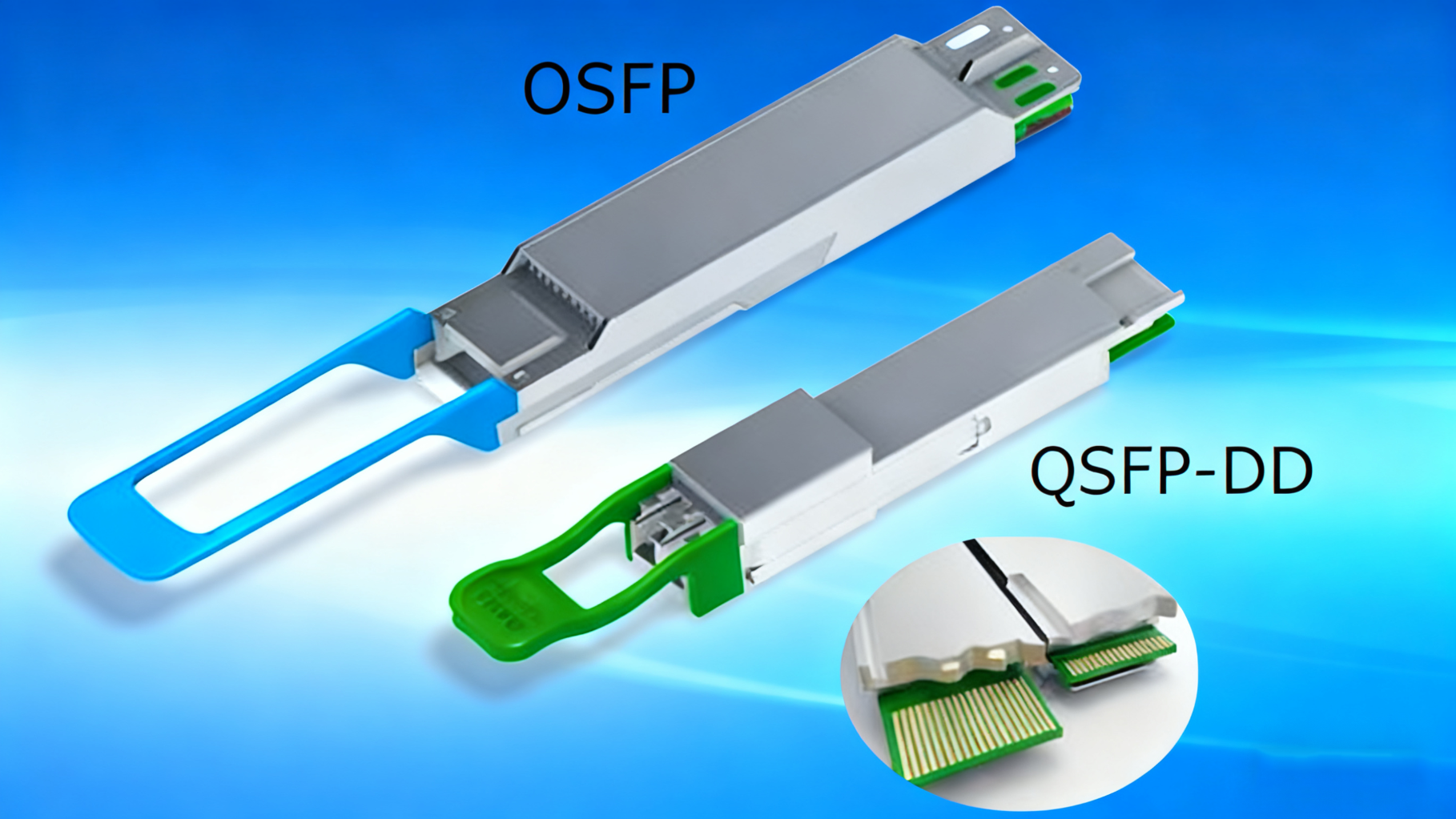
QSFP-DD (Double Density) retains the QSFP mechanical envelope but adds a second row of electrical contacts to present eight independent electrical lanes to the host ASIC. That eight-lane topology is the defining trait: it enables 200G by using eight 25G NRZ lanes (or various lane/modulation mixes) and — critically — enables 400G when each lane runs at 50G (PAM4) or in other multi-lane configurations. The extra Contact row is why QSFP-DD ports are physically compatible with legacy QSFP modules (the older modules simply don’t use the extra pins). The official QSFP-DD specification documents the second row and the eight-lane mapping.
Modulation strategies: PAM4 vs NRZ and why it matters
There are two practical ways to reach 200G inside these packages:
-
4×50G (PAM4): four lanes, each carrying 50 Gbit/s using PAM4 encoding (two bits per symbol). This is how most QSFP56 200G optics operate; PAM4 reduces the number of electrical lanes but increases DSP and signal-processing complexity (equalization, FEC, advanced DSP) inside the module.
-
8×25G (NRZ): eight NRZ lanes at 25 Gbit/s each — a lower-complexity electrical signalling scheme but requiring an eight-lane host interface like QSFP-DD. NRZ has better noise margin per lane but needs more physical lanes.
QSFP56 vendors typically choose 4×50G (PAM4) to deliver 200G in a single QSFP cage. QSFP-DD can support either approach (8×25G NRZ or 4×50G PAM4) and therefore provides a more flexible upgrade path from 200G to 400G in the same mechanical footprint. The tradeoff is DSP complexity and power: PAM4 needs stronger DSP/FEC and tighter signal-integrity management, while NRZ relies on additional lanes to carry the same throughput.
Backward and cross-formfactor compatibility
-
QSFP-DD port → QSFP56/QSFP28/QSFP+ modules: supported in the majority of vendor implementations. A QSFP-DD cage can accept standard QSFP form-factor modules because the extra QSFP-DD pins are simply unused by the smaller module. This makes QSFP-DD useful as a “future-friendly” slot.
-
QSFP56 port → QSFP-DD modules: generally not supported. A QSFP56 host lacks the extra electrical contacts and the required ASIC lane mapping to drive QSFP-DD’s eight lanes, so a QSFP-DD module will not function correctly in a QSFP56 slot. Attempting it will either fail or be unsupported by the switch vendor.
Always consult the vendor compatibility matrix: some switch vendors publish explicit interoperability tables and firmware flags governing whether reduced-lane/auto-negotiation fallbacks are permitted. Don’t rely on mechanical fit alone.
Performance, power and thermal considerations
Because QSFP56 typically implements 4×50G PAM4, it packs significant DSP and FEC inside the module; modern QSFP56 optics target low single-digit watts (many modules are in the ~4–7 W range for SR/FR variants), but performance varies by distance, wavelength and vendor. QSFP-DD modules that support 400G often consume more power (and produce more heat) than single-mode 200G QSFP56 modules because they may host more optics, higher-speed electronics, and more complex cooling requirements. Account for per-port thermal headroom when choosing dense deployments (e.g., 1RU switches populated with all ports).

Interoperability checklist — what to validate before buying or deploying
-
Host port type and spec: confirm whether your switch has a QSFP-DD cage or a standard QSFP cage; check vendor docs. QSFP-DD cages accept QSFP56, but QSFP56 cages will not accept QSFP-DD modules.
-
Module electrical mode: determine if the module uses 4×50G PAM4 or 8×25G NRZ and ensure the host PHY supports that lane encoding and required DSP features (e.g., FEC).
-
Optical standard and transceiver type: match module (SR4, FR4, DR/FR, DR4, LR4, etc.) to fiber plant and link budget. QSFP56 SR4 modules usually map to 200GBASE-SR4 optical standards.
-
Firmware/whitelist constraints: many switch vendors restrict third-party optics at the firmware level — verify compatibility or enable third-party optics settings if required.
-
Power & cooling: model expected module power consumption and ensure the chassis has capacity at full population.
Migration guidance — how to choose now for future growth
If you need a straightforward 200G upgrade with maximum module density and slightly lower cost/power per module, QSFP56 (4×50G PAM4) is a mature and widely available choice. If you want a single platform that can evolve to 400G while accepting legacy QSFP modules during transition, QSFP-DD provides a more future-resilient path thanks to its eight-lane electrical interface and backward mechanical compatibility. Either way, test interoperability on your exact switch models and use vendor compatibility lists to avoid surprises.
Conclusion
The QSFP56 vs QSFP-DD decision is not absolute — it’s about fitting an architecture to operational priorities. QSFP56 is optimized for compact 4×50G PAM4 200G density with minimal cage changes; QSFP-DD is optimized for lane flexibility and an easier path to higher aggregate rates. Choose the family that best aligns with your chassis, ASIC serdes and upgrade roadmap.
-
Use QSFP56 when you want a compact, proven 200G solution implemented as 4×50G PAM4 inside a standard QSFP cage.
-
Use QSFP-DD when you require an upgradeable platform that supports 200G today and 400G later (eight electrical lanes, backward acceptance of QSFP variants)
For reliable 200G deployments, WOLON offers a full line of standards-compliant QSFP56 and QSFP-DD optical transceivers (SR4, DR/FR variants), DACs and AOCs, all factory-tested for vendor interoperability, DOM monitoring, and robust thermal/power specifications. WOLON modules are backed by multi-vendor compatibility testing and customizable BOM/labeling for rapid rollouts — Contact WOLON for detailed compatibility matrices and volume pricing to match your switch models and migration plan.