Dense Wavelength Division Multiplexing (DWDM) networks rely on optical channel density, wavelength precision, and operational agility. When designing or upgrading networks, the engineer’s choice often reduces to two hardware models: tunable DWDM modules and fixed-wavelength DWDM modules. Below is a concise, data-forward comparison focused strictly on cost, flexibility, and operation & maintenance (O&M)—so you can quickly decide which set of optic modules best fits your deployment.
Quick definitions:What isTunable Dwdm Modules/ Fixed-Wavelength Dwdm Modules
-
Fixed-wavelength DWDM modules: transceivers set at a single ITU channel (e.g., C16) at manufacture. They’re simple, lower cost, and have been the longstanding default for stable, predictable deployments.
-
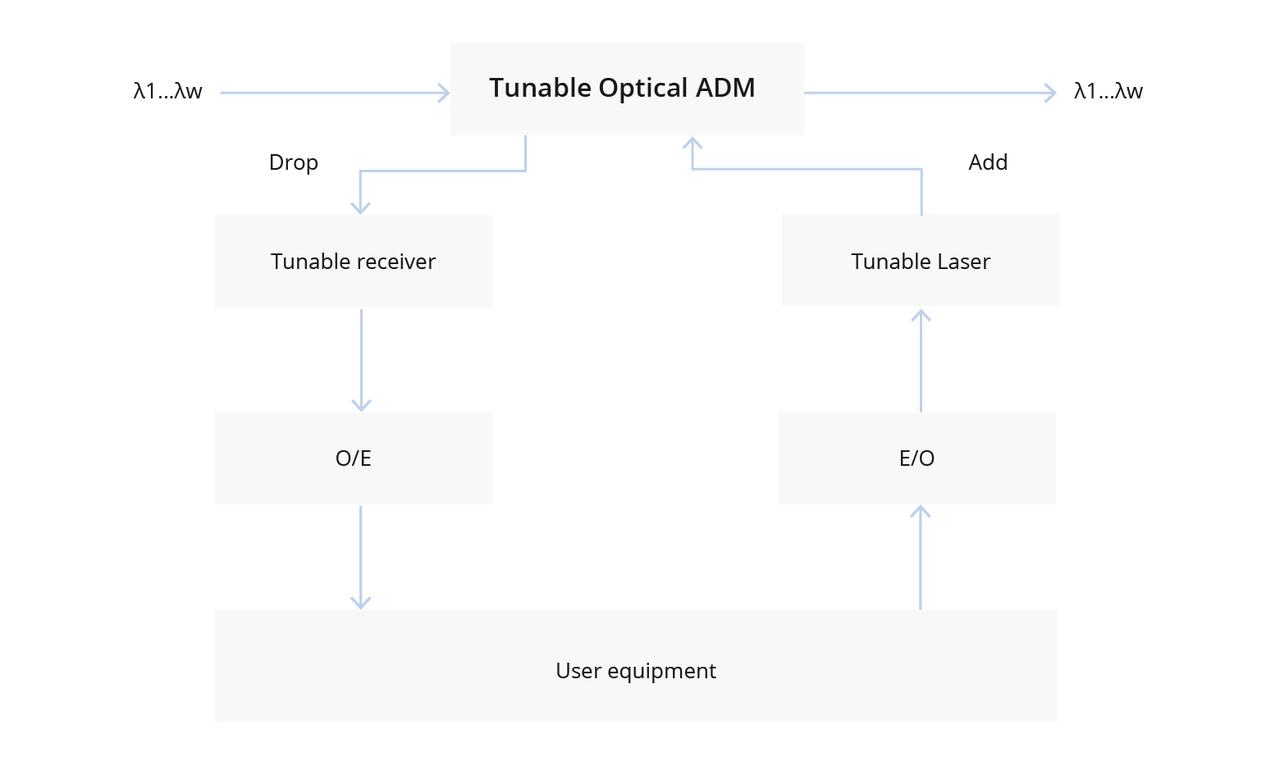
Tunable DWDM modules: transceivers whose onboard laser can be programmatically set to any supported DWDM channel within their tuning band (often full C-band). They replace many fixed SKUs with one universal part.
Upfront cost vs. total cost of ownership (TCO)
Upfront unit price: fixed modules are the lowest-cost option per unit. Tunable modules command a premium—industry sources report tunables are commonly more expensive than fixed parts, sometimes by multiples depending on bandwidth and form factor.
But pure purchase price is only half the story. For networks with:
-
many different channel SKUs in inventory, or
-
geographically distributed sites where logistics and spares are expensive,
a single tunable part can replace multiple fixed SKUs and drastically reduce spare inventory, stock-holding complexity, and emergency shipping costs. Multiple vendor analyses show that tunables often pay back their higher capex by lowering spare part counts and shortening provisioning time—especially for service providers and large metro/core networks.
Practical rule: for small, static links (few channels, predictable topology), fixed modules typically have a lower TCO. For scalable, dynamic networks (frequent re-provisioning, many channel types), tunables often yield lower lifecycle cost despite higher unit prices.
Flexibility and inventory impact
Tunable DWDM modules shine in flexibility:
-
One SKU for many wavelengths — simplifies procurement and spares.
-
Easier remediation of wavelength conflicts and re-assignment during migration or maintenance windows.
-
Useful in testbeds, labs, and dynamic provisioning where channels are frequently reallocated.
Fixed modules force SKU proliferation: each ITU channel and each speed/form factor is a different item. If you maintain dozens of unique channel SKUs across multiple sites, inventory carrying cost, part-mismatch risk, and human error go up quickly. For networks with a large channel count or frequent changes, the operational burden of fixed SKUs often outweighs their lower unit price.
Operation & maintenance (O&M): provisioning, troubleshooting, and lifecycle
Provisioning time: tunables enable “plug-and-play” wavelength assignment in the field—no pre-ordering a specific fixed SKU months ahead. That reduces lead time and speeds service turn-up. Fixed modules require correct SKU and careful labeling to avoid misinsertions.
Troubleshooting and swaps: tunables simplify hot-swap and spare usage—technicians can replace a failed module with any spare tunable and reassign its wavelength in software. With fixed modules, the proper wavelength spare must be available on-site, or the repair becomes a logistics exercise. This reduces mean time to repair (MTTR) in favor of tunables.
Compatibility & calibration: tunables require robust control and accurate calibration to meet DWDM channel tolerances, and older DWDM mux/demux gear or certain amplifiers may need verification for compatibility. Fixed modules are simpler and tend to be more “plug-and-play” with legacy gear. Plan for firmware and management system support if you choose tunables.
Performance, reliability, and risk
Modern tunables are mature: for mainstream speeds (1G, 10G, 25G, 100G optics), commercial tunable modules demonstrate similar optical performance (line width, stability, and wavelength accuracy) to fixed modules, when sourced from reputable vendors. However, tunable lasers add hardware/firmware complexity—so always validate supplier test data and MTBF figures.
Risk considerations:
-
Vendor maturity: pick tunables from vendors with proven calibration and management tools.
-
Management integration: ensure your NMS/EMS supports remote wavelength setting and lockdown policies to prevent operator errors.
-
Spare strategy: even with tunables, maintain key fixed spares for last-resort recovery if the tunable fails in a way that requires replacement with a fixed-only alternative.
Use cases — quick decision matrix
-
Choose fixed-wavelength if: few links, predictable topology, tight capex limits, legacy gear, or very price-sensitive short-term projects.
-
Choose tunable if: large-scale metro/core, many channels/sites, dynamic provisioning, desire to reduce spare SKUs, or when reducing MTTR and logistics cost matters more than unit price.
Implementation tips & O&M checklist
-
Model the spare-part savings: quantify how many fixed SKUs a tunable could replace across sites and translate that into saved inventory carrying cost and shipping time. Vendors and white papers commonly show rapid payback in larger inventories—do the math for your topology.
-
Validate NMS integration: confirm you can remotely program and audit wavelengths from your management stack.
-
Field test: run a pilot on representative links for a quarter to capture real MTTR and failure-mode data.
-
Vendor SLAs & firmware: verify calibration procedures, field firmware update process, and support response times.
-
Training: train technicians on wavelength assignment procedures and error recovery with both tunable and fixed optics.
Conclusion
Tunable Dwdm Vs Fixed-Wavelength Dwdm Modules is not an “either/or” patent; it’s a tradeoff between upfront capex and downstream operational simplicity. For small static networks, fixed-wavelength optic modules remain the economical choice. For dynamic, geographically dispersed, or rapidly scaling DWDM networks, tunables usually win on TCO when you factor inventory, MTTR, and provisioning speed. If your operations prioritize fast service turn-up, simplified logistics, and lower long-term O&M overhead, plan for tunables—validate vendors carefully and run a short pilot before full migration.