Deciding between Third-Party 100G Modules Vs Branded 100G Modules is a frequent procurement crossroads for network architects who must balance budget, reliability, and long-term support. This article cuts straight to the search intent: it explains the measurable differences—cost, compatibility, performance, warranty risk, and operational best practices—and finishes with a concise recommendation you can act on today.
Quick verdict
If your priority is predictable vendor support and the absolute lowest integration risk, choose branded 100G modules; if your priority is cost-efficiency with careful testing and a reputable supplier, Third-Party 100G Modules Vs Branded 100G Modules typically favors third-party optics for lower CapEx and similar field reliability in many deployments.
When to choose which: concise guidance
• Mission-critical spine/aggregation with strict vendor support needs: branded 100G modules.
• Large port counts where budget matters and you can run validation: reputable third-party 100G modules with a test program.
• Mixed or hybrid fleets: deploy third-party in edge or non-critical zones and reserve branded modules where vendor support or warranty symmetry is essential.
Cost comparison: how big is the price gap?
The most visible difference between Third-Party 100G Modules Vs Branded 100G Modules is price. Branded QSFP28 modules from tier-one OEMs commonly carry a substantial premium because you’re buying a validated part number, direct vendor warranty and the assurances that come with the platform. Third-party vendors frequently sell functionally equivalent 100G QSFP28 LR4/SR4 modules for a fraction of the list price—public price comparisons across multiple form factors show third-party units often costing dramatically less than OEM equivalents. For teams with many ports to equip, the aggregate savings are material and can justify a certified testing program.
Compatibility, warranty and vendor policy risks
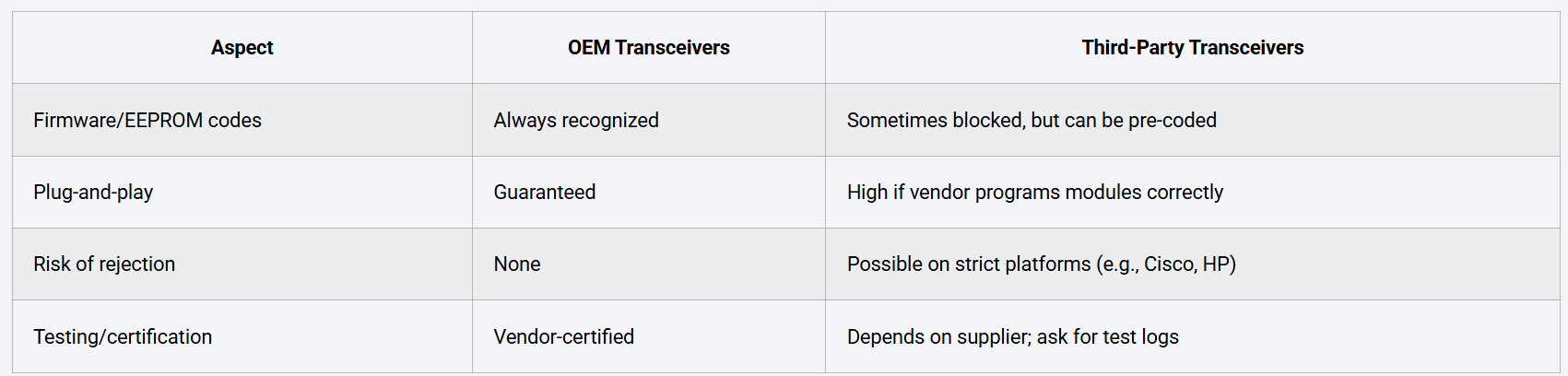
A second major axis in the Third-Party 100G Modules Vs Branded 100G Modules decision is vendor policies. Major switch vendors maintain compatibility matrices and non-entitlement clauses: devices on those matrices will be fully supported, while non-listed optics may be treated as third-party and could affect entitlement decisions. That means if an OEM suspects an optics-related failure, they may ask you to swap in OEM optics before diagnosing or honoring certain warranty claims. This policy risk is why some organizations accept the OEM premium for mission-critical links.
Performance, specs and test methodology
When you evaluate Third-Party 100G Modules Vs Branded 100G Modules technically, the two are often indistinguishable on paper: both will conform to IEEE/ITU link budgets (for SR/LR/ER optics) and provide the same interface. The important differences appear under stress testing—temperature extremes, long continuous traffic, and platform firmware interactions. For example, branded parts are generally tested by the OEM across their full hardware/firmware matrix; many third-party vendors run lab tests too, but the scope varies. To measure parity, insist on: end-to-end BER testing at target distances, power and thermal profiling in your racks, and firmware compatibility checks with your switch IOS/SONiC versions. Independent lab reports and vendor test logs are invaluable evidence when comparing offerings.
Interoperability issues and common operational traps
A recurring operational trap in the Third-Party 100G Modules Vs Branded 100G Modules comparison is the “err-disabled” or unsupported-transceiver behavior on some switch platforms. Some switches will block or place into an error state optics that don’t present an expected vendor identifier; others allow an override but log a compatibility event. This can lead to unexpected interface states after upgrades or reboots. The safe play is to check your switch vendor’s behavior for non-OEM optics (and any CLI override required), then include that behavior in runbooks and monitoring alerts.
Final recommendation
For most modern data centers, Third-Party 100G Modules Vs Branded 100G Modules is not a binary “good vs bad” choice—third-party modules often win on cost and can match field reliability when sourced and tested carefully, while branded modules remain the safest choice when vendor support and absolute compatibility are the priority.