When IT buyers weigh procurement options for fiber networks, the debate between OEM optics vs third-party transceivers is unavoidable. This comparison must separate headline claims from practical realities: upfront price delta, operational risk (failures, support), and real compatibility constraints. Below I break down the evidence-based trade-offs and give a practical checklist for making the right choice for your environment.
Cost: raw numbers and real savings
The most visible advantage of third-party transceivers is cost. List prices for OEM SFPs and QSFPs are often multiple times higher than compatible modules from independent vendors; examples range from modest discounts to savings as large as 50–90% depending on type and vendor. Market analyses also show robust growth in the third-party optics sector as buyers chase cost efficiencies.
But cost per unit isn’t the only number that matters. Total Cost of Ownership (TCO) should include failure-replacement costs, potential troubleshooting time, returns processing, and any soft costs from service interruptions. For many organizations—especially those with large port counts—well-chosen third-party optics deliver meaningful annual savings without measurable increase in TCO when a reputable supplier and warranty process are in place.
Compatibility and interoperability: what actually breaks
“Will non-OEM optics work?” Most third-party transceivers implement the same electrical, optical and protocol standards (SFP/SFP+, QSFP/QSFP28, etc.) as OEM modules; many are even manufactured in the same factories and re-branded. In practice, compatibility issues fall into three buckets: (1) vendor EEPROM/ID locks or vendor checks, (2) subtle feature gaps (DOM, temperature ranges, extended diagnostics), and (3) counterfeit or poorly tested parts that fail field validation.
Modern network gear often runs firmware that will flag unsupported transceivers as “unverified” but still allow operation. Some vendors implement stricter checks that block operation; others will operate but mark the port as using non-OEM optics. Because of this variance, a lab compatibility test with the exact switch/router model and firmware level is the safest step before large-scale deployment.
Warranty and vendor support: myth vs reality
A persistent fear is that using compatible optics will void OEM hardware warranties or support contracts. Legal and practical realities differ: most major vendors do not have a blanket prohibition that automatically voids hardware warranties, but they do reserve the right to require OEM parts during troubleshooting if they suspect an issue stems from a third-party module. In practice, many support teams will ask customers to swap in an OEM module as part of diagnosis—but widespread warranty cancellations are rare.
Document all purchases, serial numbers, and maintain a tested spare OEM module for critical systems if you want to preserve a frictionless path to vendor TAC (technical assistance center). That small insurance policy removes most practical barriers while keeping your operating costs low.
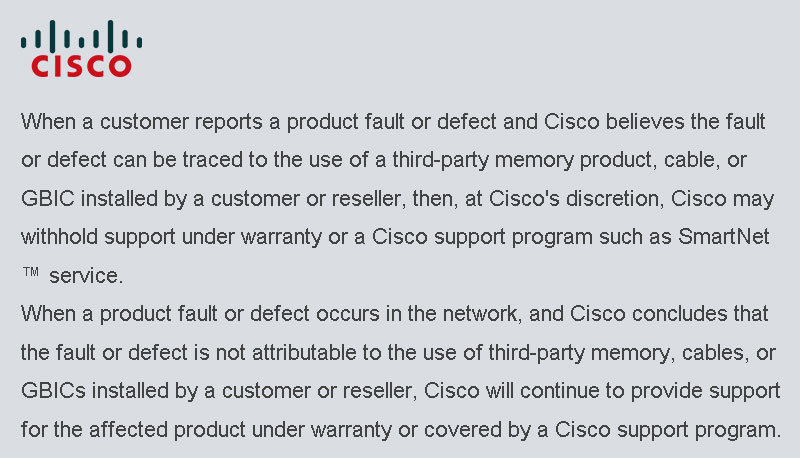
Hidden Meaning: If fault or equipment defect is caused by third-party hardware product—Cisco will withhold warranty support; If fault or equipment defect is not caused by third-party hardware—warranty will be supported by Cisco.
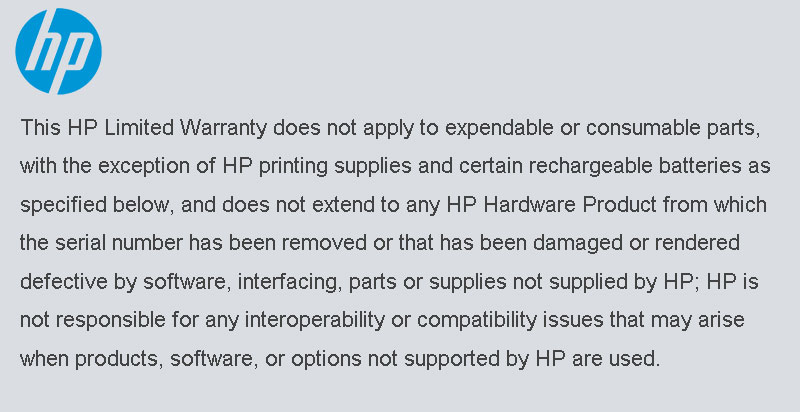
Hidden Meaning: HP limited warranty does not apply if HP equipment get defective due to use third-party hardware.
From the several policies, we can see that the big network equipment vendors have similar rules on using third-party optical transceivers—if problems are caused by third-party compatible transceiver modules, warranty support will be refused until the fiber optic transceivers are changed to OEM ones.
Reliability and field performance: data points to consider
Reliability depends on vendor quality control, burn-in/testing procedures, and operating conditions. High ambient temperatures and thermal cycling accelerate failures for any optics; OEM whitepapers and vendor tests highlight that choosing optics rated for your environment reduces field failures. Reputable third-party vendors often publish test reports and offer multi-year warranties that can match or exceed OEM warranty durations.
When evaluating reliability, insist on vendor test logs for bit error rate (BER), optical power ranges, receiver sensitivity, DOM accuracy, and temperature burn-in statistics. Ask for MTBF/field failure rates if available—some third-party suppliers will share anonymized failure rates from large deployments.
Risk mitigation: procurement and operational best practices
If you plan to use third-party transceivers, follow these steps to reduce risk:
-
Pilot-test: Validate modules on the exact switch/firmware combo for at least 30–90 days under production-like load.
-
Choose reputable vendors: Prefer suppliers with transparent factory audits, ISO certification, and positive field references.
-
Check warranty terms: Favor vendors offering 1–3+ year warranties and clear RMA procedures.
-
Maintain OEM spares: Keep a small number of OEM modules for critical troubleshooting or vendor support escalations.
-
Track and tag: Log part numbers, firmware versions, and serial numbers; track failures to detect systemic issues quickly.
These steps usually capture the majority of operational risk while preserving substantial cost savings.
When to choose OEM optics vs third-party transceivers
Use OEM optics when: you require vendor-certified features (special telemetry or encryption), you operate in vendor-managed service contracts that explicitly demand OEM parts, or when the module price is a small fraction of total project costs (e.g., small, one-off builds).
Choose high-quality third-party transceivers when: you manage large port counts, need predictable cost savings, have internal testing capability, and can accept a documented RMA and spare strategy. Many service providers and hyperscalers successfully mix OEM and compatible optics to balance cost and operational risk.
Conclusion
The real question isn’t whether OEM optics vs third-party transceivers is “better” in absolute terms, but which is better for your requirements and risk tolerance. Third-party transceivers can offer 30–90% unit cost savings and increasingly professional warranties and test data; OEM optics provide tighter vendor integration and a lower friction path for vendor support. With controlled pilot testing, trusted vendors, and a small OEM spare policy, many organizations realize the cost benefits of third-party optics with minimal incremental risk.