
As the FLAP-D region (Frankfurt, London, Amsterdam, Paris, Dublin) undergoes unprecedented expansions to support AI-driven compute clusters and hyperscale multi-tenant data centers (MTDCs), Frankfurt has solidified its position as Europe’s premier low-latency connectivity hub. Inside these dense networking environments, traditional duplex patching has completely given way to parallel optics and multi-fiber trunking.
At the center of this architectural shift is the MTP/MPO cable. By housing 8, 12, 16, or 24 optical fibers inside a single, precision-molded MT (Mechanical Transfer) ferrule, MTP/MPO assemblies dramatically compress high-density footprints while laying the physical foundation for 100G, 400G, and 800G networks.
For European network architects and infrastructure procurement specialists, selecting a manufacturing vendor requires balancing strict technical compliance with supply chain agility. Beyond basic insertion loss tolerances, procurement within the EU demands adherence to localized regulations, specifically the Construction Products Regulation (CPR) for fire safety.
Below is an engineering-focused evaluation of the top five MTP/MPO cable manufacturers operating in Germany.
1. Rosenberger OSI (Optical Networks & Infrastructure)
Headquartered in Augsburg, Bavaria, Rosenberger OSI is a highly specialized powerhouse in European data center cabling and local area network infrastructures.
Flagship Product Portfolio: PreCONNECT® trunk systems (OCTO, SEDECIM, and STANDARD architectures).
Engineering Advantage: Rosenberger OSI excels in factory-fabricated, modular plug-and-play systems. Their PreCONNECT® OCTO line is optimized for parallel optics, utilizing 8-fiber increments to eliminate unused fibers during 40G/100G SR4 and 400G DR4 migrations. They deploy ultra-low-loss MTP® Elite components to guarantee strict channel attenuation limits across highly cascaded cross-connect configurations.
Deployment Focus: Enterprise core networks and colocation data centers seeking ultra-stable optical power budgets and zero field-termination risks.
2. Telegärtner Karl Gärtner GmbH
Based in Steinenbronn, Baden-Württemberg, Telegärtner is a long-standing, engineering-driven manufacturer recognized for its premium RF and fiber optic connection components.
Flagship Product Portfolio: TICNET® Configurator System and HD (High Density) MPO Patching Solutions.
Engineering Advantage: Telegärtner is renowned for mechanical precision and robust product design. Their MTP/MPO cable solutions feature industrial-grade pulling eyes and rugged micro-jacket structures engineered to withstand heavy tensile loads during long-distance tray installations. Every assembly is subjected to exhaustive factory documentation, ensuring seamless integration into mission-critical telecom environments.
Deployment Focus: Industrial edge data centers, telecommunications central offices, and campus backbones requiring highly durable physical layer routing.
3. R&M (Reichle & De-Massari) GmbH
While headquartered in Switzerland, R&M operates an expansive manufacturing and corporate footprint in Germany, driving a significant portion of Central Europe’s structured cabling standards.
Flagship Product Portfolio: Netscale High-Density Fiber Management Platform.
Engineering Advantage: R&M focuses heavily on maximizing panel density and introducing physical-layer intelligence. Their Netscale series provides the highest port density in the European market, utilizing thin-diameter MTP/MPO patch cords integrated with their proprietary R&MinteliPhy automated infrastructure management (AIM) technology. This permits active RFID tracking of physical patch links.
Deployment Focus: Hyperscale cloud zones and massive corporate data centers necessitating real-time infrastructure auditing and configuration control.
4. Huber+Suhner AG / GmbH
Huber+Suhner (headquartered in Switzerland with centralized manufacturing and engineering hubs in Taufkirchen, Germany) is a global leader in electrical and optical connectivity components.
Flagship Product Portfolio: IANOS® and LISA High-Density Fiber Ecosystems.
Engineering Advantage: Huber+Suhner designs with a focus on future-proofing active layouts. The IANOS® system leverages modular, slide-out trays that adapt perfectly to custom MTP/MPO cable breakout configurations. Their optical engineering minimizes internal back-reflection by employing nanometer-precise polishing lines, keeping Return Loss (RL) values comfortably above 60 dB for their premium single-mode APC assemblies, exceeding the industry standard of 50 dB.
Deployment Focus: Ultra-low latency environments, high-frequency trading networks, and high-performance computing (HPC) environments.
5. Metz Connect GmbH
Operating out of Blumberg, Baden-Württemberg, Metz Connect is a highly reliable family-owned manufacturer specializing in structured network cabling components and terminal blocks.
Flagship Product Portfolio: OpDAT Series Fiber Optic Connectivity.
Engineering Advantage: Metz Connect delivers exceptional versatility for enterprise and building-backbone networks. Their OpDAT MPO solutions are engineered with modularity in mind, offering specialized wall-mount configurations, splice-box integrations, and flexible patch cords that transition seamlessly from standard MPO backbones to individual duplex LC terminations at the row or cabinet level.
Deployment Focus: Smart buildings, institutional enterprise networks, and multi-tier localized campus environments.
While technical performance is critical, procurement within the EU requires equal attention to regulatory compliance, particularly in fire safety.
The European Standard: CPR Flame Ratings & EN 50575 Compliance
Procurement managers sourcing an MTP/MPO cable within the European market cannot rely on American fire safety specifications like OFNP (Plenum) or OFNR (Riser). Instead, the EU enforces the strict Construction Products Regulation (CPR) via the EN 50575 standard.
Cables must be evaluated and certified based on their overall contribution to fire, smoke density, flaming droplets, and acidity:
表格
| CPR Euroclass | Flame Propagation | Smoke Production (s) | Flaming Droplets (d) | Acidity (a) | Data Center Sourcing Impact |
|---|---|---|---|---|---|
| B2ca | Ultra-High Resistance | s1a / s1b (Minimal) | d0 / d1 (Zero/Low) | a1 (Low toxicity) | Mandatory for public infrastructure, high-risk spaces, and high-density German colocation pathways. |
| Cca | High Resistance | s1 / s2 | d0 / d1 | a1 / a2 | Standard baseline requirement for structured cabling across major European hyperscale hubs. |
| Dca | Medium Resistance | s2 / s3 | d2 | a2 / a3 | Restricted to vertical risers or low-risk containment zones; rarely accepted in Tier-3/4 data centers. |
Deploying non-compliant or uncertified cable jackets inside German data centers can lead to mandatory infrastructure removal and severe regulatory penalties. Always demand an official Declaration of Performance (DoP) from your supplier, issued by a notified body and valid for the specific product type and batch being purchased.
Enforce Physical Layer Compliance
Ensure your network adheres to strict EU fire regulations and geometric benchmarks. Request an official 3D interferometer verification report and a premium, CPR-compliant MTP/MPO cable evaluation sample tailored to your specifications.
Request CPR Samples & 3D ReportsGlobal Sourcing with WolonFiber: Engineering Without Compromise
While local procurement from German Tier-1 manufacturers ensures adherence to local compliance mandates, it frequently introduces distinct operational bottlenecks. During peak data center construction phases, domestic suppliers often exhibit extended factory lead times, rigid customization boundaries, and premium brand pricing.
For commercial enterprise rollouts and international operators seeking agile supply chains alongside technical precision, WolonFiber provides a reliable alternative.
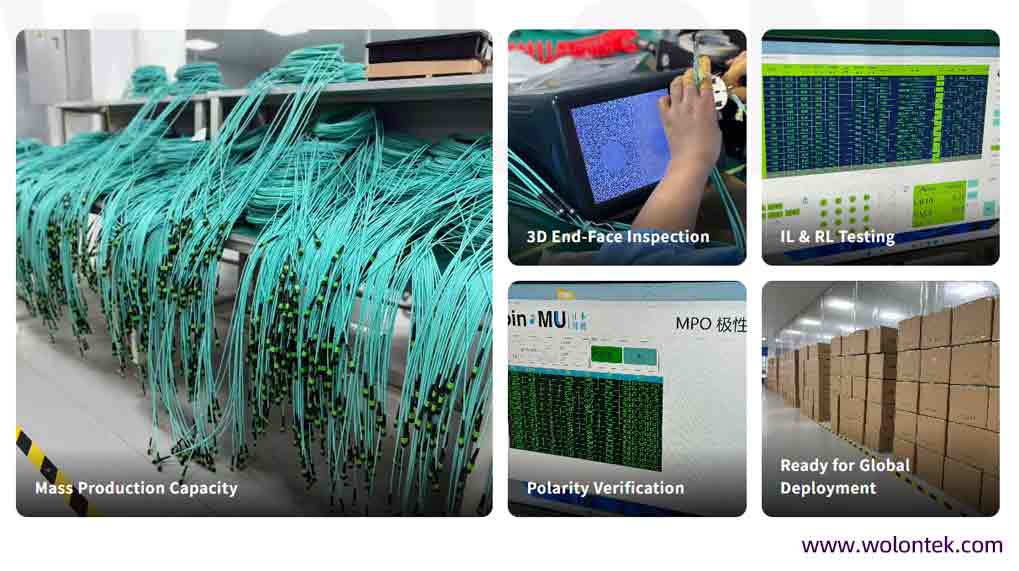
Operating three advanced production facilities within Wuhan’s Optics Valley with a dedicated engineering and manufacturing workforce of 400 to 500 optical specialists, WolonFiber (wolontek.com) delivers factory-terminated MTP/MPO cable trunks designed to match exact European performance profiles.

- Tailored CPR-Compliant Jacketing: We manufacture custom MPO trunks utilizing high-grade LSZH (Low Smoke Zero Halogen) materials certified to meet strict B2ca and Cca Euroclass safety specifications.
- 100% 3D Interferometer Validation: Every MT ferrule undergoes complete geometric testing in accordance with IEC 61300-3-30. We verify radius of curvature, fiber protrusion, and apex offset to eliminate active transceiver damage.
- Premium Loss Thresholds: By sourcing ultra-precise low-loss ferrules, our assemblies consistently maintain insertion losses ≤ 0.35 dB, providing sufficient optical budget margin for complex multi-stage patches.
- Optimized Routing Layouts: We engineer custom breakout configurations and precise trunk lengths to match your exact rack profiles, eliminating excess cable slack and maintaining optimal airflow corridors.
De-Risk Your Fiber Supply Chain
Avoid structural bottlenecks and extended factory lead times. Get a free, no-obligation quote for your MTP/MPO cable project in 24 hours. We also offer quick-turn evaluation prototypes for urgent deployments, backed by rigorous documentation and full CPR compliance.
Bypass Extended Manufacturing Timelines
Whether you require custom length configurations, specific Base-8 polarities, or bulk volumes of certified Cca-rated trunks, our technical team executes to your precise engineering specifications.
What is the mechanical difference between a standard MPO and a branded MTP cable?
MPO (Multi-Fiber Push-On) is the generalized international standard interface (IEC 61754-7). MTP® is a registered trademark of US Conec and represents a premium, mechanically enhanced version of the MPO connector. MTP connectors feature an enhanced floating ferrule design with tighter tolerances, combined with elliptical guide pins to reduce mechanical wear and a removable housing that allows for field re-polishing or gender changes.
Why is single-mode MTP/MPO cabling always polished at an 8-degree angle (APC)?
Multi-fiber connectors feature a large surface area. Parallel physical contact (UPC) in single-mode fibers would cause extensive Fresnel reflection, destabilizing high-speed laser transceivers. An 8-degree Angled Physical Contact (APC) polish ensures that reflected light is deflected directly into the fiber cladding rather than traveling back toward the transmitter, achieving a Return Loss (RL) of > 60 dB. Note that multimode MTP/MPO connectors typically remain flat (PC/UPC) due to lower back-reflection sensitivity.
How does a Base-8 MTP/MPO cable configuration differ from a Base-12 setup?
Base-12 uses a 12-fiber ferrule backbone, which aligns with traditional duplex migrations (e.g., three 4-fiber circuits). However, modern transceivers for 40G/100G/400G parallel optics (like SR4 or DR4) only utilize 8 fibers (4 TX and 4 RX). In a Base-12 configuration, 4 fibers per connector remain dark and wasted. Base-8 architectures utilize 8-fiber ferrules directly, ensuring 100% fiber utilization across parallel transceiver paths without requiring expensive conversion cassettes.