
Despite the industry’s gradual transition to 8-fiber and 16-fiber base architectures for specialized 400G/800G parallel optics applications, 12-fiber base structured cabling remains the undisputed foundational backbone of the majority of enterprise data center infrastructures. At the core of this architecture lies the MPO-12 fiber cable. By consolidating twelve individual optical fibers within a single high-density Mechanical Transfer (MT) ferrule, MPO-12 trunk cables maximize rack space efficiency, minimize cable tray congestion, and deliver a scalable migration path for 10G, 40G, and 100G Ethernet upgrades.
For network architects and procurement managers designing and deploying U.S.-based data center infrastructure, manufacturer selection extends far beyond cost optimization. Critical evaluation criteria include precision optical insertion loss tolerances, standardized polarity management, and full compliance with rigorous MT ferrule geometric specifications. Below is an engineering-focused review of the top five MPO-12 fiber cable manufacturers operating in the United States.
1. Corning Incorporated
Headquartered in Corning, New York, Corning is the industry pioneer of low-loss optical glass and pre-terminated data center cabling infrastructure.
Flagship Product Line: EDGE™ and EDGE8® Structured Cabling Systems
Engineering Advantage: Corning’s MPO-12 trunk cables adopt proprietary ClearCurve® bend-insensitive fiber, significantly mitigating microbend signal loss in densely populated server rack environments. All trunks are factory-terminated with premium US Conec MTP® Elite connectors, delivering a maximum insertion loss (IL) rating of ≤0.35 dB for consistent high-performance transmission.
Deployment Focus: Hyperscale availability zones and complex enterprise core networks requiring modular, plug-and-play scalability and ultra-stable optical performance.
2. CommScope
Headquartered in North Carolina with large-scale global R&D and manufacturing campuses, CommScope is a leading authoritative provider of enterprise physical layer infrastructure solutions.
Flagship Product Line: SYSTIMAX® InstaPATCH® 360 Cabling System
Engineering Advantage: CommScope specializes in intelligent physical layer infrastructure. Its MPO-12 trunk cables are engineered for seamless integration with Automated Infrastructure Management (AIM) systems, enabling data center operators to monitor real-time physical layer connectivity, port status, and link integrity for full network visibility.
Deployment Focus: Multi-tenant data centers (MTDCs) and large financial enterprise networks that demand rigorous physical layer auditing, traceability, and compliance control.
3. Panduit
Based in Tinley Park, Illinois, Panduit delivers high-strength, high-performance physical infrastructure solutions tailored for data center and industrial network deployments.
Flagship Product Line: QuickNet™ and PanMPO™ Connectivity Solutions
Engineering Advantage: The patented PanMPO™ connector redefines field deployment flexibility. Field technicians can directly reconfigure connector gender and switch polarity between Type A and Type B on-site via adjustable guide pin extension and retraction mechanisms. This innovative design eliminates the need for redundant cable inventory and reduces on-site deployment delays.
Deployment Focus: Agile enterprise environments with frequently changing hardware interface and polarity requirements during iterative construction and upgrade cycles.
4. AFL (America Fujikura Ltd.)
Headquartered in Spartanburg, South Carolina, AFL (a wholly-owned subsidiary of Fujikura) provides precision-engineered telecom and utility-grade optical fiber solutions.
Flagship Product Line: MicroCore® MPO Trunk Assemblies
Engineering Advantage: AFL leads the industry in advanced micro-jacket cable design. Its MPO-12 trunks feature an ultra-small outer diameter (OD) jacket reinforced with high-performance aramid yarns. The superior strength-to-weight ratio enables high-density cable tray routing and optimizes thermal airflow efficiency in hot-aisle containment systems.
Deployment Focus: Colocation meet-me rooms (MMRs) and edge computing facilities with limited conduit and cable tray space constraints.
5. Leviton
Following its strategic acquisition of Berk-Tek, Melville, New York-based Leviton has solidified its leadership position in U.S.-manufactured copper and fiber cabling solutions.
Flagship Product Line: Opt-X® Unity Fiber Systems
Engineering Advantage: Leviton integrates high-quality Berk-Tek fiber cable with precision-polished MTP connectors in its domestic U.S. manufacturing facilities. Its premium MPO-12 trunk series features ultra-low channel attenuation, reserving sufficient optical power budget margin to support stable 100GBASE-SR4 transmission over extended distances in multi-tier cross-connect network architectures.
Deployment Focus: Low-latency high-frequency trading networks and large-scale enterprise campus core backbones.
Beyond Insertion Loss & Return Loss: IEC 61300-3-30 Ferrule Geometry Standard
While most procurement evaluations focus solely on insertion loss (IL) and return loss (RL) indicators, the long-term stability and physical durability of MPO-12 fiber cables are fundamentally determined by MT ferrule end-face geometric parameters. Tier-1 manufacturers must comply with the IEC 61300-3-30 3D interferometer testing standard, which regulates the microscopic geometric specifications of MT ferrules. Non-compliant parameters will cause persistent network failures and hardware damage, as detailed below:
| Geometric Parameter | Engineering Definition | Failure Impact |
|---|---|---|
| X/Y Radius of Curvature | The spherical curvature of the MT ferrule end-face in horizontal and vertical dimensions. | Causes incomplete physical contact between mated fiber ends, resulting in excessive return loss and unstable optical links. |
| Fiber Protrusion / Undercut | The vertical offset between fiber end-face and ferrule end-face (protrusion or recess). | Excessive undercut induces air gaps between mated fibers, leading to immediate signal attenuation and link power loss. |
| Apex Offset | The offset distance between the ferrule curvature apex and the center of the fiber array. | Creates uneven mating pressure during connection, which may permanently damage delicate fiber cores and render optical transceivers invalid. |
Suppliers unable to provide official 3D interferometer test reports verifying full IEC 61300-3-30 compliance pose significant risks to high-value 100G/400G optical transceiver hardware and long-term network reliability.
Verify Optical Reliability Before Deployment
Don’t risk your 100G/400G transceivers with unverified ferrule geometry. Request an official 3D interferometer compliance report and a premium low-loss MPO-12 evaluation sample from our engineering lab.
Request 3D Interfere Report & SampleGlobal Sourcing Alternative: WolonFiber – Engineering Without Compromise
Exclusive reliance on traditional U.S. Tier-1 manufacturers often leads to prolonged production lead times, rigid customization limitations, and substantial brand premium costs, especially during large-scale hyperscale data center construction peaks.
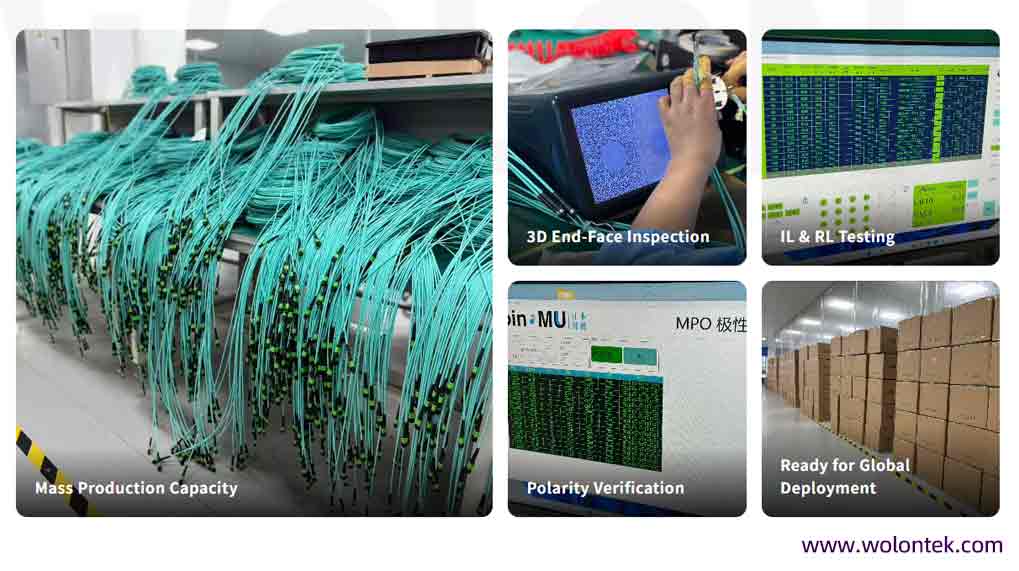
For commercial enterprises and global deployment projects pursuing premium engineering performance and flexible supply chain solutions, WolonFiber serves as a reliable, engineering-driven alternative. Operating three advanced manufacturing facilities in Wuhan Optics Valley, WolonFiber specializes in custom factory-terminated MPO fiber assemblies. Beyond standard cable assembly, the company delivers precision-engineered optical transmission pathways that fully meet Western data center industry tolerance standards.
Full IEC Geometric Compliance: All MT ferrules undergo strict 3D interferometer testing, ensuring qualified fiber protrusion, curvature radius, and apex offset to fully protect active optical hardware.
Premium Optical Performance: Adopting high-grade low-loss MT ferrules, all MPO-12 products sustain a maximum insertion loss of ≤0.35 dB, stabilizing link budgets for multi-stage cascaded patch deployments.
Zero-Excess-Slack Cabinet Routing: Customizable cable lengths and breakout leg staggering specifications match precise switch elevation layouts, eliminating airflow obstruction and thermal inefficiency caused by redundant cable slack.
De-Risk Your Fiber Supply Chain
Avoid deployment delays caused by inflexible manufacturer lead-time constraints. WolonFiber provides standard 12-fiber base MPO trunks, customized polarity configurations, and rapid proof-of-concept prototypes with precise engineering execution.
Accelerate Your Network Build Cycle
Whether you require custom staggered leg breakouts, specific Type B polarity mappings, or high-volume Base-12 trunks, our engineering team delivers precise physical layer components within your timeline constraints.
Are MPO-12 cables fully compatible with branded MTP-12 connectors?
Yes. MTP® is a registered trademark of US Conec and represents a premium, brand-name variant of the generic MPO connector. Branded MTP connectors feature mechanical improvements (such as a floating ferrule and elliptical guide pins) designed to reduce wear and improve insertion loss. However, they comply with identical physical mating footprints (TIA-604-5 / FOCIS 5), meaning high-quality low-loss MPO-12 cables intermate seamlessly with MTP-12 patch panels and transceivers without performance degradation.
Which jacket fire rating should be specified for U.S. data center plenum spaces?
For installations within the United States, any cable routed through horizontal air plenums, raised floors, or drop ceilings used for environmental air handling must be rated OFNP (Optical Fiber Nonconductive Plenum) in accordance with the National Electrical Code (NEC). OFNR (Riser) ratings are restricted to vertical shafts. LSZH (Low Smoke Zero Halogen) jackets, while mandatory in Europe, do not automatically satisfy U.S. plenum flame-spread and smoke-density requirements unless dual-rated as OFNP/LSZH.
How do Type A, Type B, and Type C polarities differ in Base-12 cabling?
Polarity defines the mapping of fibers from end to end to ensure transmitter (TX) connects to receiver (RX).
Type A (Straight-Through): Uses a Key-Up to Key-Down configuration; Fiber 1 maps to Fiber 1.
Type B (Cross-Over): Uses a Key-Up to Key-Up configuration; Fiber 1 maps to Fiber 12. This is critical for direct parallel transceiver linking (e.g., 40G/100G SR4).
Type C (Flipped-Pair): Flips adjacent pairs (1-2 becomes 2-1); used primarily in legacy duplex architectures.