
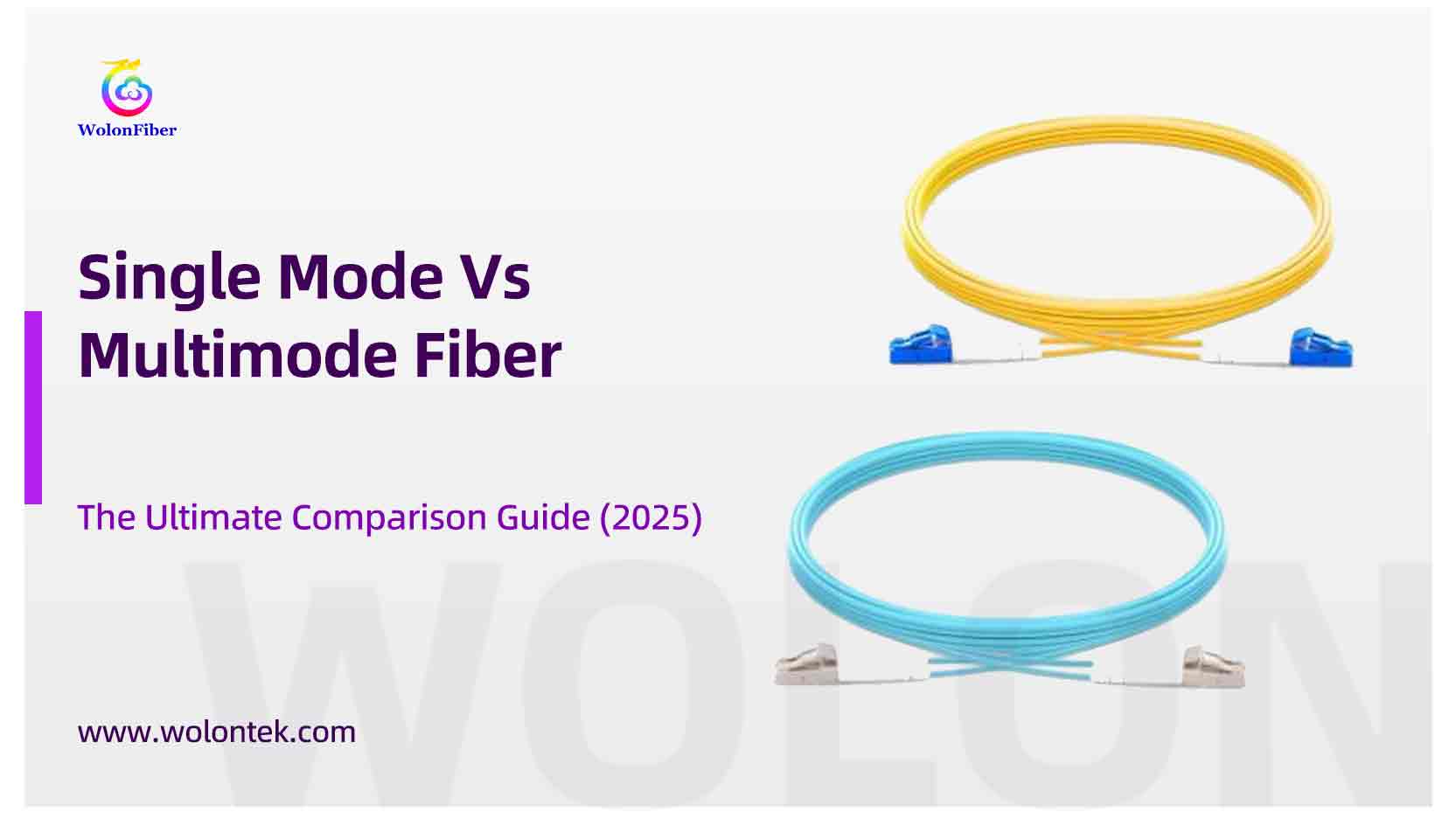
Are you planning a new network infrastructure project but stuck on the cabling specifications? You are not alone.
Choosing the wrong fiber optic cable can be a costly mistake. It can lead to signal loss over long distances or unnecessary overspending on transceivers.
So, what is the real difference between Single Mode vs multimode fiber?
The Quick Answer:
-
Single Mode Fiber (SMF) is best for long-distance transmission (km) and higher bandwidths.
-
Multimode Fiber (MMF) is most cost-effective for short-distance runs (< 550m) within buildings or data centers.
In this guide, we will break down the technical differences—from core diameter to light sources—and help you decide which one fits your project budget.
![Image: Side-by-side comparison illustration of single mode vs multimode fiber structure, clearly showing the core size difference]
What is Single Mode Fiber (SMF)?
Single Mode Fiber (SMF) is designed to carry light directly down the fiber. It has a very small core diameter, typically around 9 µm (microns).
Because the core is so narrow, light travels in a single path (or “mode”). This significantly reduces light reflection, allowing the signal to travel much further without attenuation (loss of signal).
-
Common Standards: OS1, OS2.
-
Jacket Color: Typically Yellow.
-
Best For: Carrier networks, MANs (Metropolitan Area Networks), and PON (Passive Optical Networks).
Pro Tip: If you are connecting buildings that are more than 500 meters apart, Single Mode is usually your only safe option to guarantee speed.
What is Multimode Fiber (MMF)?
Multimode Fiber (MMF) features a much larger core, typically 50 µm or 62.5 µm.
This larger core allows multiple modes of light to propagate at the same time. However, this creates a phenomenon called “modal dispersion,” where light signals spread out and degrade over longer distances. This limits the transmission distance of multimode fiber.
-
Common Standards: OM1, OM2, OM3, OM4, OM5.
-
Jacket Color: Orange (OM1/OM2), Aqua (OM3/OM4), or Lime Green (OM5).
-
Best For: Data centers, CCTV systems, and LAN backbones.

Single Mode vs Multimode Fiber: Key Differences
To make an informed purchasing decision, you need to compare the specs. Here is the breakdown of sm vs mm fiber.
1. Core Diameter
The most physical difference is the core size.
Single Mode: ~9 µm. Small core keeps light focused.
Multimode: 50 µm to 62.5 µm. Large core gathers more light but suffers from dispersion.

2. Light Source & Wavelength
Single Mode: Uses Laser or Laser Diodes. These are powerful and precise but the equipment (transceivers) is more expensive. (Wavelengths: 1310nm, 1550nm).
Multimode: Uses LEDs or VCSELs (Vertical-Cavity Surface-Emitting Lasers). These light sources are cheaper to manufacture. (Wavelengths: 850nm, 1300nm).
3. Bandwidth & Speed
While both can handle 10G, 40G, or even 100G speeds, the distance at which they can sustain that speed varies.
Single Mode: Can support high bandwidths over tens of kilometers.
Multimode: High bandwidth is limited to short distances. For example, OM4 can do 100G but only up to roughly 150 meters.
Comparison Matrix: SM vs MM Fiber
| Feature | Single Mode Fiber (SMF) | Multimode Fiber (MMF) |
|---|---|---|
| Core Diameter | 9 µm (Very Small) | 50 µm / 62.5 µm (Large) |
| Light Source | Laser (High Precision) | LED / VCSEL (Low Cost) |
| Distance | Long Distance (up to 40km+) | Short Distance (up to 550m) |
| Bandwidth | Unlimited (Theoretically) | Limited by Modal Dispersion |
| Jacket Color | Yellow |
Orange (OM1/OM2) Aqua (OM3/OM4) Violet (OM4) |
| Cost Dynamics | Cable is cheap; Electronics (SFP) are expensive. |
Cable is pricey; Electronics are cheap. |
Table: Key differences between Single Mode and Multimode optical fibers.

Cost Analysis: The “System Cost” Reality
Many buyers have a misconception: “Single mode fiber is more expensive.”
This is actually a myth.
If you look at the cable price per meter, Single Mode cable is often cheaper than Multimode (especially high-end OM4/OM5) because the manufacturing process for the larger, graded-index core of multimode fiber is more complex.
However, you must calculate the Total System Cost:
Optics Cost: The SFP/SFP+ modules for Single Mode (using lasers) are significantly more expensive—sometimes 2x or 3x the price of Multimode modules.
The Verdict:
-
For short links (data centers), use Multimode to save money on the transceivers.
-
For long links, use Single Mode because Multimode simply won’t work, regardless of cost.
Beyond Specs: Choosing the Right Manufacturer
When sourcing Fiber optic cables for critical infrastructure, specs are only half the story. The manufacturing quality determines the longevity of your network.
At Wolon, located in China’s “Optics Valley” (Wuhan), we understand that every project has unique demands.
Since our establishment in 2010, we have grown to a team of over 1,000 employees across 3 dedicated factories. Whether you are an ISP in Europe or a contractor in South America, here is why sourcing from a certified manufacturer matters:

1.Quality Assurance (Certifications): Cheap cable jackets crack over time. Ensure your supplier carries international certifications. Our products, for instance, are fully compliant with CE and RoHS standards, ensuring they meet strict safety and environmental regulations for the US and EU markets.
2.Customization (OEM): Do you need a specific cable print, custom color, or armored protection for harsh environments? We provide extensive 3.OEM services to tailor the cable specs specifically to your project needs.
Capacity: With three factories, we handle massive bulk orders for clients in over 80 countries, including Russia, the USA, and Brazil.
Pro Tip: Always ask your supplier for a test report (like an OTDR trace) before shipping to ensure low insertion loss.
![Image: Photo of Wolon factory production line showing quality testing equipment]
Conclusion
Choosing between single mode vs multimode fiber ultimately comes down to two factors: Distance and Budget.
-
Choose Multimode for internal enterprise networks and data centers.
-
Choose Single Mode for inter-building links, campus backbones, and long-haul telecoms.

We will provide a formal quote within 2 hours.
FAQ: Common Questions about Fiber Selection
Q:Can I mix Single Mode and Multimode fiber?
A: No. You cannot connect a Single Mode fiber to a Multimode fiber directly. The core sizes are different (9µm vs 50µm), which causes massive signal loss (up to 99%).
Q: Is Single Mode fiber faster than Multimode?
A: In terms of raw speed capability, both can handle 100Gbps+. However, Single Mode can sustain that speed over much longer distances than Multimode.
Q: Which is better for CCTV security cameras?
A: If the camera is within 300 meters of the switch, Multimode is fine. If it is a perimeter camera located 1km away, you must use Single Mode.