
We often talk about “The Internet” as if it were some invisible cloud floating above us. But let’s get real for a second. If you could see the internet, it wouldn’t look like a cloud. It would look like a massive, complex web of wires buried underground and running through walls.
This physical layer—the actual cable of internet infrastructure—is the backbone of every email sent and every video streamed. Whether you are an ISP contractor or a facility manager, understanding the specific types of cables used in modern telecommunications cabling is the first step to building a network that doesn’t fail when the pressure is on.
For those of us in the industry, the physical layer is where the magic happens. Whether you are an ISP laying backbone or a facility manager wiring a new office, choosing the right cable for the internet connection is the most critical decision you will make. Pick the wrong spec, and you bottleneck your entire network before you even switch it on.
In this deep dive, we are going to break down the three major types of cables used in modern telecommunications cabling: Twisted Pair, Coaxial, and fiber Optic. We will look at the exact specifications, the wiring standards, and why physics dictates which one you should use.
wisted Pair Cables: The LAN Workhorse
If you cut open the blue cable plugged into your PC, this is what you find. A twisted pair network cable is a type of wiring in which two conductors (usually copper) of a single circuit are twisted together.
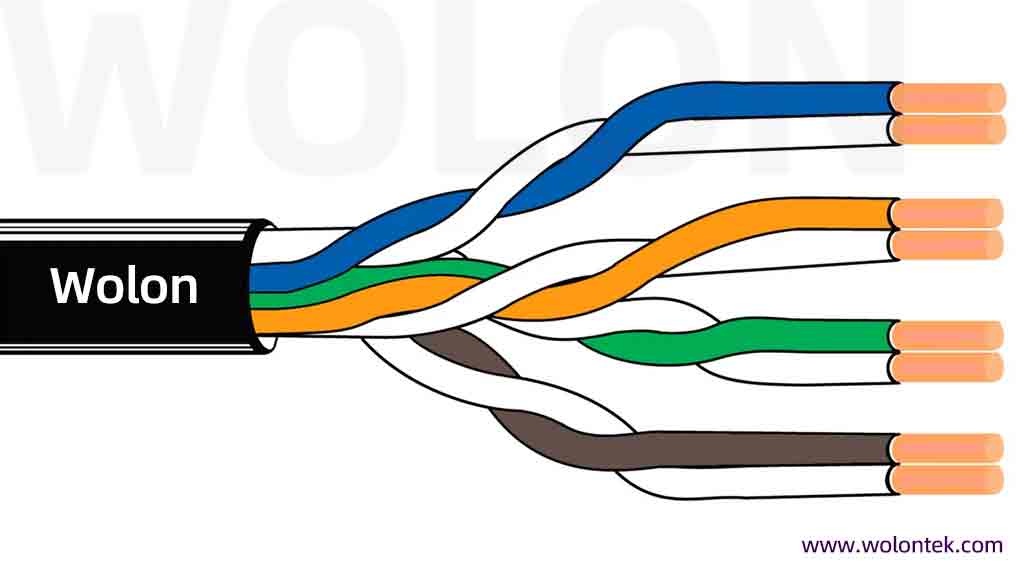
Why do we twist them? (It’s not just for looks) In my years on the production floor, I’ve seen customers ask why they can’t just use straight wires. The answer is interference. By twisting two insulated copper wires together at a certain density, the electric waves radiated by each wire in transmission will be offset by the electric waves emitted from the other wire.
This simple trick of physics effectively reduces the degree of signal interference (Crosstalk). It makes twisted pair the most cost-effective cable of internet access for short and medium-length connections.
The “Cat” List: Twisted Pair Specifications
You can’t source cable without knowing your Categories. According to frequency and signal-to-noise ratio, we divide these cables into “Cats”.
Here is the master list of specifications we refer to when manufacturing. Save this chart for your next project:
| Category | Shielding | Bandwidth (MHz) | Max Speed | Typical Application |
|---|---|---|---|---|
| Cat 3 | UTP | 16 MHz | 10 Mbps | Legacy 10BASE-T (Obsolete) |
| Cat 4 | UTP | 20 MHz | 16 Mbps | Token Ring (Obsolete) |
| Cat 5 | UTP | 100 MHz | 100 Mbps | 100BASE-TX (Replaced by 5e) |
| Cat 5e | UTP | 100 MHz | 1 Gbps | The “Basic” Standard: Gigabit Ethernet |
| Cat 6 | STP / UTP | 250 MHz | 10 Gbps (55m) | Recommended: Enterprise / Home Office |
| Cat 6a | STP | 500 MHz | 10 Gbps (100m) | Data Center Standard: Full 10GBASE-T |
| Cat 7 | STP | 600 MHz | 10 Gbps+ | POTS / CATV / Shielded Labs |
| Cat 8 | STP | 2000 MHz | 40 Gbps (30m) | Top-of-Rack: High-Speed Switch Links |
Table: From Cat3 to Cat8 – Choosing the right cable for your network.
Don’t risk your network’s performance. At Wolon, we manufacture Cat5e, Cat6, Cat6a, and Cat8 cables with 100% pure copper and strict Fluke testing.
Whether you are cabling a small office or a massive data center, our experts can help you choose the perfect spec.
Wiring Standards: T568A vs. T568B
Having the right cable is useless if you terminate it wrong. TIA and EIA refer to T568A and T568B as the two basic wiring standards used by twisted pair network cables. These specify the pin arrangements for the RJ45 connectors.
People often ask me, “What’s the difference?” Honestly, not much electrically. The only difference between T568A and T568B is that the orange and green pairs are interchanged.
-
Pro Tip: Just pick one and stick to it throughout your building. In the US commercial market, T568B is the dominant standard.

Shielding: UTP vs. STP
Another common question we get on the sales line is: “Do I need shielded cable?”
-
UTP (Unshielded Twisted Pair): This cable lacks metallic shielding around the copper wires. It relies purely on the “twist” to minimize interference. It is perfect for indoor telephone applications and office computer networks.
-
STP (Shielded Twisted Pair): Here, the wires are enclosed in a shield that functions as a grounding mechanism. If you are running telecommunications cabling near heavy machinery, elevators, or fluorescent lights, you need STP to provide greater protection from electromagnetic interference.

Coaxial Cable: The RF Specialist
Before fiber took over the ISP world, Coaxial cable was the heavy lifter for the cable of internet delivery (think DOCSIS modems). Even today, it has specific advantages that copper pairs can’t match.
The Geometry of Shielding Coax is built like a tank. It has an inner conductor surrounded by a tubular insulating layer, which is then surrounded by a tubular conducting shield. The key is that the inner conductor and the outer shield share a geometric axis.
Why do engineers still love Coax? In a high-quality coaxial cable, the electromagnetic field carrying the signal exists only in the space between the inner conductor and the outer conducting shield. This is a huge deal. It means coaxial cables are allowed to be installed next to metal objects (like gutters or metal conduits) without the power losses that occur in other types of radio transmission lines. This makes them ideal for feedlines connecting radio transmitters to antennas and distributing cable television signals.

Fiber Optic Cable: The Long-Distance Champion
When you need to move massive amounts of data across a city—or under an ocean—copper simply can’t compete. This is where Optical Fiber Cabling comes in.
Unlike the electrical signals used in copper wires, fiber optic cable uses beams of light to relay data. This gives it two massive advantages that define modern internet infrastructure:
-
High Data Capacity: It supports transmission speeds from 10 Mbps all the way up to 100 Gbps or higher.
-
Distance: Light doesn’t diminish over distance the way electrical signals do, allowing these cables to run for kilometers without signal boosters.
Generally, we manufacture two main types based on core diameter:
-
Single Mode Fiber (SMF): Has a tiny core (9/125µm). It’s designed for long-reach applications (ISP backbones).
-
multimode fiber (MMF): Has a wider core (62.5/125µm or 50/125µm). It’s used for shorter reach, high-speed connections inside data centers.

Conclusion
So, what is the best cable for the internet? The answer is: it depends on where you are installing it.
-
Twisted Pair is your go-to for cost-effective, short-distance LAN connections.
-
Coaxial Cable is the king of RF shielding and antenna connections.
-
Fiber Optic is the undisputed heavy lifter for long-distance, high-bandwidth transmission.
Twisted pair, coaxial cables, and fiber optic cable are the three major network cable types in communication systems. They have different cable structures, speeds, bandwidths, and applications. Understanding these differences is the key to building a network that lasts.
Contact Wolontek today, and let’s discuss the right cabling solution for your environment.

Frequently Asked Questions (FAQ)
Q1: What is the difference between UTP and STP twisted pair cables?
A: The main difference is shielding. UTP (Unshielded Twisted Pair) lacks metallic shielding and relies on the wire twist to reduce interference, making it cost-effective for indoor telephone and computer networks. STP (Shielded Twisted Pair) features a conductive shield that acts as a grounding mechanism, offering greater protection against electromagnetic interference (EMI) in industrial or outdoor environments.
Q2: Which is better for long-distance internet: Fiber Optic or Coaxial Cable?
A: Fiber Optic is superior for long distances. Because it uses beams of light rather than electrical signals, data does not diminish (attenuate) over distance the way it does with copper or coaxial cables. Fiber supports runs measured in kilometers with speeds of 100 Gbps or higher.
Q3: Should I wire my facility with T568A or T568B?
A: Both are recognized telecommunications standards from TIA and EIA. The only physical difference is that the orange and green wire pairs are interchanged. In the US commercial market, T568B is the most common choice. The most important rule is to pick one standard and use it consistently throughout your entire project to avoid connectivity issues.
Q4: Can Coaxial cable be installed next to electrical power lines?
A: Yes, better than other copper cables. In a high-quality coaxial cable, the electromagnetic field exists only between the inner conductor and the outer shield. This design allows it to be installed next to metal objects or conduits without the power losses typical of other radio transmission lines.
Q5: What is the maximum speed of Cat 6 vs. Cat 8 cable?
A: Cat 6 is designed for 250 MHz bandwidth and supports 10 Gbps up to 55 meters. Cat 8 is the highest performance copper standard, supporting 40 Gbps (2000 MHz bandwidth), but it is limited to short distances (30 meters), making it suitable mainly for switch-to-switch connections in data centers.