
Introduction
This article answers one question cleanly: how far will short-reach and long-reach optical transceivers actually carry your signal? I’ll stick to the essentials—standards, typical real-world distances, why the limits exist, and a short buying checklist you can use the moment you walk into a rack room or plan a campus link. (Main phrase used sparingly.)
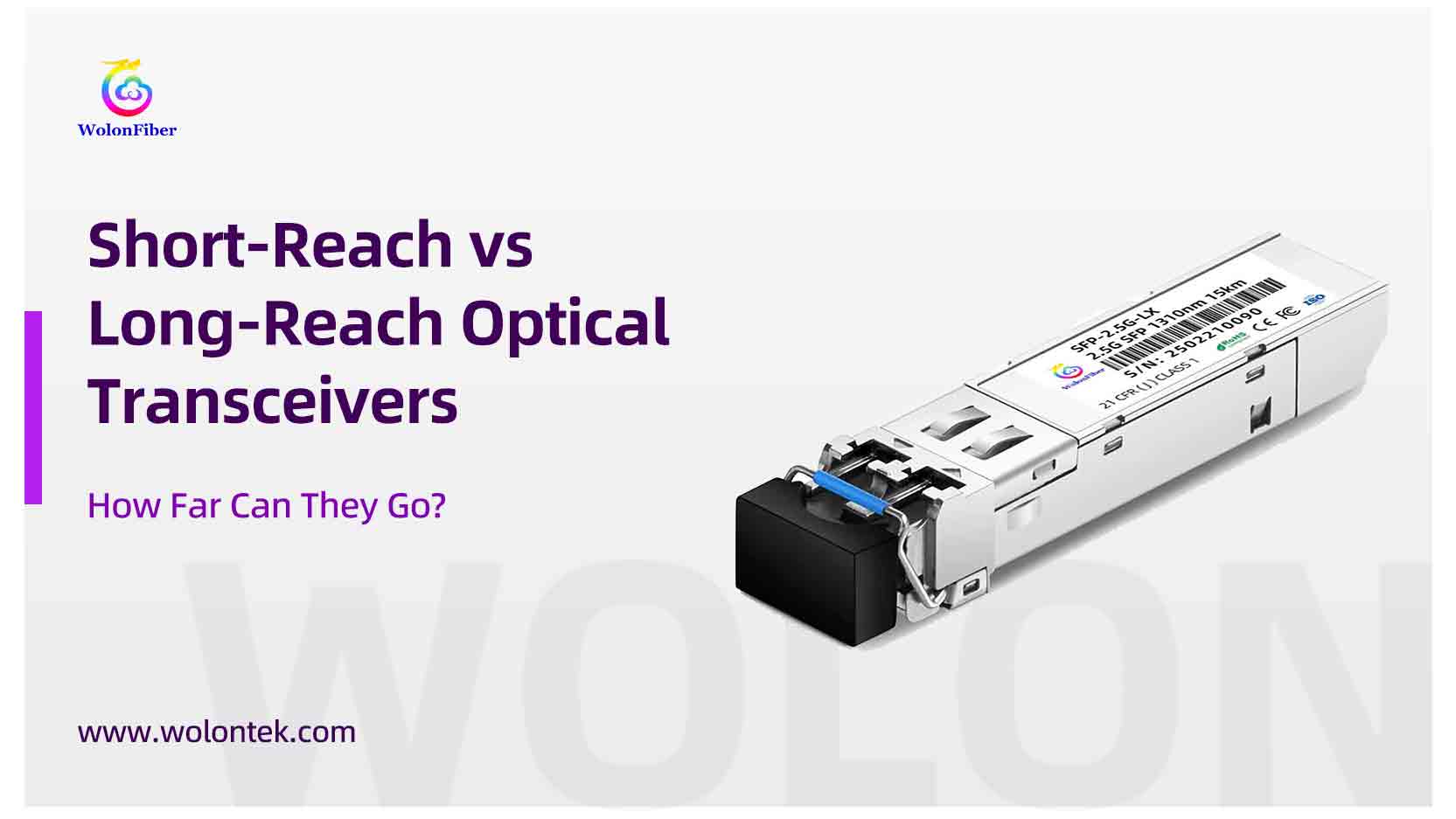
What “reach” means in plain terms
“Reach” is shorthand for a link budget: the optical power your transmitter can send, the sensitivity of the receiver, and the total losses between them (fiber attenuation, connectors, splices, and modal effects in multimode fiber). Standards give a baseline (what interoperable parts should achieve); vendors publish datasheets with the exact lasers, receivers and conservative distances you should expect in practice.
Short-Reach (SR) Optical Transceivers: where it belongs and how far it goes
Short-reach modules are optimized for cost, low power and density. They almost always use 850 nm VCSEL lasers and multimode fiber (MMF), and they’re the default inside racks and across rows of cabinets.
Typical, real-world numbers you’ll see on datasheets and in deployments:
-
10GBASE-SR (SFP+) — commonly specified at ~300 m on OM3 and ~400 m on OM4 for standard 10G SR parts.
-
40GBASE-SR4 (QSFP+) — IEEE SR4 parts commonly reach roughly 100 m on OM3 and 150 m on OM4; “CSR4” (laser-optimized) parts extend that to a few hundred metres on the same fibers.
-
100GBASE-SR4 (QSFP28) — common vendor specs list ~70 m on OM3 and ~100 m on OM4 for SR4 QSFP28 transceivers.
Those distances explain why MMF + SR optics are dominant for short, dense links: cheaper optics and lower system cost for the same short runs.
Long-Reach (LR) Optical Transceivers: when single-mode is the right choice
Long-reach parts use Single-mode fiber (SMF) and longer wavelengths (typically 1310 nm for classic LR, 1550 nm for extended/metro classes). They trade price and power for distance.
A canonical example: 10GBASE-LR is specified to 10 km over standard SMF (G.652)—that’s the interoperable expectation across vendors. For higher classes, FR/ER/DR/ZR and DWDM variants extend reach into tens or hundreds of kilometers when paired with amplification, dispersion compensation or wavelength multiplexing.
Feature Comparison Table
|
Feature |
Short-Reach (SR) |
Long-Reach (LR, ER, ZR) |
|---|---|---|
|
Typical Range |
≤300–400 m (MMF) |
10 km (LR), 40 km (ER), 80 km (ZR) (SMF) |
|
Fiber Type |
Multimode (OM3/OM4/OM5) |
Single-Mode (OS1/OS2) |
|
Wavelength |
850 nm |
1310 nm, 1550 nm |
|
Power Consumption |
~1W |
~2–3W |
|
Applications |
Data centers, server rooms |
Campus, MANs, long-haul |
|
Laser Type |
VCSEL |
DFB/EML |
|
Diagnostic Features |
Few/none |
DDM, FEC, temperature control |
Why the distances differ (the short technical explanation)
Three physical facts explain the gap between SR and LR:
-
Mode structure of the fiber. Multimode fiber carries many spatial modes; those modes arrive at slightly different times (modal dispersion), which spreads pulses and limits distance at high data rates. Single-mode fiber carries one mode and scales to kilometers.
-
Laser type and wavelength. Cheap VCSELs at 850 nm efficiently drive MMF but are not suitable for long SMF spans; LR/ER optics use DFB/EML lasers at 1310/1550 nm with higher launch power and narrower spectra.
-
Link budget and component design. LR modules have stronger transmit power and/or more sensitive receivers; SR modules rely on low losses and laser-optimized multimode fiber to do their job.
Practical rules of thumb (what to check before buying)
-
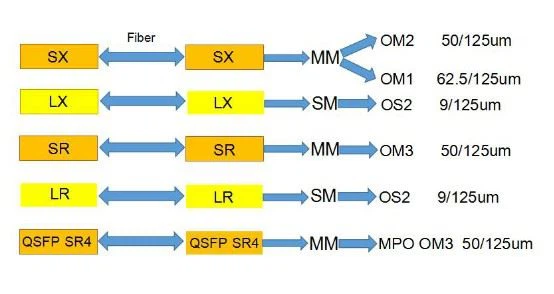
Identify the fiber you have. Know whether your plant is OM1/OM2/OM3/OM4 (MMF) or OS1/OS2 (SMF). OM3/OM4 are laser-optimized for VCSELs and are the sensible default for modern data centers.
-
Short runs inside rooms → SR + MMF. If the cabling is inside the hall or between adjacent cabinets, SR optics on OM3/OM4 usually win on cost.
-
Building crosses and metro spans → SMF + LR. Anything that crosses buildings, manholes or long campus routes should default to single-mode + LR optics for margin and future flexibility.
-
Plan for upgrades. If you expect 40/100G now or soon, install OM4 or an MPO backbone so you don’t re-cable later. Vendor migration guides and TIA/IEEE recommendations help on this point.
Operational pitfalls that bite teams in the field
Assuming labels are universal. “SR” or “LR” cover a range of parts—always check the vendor datasheet for the exact fiber grade and distance.
Parallel optics demand correct MPO/MTP polarity. SR4 and other parallel formats require matched ribbon fiber and correct polarity; a bad harness can make a perfectly good transceiver fail.
Dirty or poorly seated connectors, tight bends and aging cable reduce margin. Always allow extra link budget beyond the nominal spec.
Summary Table: Reach Capabilities for Short-Reach & Long-Reach Transceivers
I recommend you understand the reach capabilities of major Transceiver types before planning your network. Here’s a detailed comparison table. It shows typical supported distances, matched fiber types, wavelengths, and main applications for the most common short-reach and long-reach models:
|
Transceiver Model |
Range Designation |
Fiber Type |
Wavelength (nm) |
Max Distance |
Typical Use Case |
|---|---|---|---|---|---|
|
SR (Short Range) |
MMF (OM3/OM4) |
850 |
300m (OM3), 400m (OM4) |
Short-haul inside buildings, rack-to-rack in data centers |
|
|
SFP-10G-LRM |
LRM (Long MMF) |
MMF (OM1–OM4) |
1310 |
33m (OM1/OM2), 220m (OM3/OM4) |
Upgrades for legacy MMF, where MMF is already deployed |
|
SFP-10G-LR |
LR (Long Range) |
SMF (OS2) |
1310 |
10km |
Campus interconnects, enterprise, city networks |
|
SFP-10G-ER |
ER (Extended Range) |
SMF |
1550 |
40km |
Long building-to-building, metro or regional fiber |
|
SFP-10G-ZR |
ZR (Extra Long) |
SMF |
1550 |
80km |
Regional/telecom long-haul, WAN backbone |
|
QSFP-40G-SR |
SR (Short Range) |
MMF (OM3/OM4/OM5) |
850 |
30m (OM3), 50m (OM4/OM5) |
Dense 40G server racks, short high-speed runs |
|
QSFP-40G-LR |
LR (Long Range) |
SMF (OS2) |
1310 |
10km |
40G metro, large backbone, data center campus |
|
40GBase-ER4 |
ER (Extended Range) |
SMF |
1550 |
30km |
Metro, long-haul 40G transport |
|
100GBase-ER4L |
ER (Extended Range) |
SMF |
1295–1310 |
40km |
100G backbone, WAN environments |
|
100GBase-ZR4 |
ZR (Extra Range) |
SMF |
1310–1550 |
80km |
Ultra-long 100G enterprise or carrier-grade links |
|
100GBase SL-DR |
Short Distance Direct |
SMF |
1310 |
500m |
High-capacity direct links for aggregation/local DCI |
|
100GBase SL-FR |
Short Distance Ext. |
SMF |
1310 |
2km |
Medium-length 100G fiber for campus or small-metro |
WOLON optical transceiver series (product footer / promotional blurb)
WOLON’s transceiver lineup covers both ends of the distance spectrum. For dense data-center connections, WOLON’s 850 nm short-reach modules deliver reliable 10/40/100G links on OM3/OM4 with tight quality control and DOM reporting.
For campus and metro requirements, WOLON’s single-mode LR and DWDM offerings meet standard reach classes (10 km and beyond) and include compatibility matrices and sample testing so you can match optics to fiber plants with confidence.
Contact WOLON for datasheets, DOM/diagnostic support and compatibility checks tailored to your network.