Introduction
Picking the right pluggable transceiver form factor is one of the first technical and cost decisions network designers face. This guide compares SFP, SFP+, SFP28 and QSFP across performance, density, power, reach and cost so you can match technology to real use cases (access, aggregation, spine-leaf, campus and long-haul). I keep the focus strictly on the title topic and provide practical takeaways for selecting the best form factor for your deployment.
At-a-glance comparison
-
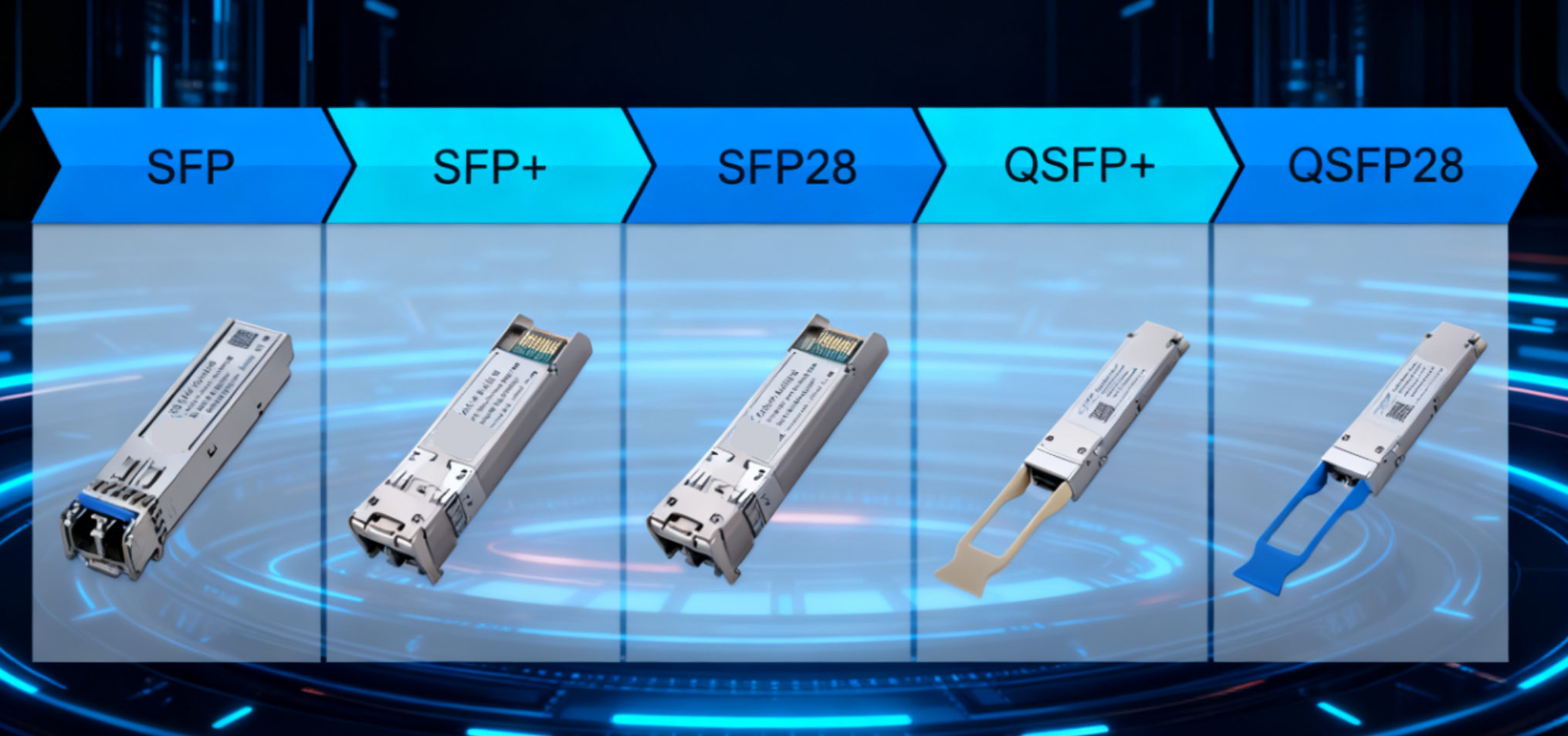
SFP — typically used for 1G (legacy/industrial/edge) with long-reach single-mode and short-reach multimode options.
-
SFP+ — designed for 10G Ethernet and Fibre Channel; common, low-power option for access and aggregation.
-
SFP28 — same small SFP footprint but at 25G per lane; ideal for server links and top-of-rack uplinks.
-
QSFP (family) — a quad form factor (4 lanes) that scales from 40G (QSFP+) to 100G (QSFP28) and beyond, used in high-density data-center spine switches.
Typical Applications Table
|
Form Factor |
Data Rate |
Lanes |
Typical Use |
Power |
|
|---|---|---|---|---|---|
|
SFP |
up to 4.25 Gbps |
1 |
1G/4G Ethernet, FC |
LC Duplex |
~1W |
|
SFP+ |
up to 10 Gbps |
1 |
10G Ethernet, FC |
LC Duplex |
~1.5W |
|
SFP28 |
up to 25 Gbps |
1 |
25G Ethernet, 5G fronthaul |
LC Duplex |
1.5–2W |
|
40 Gbps (4x10G) |
4 |
40G Ethernet, high-density core |
MPO/LC |
~3.5W |
|
|
QSFP28 |
100 Gbps(4x25G) |
4 |
100G Ethernet, cloud data center |
MPO/LC |
3.5–4W |
What each form factor actually means — technical essentials
SFP (Small Form-Factor Pluggable)
SFP modules are the longstanding, compact transceivers used for 100BASE and 1000BASE applications and for various optical reach options (SR, LR, ER, ZR). They are low-cost, widely compatible and ideal where throughput needs are modest: campus access, small aggregation points and industrial equipment. Typical manufacturer datasheets list 1.25 Gbit/s (1G) as the common Ethernet use case, with optical variants optimized for distances from tens of meters to tens of kilometers.
When to pick SFP: budget-constrained edge ports, legacy devices, or where single-gigabit links suffice.
SFP+ (Enhanced SFP) — 10G workhorse
SFP+ keeps the same mechanical size as SFP but supports higher-speed electrical interfaces and 10 Gbit/s Ethernet. The SFF committee specifications formalize the electrical/management interface for 10G operation; SFP+ modules are hot-pluggable and widely supported by commodity switches and NICs. They are often the first upgrade from 1G SFP when higher bandwidth is needed without changing chassis density.
When to pick SFP+: 10G server access, ToR uplinks in smaller racks, and growth paths from 1G to 10G.
SFP28 — 25G in the same small package
SFP28 leverages the SFP form factor but uses a faster PHY to deliver 25 Gbit/s. It’s commonly used for direct server NIC links (25G Ethernet) and for leaf switch uplinks where higher per-port bandwidth is required while preserving high port density. SFP28 is backward-compatible at the electrical level with 10G SFP+ in many cases (operating at reduced speed), which eases migration.
When to pick SFP28: high-performance server connections, leaf uplinks in modern data centers, and cases where port density must remain high.
QSFP (Quad SFP family) — scale with lanes
QSFP form factors carry four electrical lanes inside a single larger cage. Historically QSFP+ provided 4×10G = 40G, while QSFP28 offers 4×25G = 100G. Later members (QSFP56, QSFP-DD) push lane rates and lane counts further. QSFP modules trade off a larger physical footprint for very high aggregate bandwidth per cage—perfect for spine switches and dense aggregation fabrics.
When to pick QSFP: spine links, high-capacity aggregation, and situations where you need 40G/100G (or higher) from a single port.
|
Form Factor |
Max Speed |
Lanes |
Typical Connector |
Typical Use Case |
Backwards Compatibility |
|---|---|---|---|---|---|
|
SFP |
1.25 Gbps |
1 |
LC/RJ45 |
Legacy access |
SFP |
|
SFP+ |
10 Gbps |
1 |
LC/RJ45 |
10G core, aggregation |
SFP+ |
|
SFP28 |
25 Gbps |
1 |
LC |
25G access, 100G aggregation |
SFP+/SFP (lower speed) |
|
QSFP+ |
40 Gbps |
4 x 10 G |
MPO/LC |
40G spine, 4x10G breakout |
QSFP+ (via adapters) |
|
QSFP28 |
100 Gbps |
4 x 25 G |
MPO/LC |
100G core, 4x25G breakout |
QSFP+, 40G |
Comparison by key criteria
1. Bandwidth per port
-
SFP: commonly 1G (legacy) but spec sheets show up to ~4.25G in some specialized parts — still principally used for 1G today.
-
SFP+: 10G.
-
SFP28: 25G.
-
QSFP: 40G (QSFP+) and 100G (QSFP28) are the widespread options; higher QSFP variants exist for 200G and up.
2. Port density and chassis economics
SFP/SFP+/SFP28 keep the smallest footprint per lane; QSFP provides higher aggregate bandwidth per cage—fewer cages for the same aggregate throughput but larger single-port cost. For rack/tile design, SFP28 gives the best compromise when you need lots of 25G server links; QSFP is better when switching fabric needs fewer, very high-capacity ports.
Detailed Form Factor Dimensions
-
SFP, SFP+, SFP28:
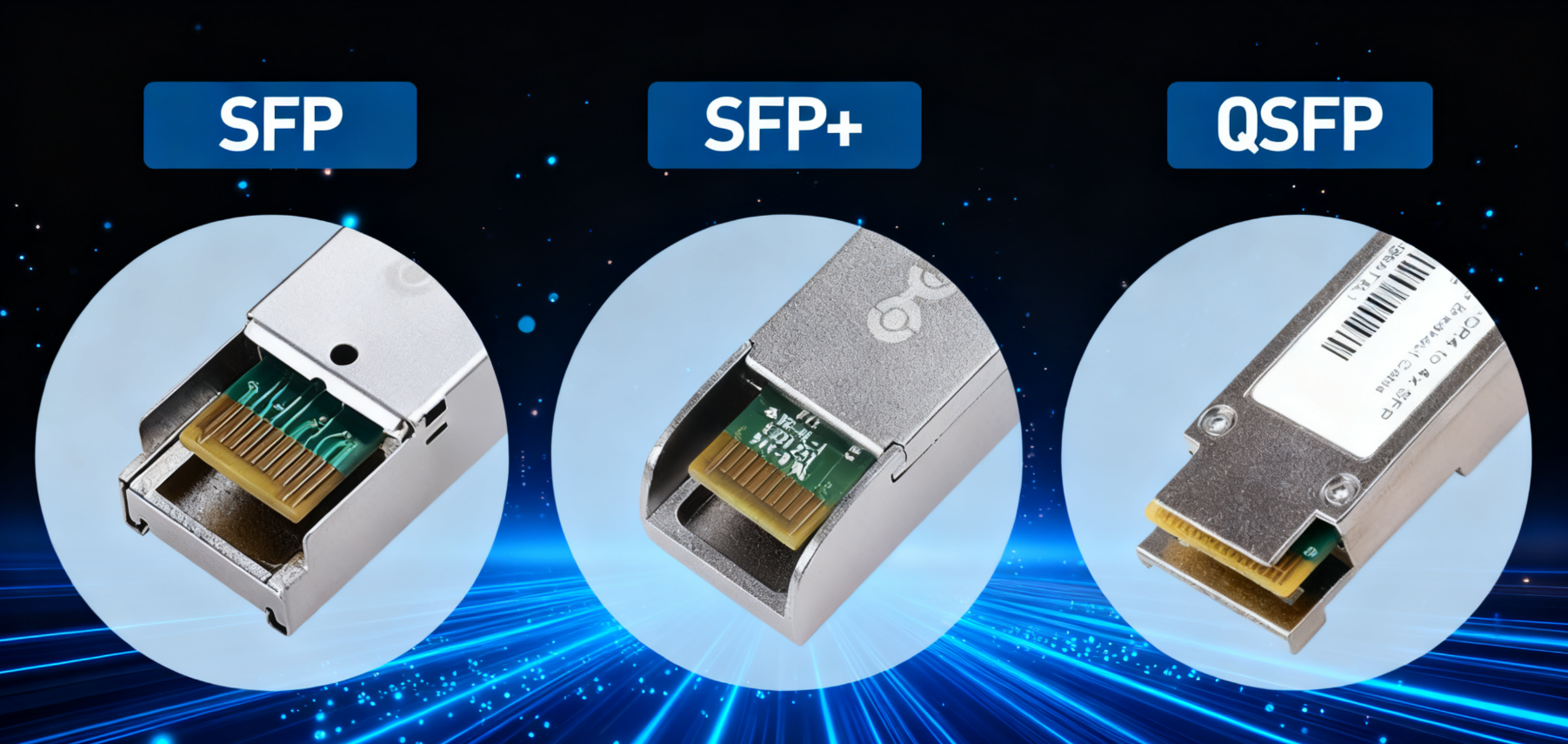
These three modules share the same compact size—13.4 mm (width) × 56 mm (length) × 8.5 mm (height). SFP28 delivers single-lane 25Gbps. In terms of size, it’s identical to SFP/SFP+. -
QSFP+, QSFP28:
Both use a larger size—18.35 mm (width) × 72 mm (length) × 8.5 mm (height). This size allows quad-lane operation. QSFP+ handles 40Gbps (4×10G). QSFP28 handles 100Gbps (4×25G). -
QSFP-DD:
The outer dimensions match QSFP28. But the depth increases to fit eight electrical lanes. This design supports up to 400Gbps per module.
3. Power consumption
Higher lane rates typically increase module power. SFP modules (1G) consume the least; SFP+ and SFP28 are efficient for their speeds; QSFPs can consume more per port but deliver much higher aggregate throughput. Exact power varies by part/vendor and line rate (e.g., LR vs ZR optics). Check vendor datasheets for watt figures when designing cooling and power budgets.
4. Reach and optics variety
All form factors support a wide selection of optics (SR, LR, ER, ZR, CWDM/DWDM, BiDi). Reach depends on the optical standard (e.g., 25GBASE-LR vs 100G-LR4) rather than the cage itself — so pick optics by distance and fiber type, not only form factor.
5. Interoperability & migration
SFP28 ports often accept 10G SFP+ optics at reduced speed, easing migration. QSFP cages sometimes support breakout cables (e.g., QSFP28 → 4×25G SFP28) for flexible use. Always verify switch/NIC vendor compatibility and firmware compatibility matrices before mixing third-party optics.
Backward Compatibility Summary Table
|
Host Port Type |
SFP |
SFP+ |
SFP28 |
QSFP+ |
QSFP28 |
|---|---|---|---|---|---|
|
SFP |
Yes |
No |
No |
No |
No |
|
SFP+ |
Yes |
Yes |
No* |
No |
No |
|
SFP28 |
Yes |
Yes |
Yes |
No |
No |
|
QSFP+ (40G) |
No |
No |
No |
Yes |
No* |
|
QSFP28 (100G) |
No |
No |
No |
Yes |
Yes |
** Certain dual-rate SFP28 modules may run at 10G in SFP+ ports.
6. Cost
Per-port cost rises with speed and complexity: SFP (1G) is cheapest, SFP+ is modest, SFP28 higher, QSFP modules and optics (especially Coherent or DWDM types) command premium prices. However, QSFP can reduce total cost-per-Gb by aggregating lanes—so evaluate cost per Gbit, not only per module.
Summary Table: Cost Optimization
|
Form Factor |
Typical Use Case |
Unit Cost |
Scale Efficiency |
Best For |
|---|---|---|---|---|
|
SFP |
Entry, legacy, access |
$17–$20 |
Low (not scalable) |
Small/legacy deployments |
|
SFP+ |
10G access/aggregation |
$44–$51 |
Medium |
Incremental 10G upgrades |
|
SFP28 |
25G/5G upgrades |
$17–$20 |
High (per-port $/Gbps) |
Server/5G edge, low TCO |
|
QSFP+ |
40G high-density |
$375–$436 |
High |
Datacenter core/spine |
|
QSFP28 |
100G scale/core |
$38–$233 |
Highest |
High-performance, cloud/DC |
How to Choose the Right Form Factor: SFP, SFP+, SFP28, QSFP+/QSFP28
Choosing the right optical transceiver starts with seven factors: bandwidth, port density, power, reach, connector type, cost, and scalability. Use this quick guide to match form factor to role—access, aggregation, or core—and future-proof your network without overspending.
Quick decision checklist
-
Bandwidth needs: 1G–4G → SFP; 10G/16G → SFP+; 25G → SFP28; 40G/100G+ → QSFP+/QSFP28.
-
Port density: Need many small ports? Choose SFP/SFP28. Need very high throughput per slot? Choose QSFP28.
-
Power: SFP-family modules consume <~1.5W; QSFP-class consumes more but reduces chassis count and cabling complexity.
-
Distance & optics: Select LR/ER/coherent variants by reach (tens of km to 80+ km).
-
Connectors & cabling: LC duplex for SFP-family; MPO/MTP or breakout for QSFP-family.
-
Compatibility & cost: SFP28 and SFP+ are interoperable at 10G; QSFP28 supports multi-rate operation and breakout (e.g., 1×100G or 4×25G).
-
Scalability: Prefer multi-rate QSFP ports in spine/core for flexible upgrades and breakout options.
Summary Table—Best Use Cases by Form Factor
|
Form Factor |
Key Use Cases |
Max Data Rate |
Max Reach |
Example Scenario |
|---|---|---|---|---|
|
SFP |
Legacy networks, industrial IoT, long-distance |
1 Gbps |
120 km (SMF) |
Remote monitoring, legacy switch upgrades |
|
SFP+ |
10G Ethernet, SAN, data center edge, video |
10 Gbps |
10/80 km |
Enterprise server uplinks, storage |
|
SFP28 |
25G Ethernet, cloud, 5G fronthaul, high port den. |
25 Gbps |
10/40 km |
Cloud data center ToR switches, mobile fronthaul |
|
QSFP+ |
40G aggregation, spine-leaf, HPC |
40 Gbps |
10 km/100 m |
Data center backbones, cluster interconnect |
|
QSFP28 |
100G core, AI/ML clusters, 5G core, hyperscale |
100 Gbps |
40/80 km |
Core switch aggregation, AI infrastructure |
-
Port Density: SFP28 offers maximum physical port count. QSFP28 maximizes bandwidth per port for high-speed core builds.
-
Upgrade Path: Based on my experience, SFP/SFP+ support cost-efficient, incremental upgrades. QSFP+/QSFP28 are built for rapid scaling in data-heavy and cloud environments.
If you need:
– Legacy reach and low speed: I suggest choosing SFP.
– Affordable, easy-to-scale 10–25G upgrades: Go for SFP+/SFP28.
– Hyperscale speed, high-density core/AI/ML: Select QSFP28.
Optical Module Comparison Table
|
Feature |
SFP |
SFP+ |
SFP28 |
QSFP |
QSFP28 |
|---|---|---|---|---|---|
|
Max Data Rate |
Up to 4.25 Gbps |
Up to 10 Gbps |
Up to 25 Gbps |
Up to 40 Gbps (4x10G) |
Up to 100 Gbps (4x25G or 1x100G) |
|
Physical Size |
Compact (SFP) |
Same as SFP |
Same as SFP+ |
Larger quad module (1.5x SFP+) |
Same as QSFP |
|
Channel Lanes |
1 |
1 |
1 |
4 (4x10G) |
4 (4x25G) |
|
Connector |
LC Duplex |
LC Duplex |
LC Duplex |
MPO (SR4) / LC (LR4) |
MPO (SR4), LC (LR4/CWDM4) |
|
Wavelength(s) |
850nm, 1310nm, 1550nm |
Same as SFP |
Same as SFP+ |
850nm (SR4), 1310nm (LR4) |
850nm (SR4), 1310nm (LR4), CWDM4 |
|
Typical Distance |
550m (SR), 10km (LR) |
300m (SR), 10km (LR), |
100m (SR), 10km (LR), |
100m (SR4), 10km (LR4) |
100m (SR4), 10km (LR4), 40km (ER4) |
|
40km (ER) |
40km (ER) |
40km (ER) |
|||
|
Power Consumption |
~1W |
~1.5W |
1.5–2W |
~3.5W |
3.5–4W |
|
Ethernet Application |
1GbE |
10GbE |
25GbE |
40GbE |
100GbE |
|
Fibre Channel |
4G |
8G/16G |
32G |
— |
— |
|
Standard |
IEEE 802.3, SFF-8472 |
IEEE 802.3ae, SFF-8431 |
IEEE 802.3by |
IEEE 802.3ba |
IEEE 802.3bm |
|
Backward Compatibility |
No |
SFP slot (at 1G) |
SFP+ slot (at 10G) |
No |
QSFP slot (at 40G) |
|
Example Use |
Legacy/access switches |
Datacenter core/SAN |
25G, 5G fronthaul/edge |
Aggregation/backbone |
Core aggregation, cloud, AI/ML |
Final recommendation
For edge and legacy deployments pick SFP. For an economical 10G upgrade, pick SFP+. If you need modern server-side bandwidth with maximum port density, choose SFP28. If you need aggregated high bandwidth for spine/aggregation use cases, go QSFP (QSFP28/100G or higher). Use breakout cables and backward compatibility features to smooth migrations between generations.
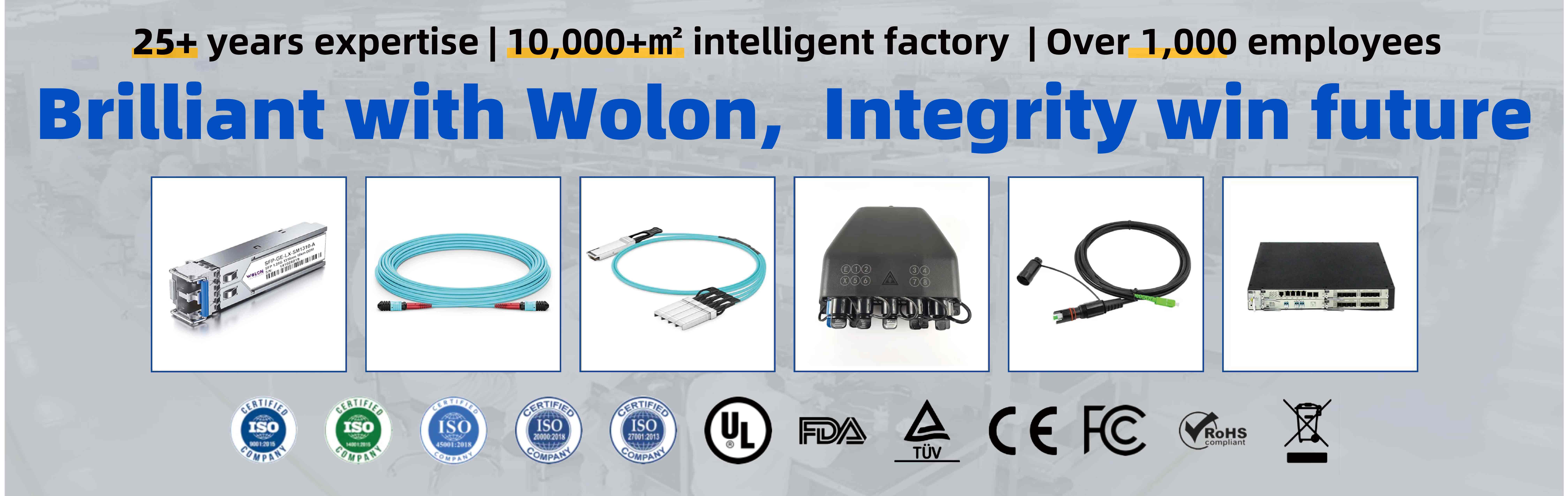
WOLON manufactures a full line of compatible SFP, SFP+, SFP28 and QSFP optical transceivers and DAC/AOC assemblies. Our modules are factory-tested for reliability, compliant with MSA electrical/optical profiles, and priced to give you the best total cost of ownership on upgrades and large deployments. Whether you’re refreshing ToR servers with 25G SFP28 or scaling fabrics with QSFP28 100G, WOLON delivers quality optics at competitive prices — Contact Wolon for volume quotes and compatibility guidance.