
Introduction
Choosing between “10G SFP” and 10G SFP+ still trips up engineers and buyers in 2025 because the two form factors look identical at a glance but behave differently electrically, operationally, and in system compatibility. This guide cuts to the chase: precise technical contrasts, real-world implications, and migration advice so you can design or upgrade a network with confidence.
What each name actually means
SFP (Small Form-factor Pluggable): originally defined for Gigabit Ethernet and Fibre Channel (100 Mbps–1.25 Gbps typical). Generic SFP mechanical dimensions are widely used, but the original SFP electrical and firmware expectations were not intended for sustained 10 Gbit/s operation.
SFP+ (Enhanced SFP): an MSA-driven enhancement whose electrical interface and timing were specified to support 10 Gbit/s and adjacent high-speed protocols (SFF-8431 et al.). SFP+ preserves the same mechanical footprint as SFP but adds a high-speed electrical lane and tighter signal/power tolerances.

WOLON SFP MODULE
ore technical differences
Electrical interface and supported data rate
SFP modules and hosts were designed around 1G-class electrical parameters; they do not guarantee reliable 10G performance. In contrast, SFP+ explicitly defines the 10 Gbit/s electrical lane and transmitter/receiver timing used by 10G Ethernet and Fibre Channel. This is the single biggest technical divide.
Standards and specifications
SFP+: SFF-8431 (high-speed electrical specs) plus IEEE 802.3ae (10GBASE) for 10G optics. vendors reference these standards for SFP+ modules and host slot designs. SFP modules follow older SFFs oriented to 1G interfaces.
Power and thermal behavior
Because SFP+ carries higher-speed signalling, its modules (and host PHYs) are engineered for the different power envelope and thermal dissipation of 10G transceivers. Practical module power figures vary by vendor and type (optical vs. copper), but vendor datasheets (e.g., 10GBASE-T SFP+ modules) list typical consumption numbers and link budgets—important when planning dense switch/port deployments.
Signal integrity and lane conditioning
SFP+ ports/hosts often include equalization and lane conditioning suitable for 10G links (for example to support longer DACs or certain copper PHYs). A plain SFP host lacks those high-speed conditioning characteristics. That’s why even though the mechanical shell is the same, the host electronics determine whether a 10G module will work.
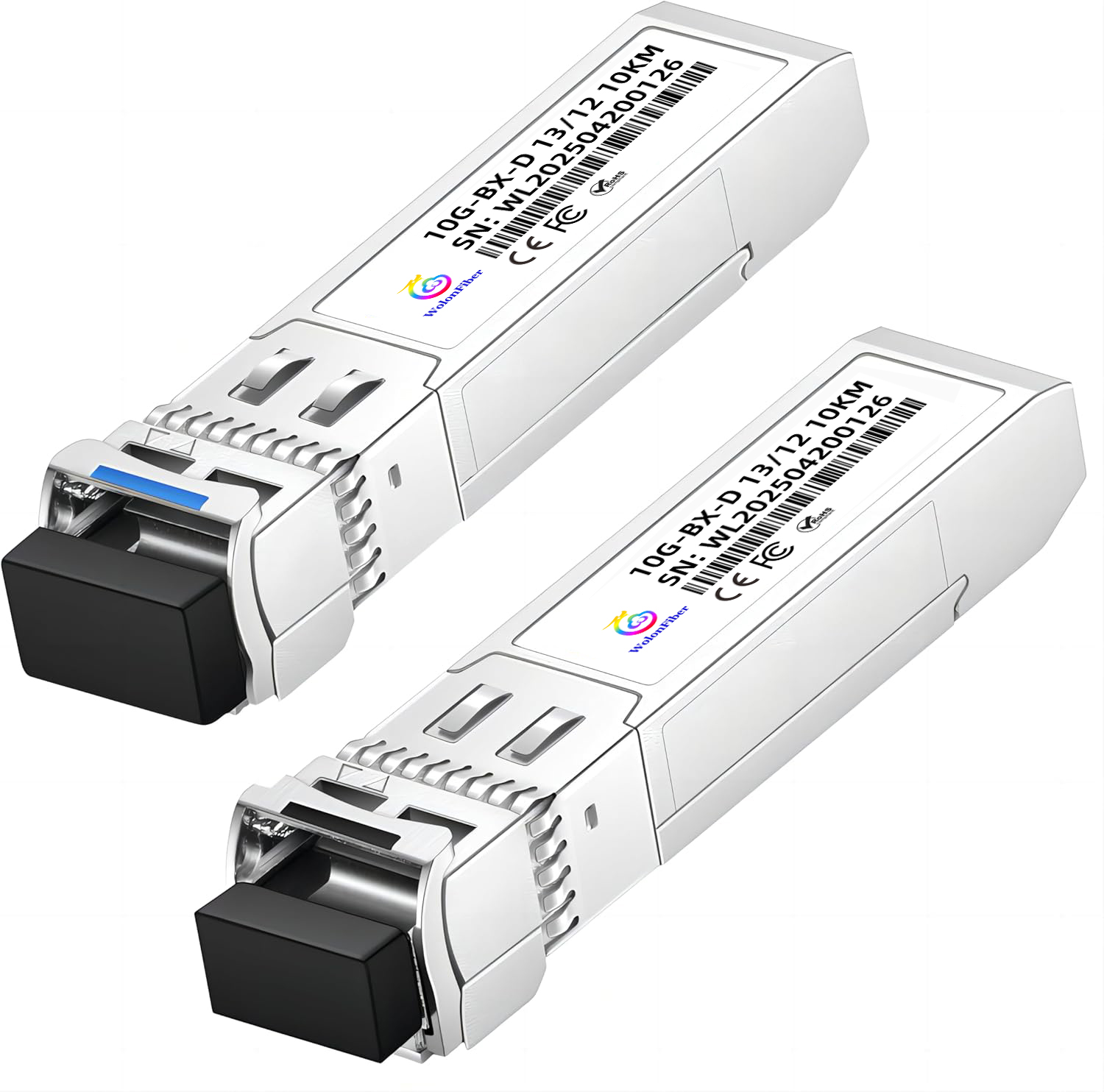
Mechanical form factor vs. electrical reality
Mechanically, SFP and SFP+ are identical (same cage and pluggable size). This visual parity causes confusion: a 10G SFP+ module will physically fit an SFP slot on some devices, but fitting does not equal functioning at 10G — the host must support the electrical signalling and PHY for 10G. Conversely, many SFP+ ports are backward-compatible with 1G SFP modules and will operate at reduced speed if the host ASIC supports auto-negotiation. Always confirm switch/router vendor compatibility lists before mixing modules.
Optics, copper transceivers and cables: what changes at 10G
-
optical transceivers (SR/LR/ER): At 10G, common optics are 10GBASE-SR (multimode), 10GBASE-LR (singlemode), and variants. These are available in the SFP+ electrical/mechanical package and follow IEEE optical budgets and wavelengths; SFP legacy optics were not specified for 10G link budgets.
-
Direct Attach Copper (DAC) and AOC: SFP+ supports passive and active DACs/AOCs for short-range (often up to 7–10 m for passive) and longer ranges for active/AOC. Passive DACs have minimal electronics and lower power; active DACs/AOCs include signal conditioning to extend reach. Using DACs relies on the host’s SFP+ PHY behavior — SFP hosts designed for 1G will not run a 10G DAC link.
Compatibility rules and practical checks
-
SFP+ port → SFP Module: commonly allowed; the SFP+ port can operate at 1G with a legacy SFP inserted, but check switch vendor docs.
-
SFP port → sfp+ module (10G): generally not supported. A port designed for SFP electrical parameters cannot host the high-speed lane required for 10G modules. Attempting this will either fail or force the link to an unsupported state.
-
Vendor lock-in / firmware: some vendors restrict optics by vendor OUI or EEPROM signatures; always consult the platform compatibility matrix or enable allowed-module settings where available.
When to pick SFP+ vs. when legacy SFP is enough
Choose SFP+ when you need true 10 Gbit/s capacity, plan to use 10GBASE optics/DACs, or expect higher per-port throughput for servers/storage. SFP+ is the industry standard for 10G links.
Choose SFP (1G) when your topology and traffic demands are firmly in the 1G realm and you want maximum compatibility with older infrastructure. Do not try to force a 10G SFP+ transceiver into an SFP-only host expecting 10G performance.
Summary
Mechanically identical but electrically different: SFP+ is the correct, standards-backed choice for 10G. SFP is for 1G-class applications. Many SFP+ ports accept SFP modules for 1G backward compatibility, but you cannot rely on an SFP port to host a 10G SFP+ transceiver. Plan around the host ASIC and the module electrical spec, not the shell.
