Choosing the right 100G building block is a strategic decision that affects port density, power budgets, cabling topology, upgrade paths and long-term TCO. Two competing approaches — the established QSFP28 (4×25G lanes in one cage) and the newer SFP112 (single-lane 100G in an SFP-sized package) — each bring distinct trade-offs. This guide explains the technical differences, practical implications for 100G→400G migration, and an actionable checklist so you can pick the option that fits your network goals.
what are QSFP28 and SFP112?
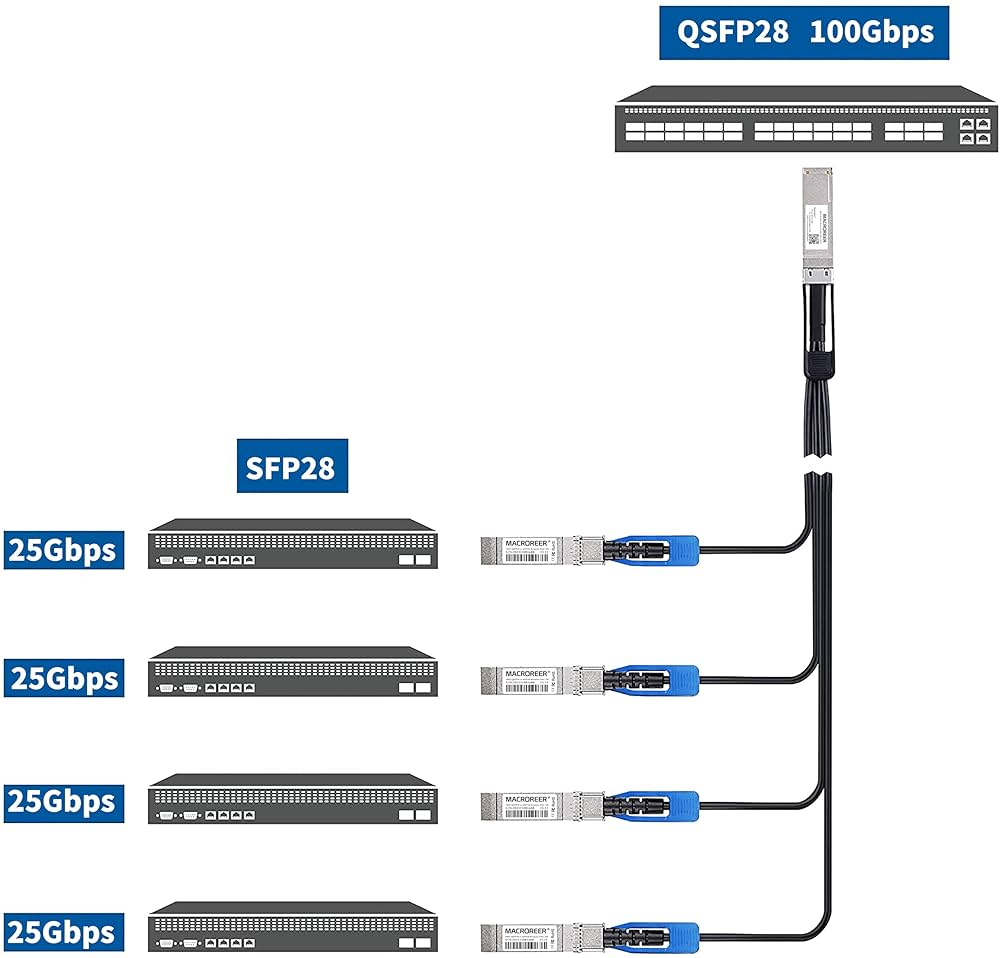
QSFP28 is a mature 100G form factor that implements 100Gb/s by aggregating four 25Gb/s electrical lanes (4×25G). Its breakout heritage (100G ↔ 4×25G) makes it extremely flexible for mixed-speed topologies and for incremental migration strategies.
SFP112 is an SFP-sized 100G module standardized to carry a full 100Gb/s link inside the small SFP package—often using PAM4 modulation and advanced DSPs to fit the bandwidth into a single electrical lane. SFP112 is explicitly designed to increase 100G port density where chassis faceplate real estate is the binding constraint.
Port density and physical footprint
If chassis faceplate real estate is your primary constraint, SFP112 can deliver more 100G ports per RU because it reclaims the SFP slot for full 100G use. This allows network designers to increase raw port counts without moving to larger chassis. However, “density” is only part of the economics: switch costs, optics pricing, cooling and cabling must be modeled together to estimate cost per usable 100G port. Independent comparisons show that SFP112 is a density play, while QSFP28 yields density through breakout cables and well-known DAC/AOC ecosystems.

Power, complexity and thermal tradeoffs
SFP112 modules commonly rely on integrated DSPs and PAM4 signaling to hit 100G within a small envelope. Those DSPs enable excellent spectral efficiency but add silicon complexity and power draw compared with simpler NRZ/25G lane QSFP28 optics. For extremely dense deployments, per-port power differential can translate to substantial cooling and operational cost differences — it’s wise to run lab power measurements on candidate optics rather than rely only on datasheet numbers.
Flexibility and breakout behavior
QSFP28’s breakout capability remains one of its strongest practical advantages. A single QSFP28 port can break out to 4×25G (SFP28) with a passive/active breakout cable or use 100G single-lambda QSFP optics that ease migration to higher speeds later. That flexibility simplifies heterogeneous speed topologies (25G leafs, 100G spines) and reduces the number of distinct module types you must stock. SFP112, being a single-lane 100G device in an SFP shell, does not naturally provide a straightforward 4×25G breakout path — so if you expect frequent breakout usage, QSFP28 keeps a simpler operational model.
Optical reach and transceiver variants
Both form factors already support a broad set of optical classes (SR, LR/DR, ER) and can be offered as multimode or single-mode variants. The technical details differ between vendors: some SFP112 parts deliver single-wavelength 100G over duplex LC, while QSFP28 variants use multi-lane or LAN-WDM schemes for LR/DR optics. Always validate vendor link-budget tables and perform an OTDR/power-meter test during commissioning — real fiber plant characteristics matter more than theoretical maxima.
The 400G migration angle
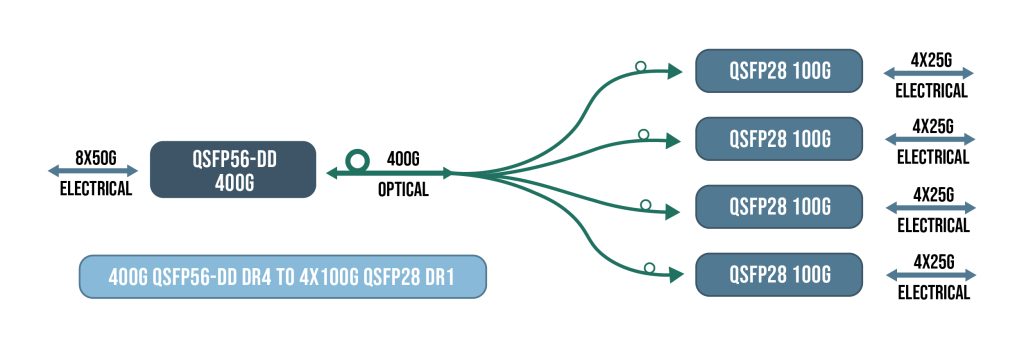
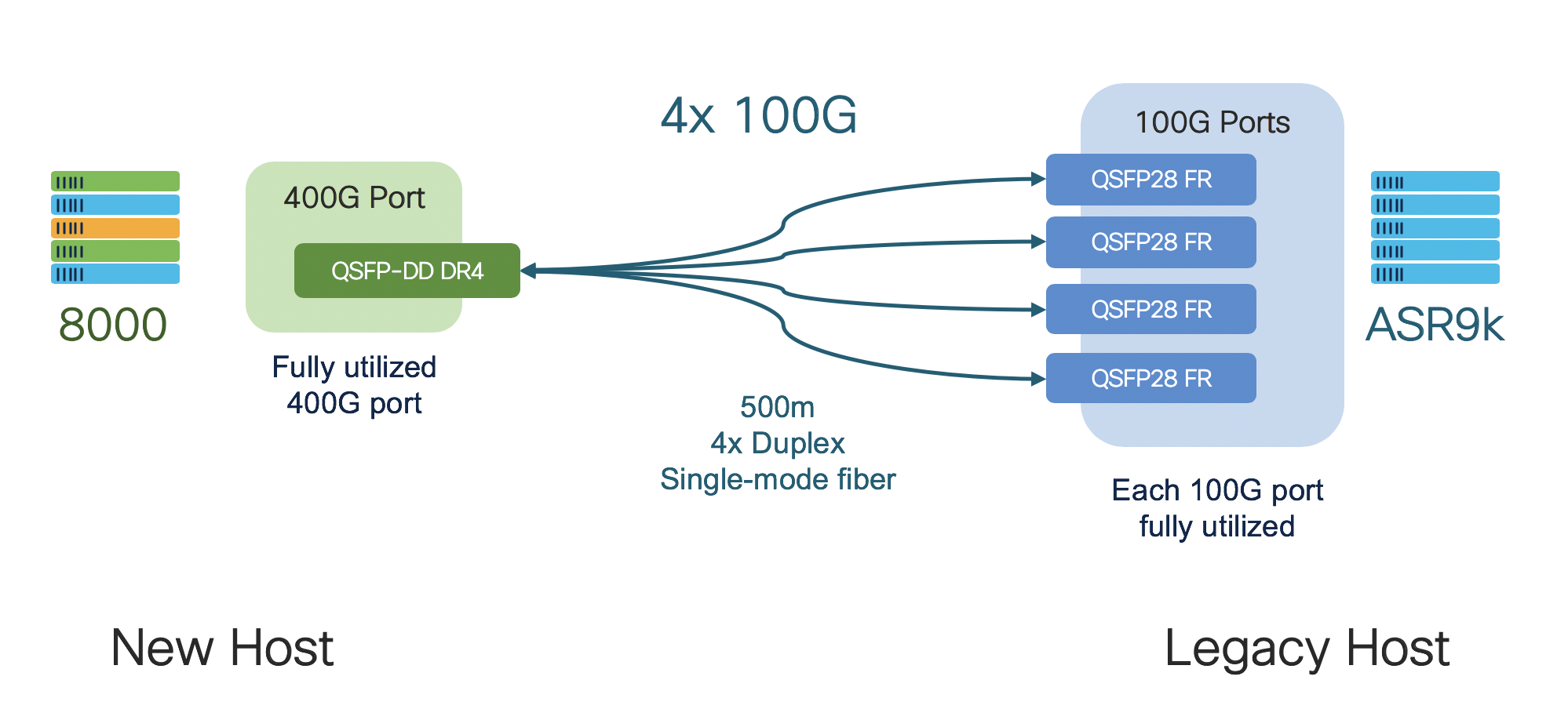
When planning beyond 100G, the ecosystem landscape expands to multi-lane 400G pluggables such as QSFP-DD and OSFP. These newer high-speed cages aggregate more lanes (e.g., 8×50G) and have strong vendor backing for 400G rollouts. QSFP28 can participate in migration paths via breakout and single-lambda optics that map to higher-speed modules or through chassis upgrades that accept QSFP-DD/OSFP; SFP112 is primarily a 100G density optimization and is less directly aligned with the mainstream 400G pluggable families. If your roadmap emphasizes an incremental, breakout-friendly migration to 400G, design choices favor QSFP-class ecosystems.
Ecosystem maturity and interoperability
QSFP28 benefits from a long installed base, a broad accessory market (DACs/AOCs/breakouts) and well-tested interoperability matrices across major switch vendors. SFP112 has made substantial technical progress and several optics vendors now publish SFP112 LR/ER products, but the interoperability matrix is younger and will vary more by vendor. For production networks, erring on the side of broad vendor support reduces surprise interoperability work during roll-outs.
Practical selection checklist
-
Define port-density targets per RU and model cost per usable 100G port (switch + optics + cooling).
-
Map breakout needs for the next 3–5 years; if breakouts are frequent, favor QSFP28.
-
Measure real per-module power in lab tests for target optics (don’t trust nameplate alone).
-
Validate reach with vendor link budgets and test representative fiber runs.
-
Confirm switch vendor support, firmware compatibility and return/warranty policies.
-
Run a small pilot (sample optics + real traffic) before wide deployment.
Recommendation summary
-
Choose SFP112 when the overriding constraint is faceplate real estate and you can lock into vendors that provide proven SFP112 optics and robust firmware support. It’s the density-first option.
-
Choose QSFP28 if you need breakout flexibility, broad accessory availability, simpler thermal behavior and a well-proven path into 400G ecosystems. It’s the lower-risk, ecosystem-friendly choice.
Both approaches are technically valid — the right choice depends on your data-center topology, migration timeline and whether density or operational flexibility is the decisive factor. Wherever you land, include measured lab data and a small proof-of-concept before large-scale purchases.
If you’d like, Wolonfiber can run a hands-on evaluation for your environment: power and BER lab measurements, breakout experiments and a per-rack TCO model tailored to your topology. Request a personalized 100G→400G migration brief and a sample kit at wolontek.com — we’ll include measured data and a migration plan so your architecture decision is backed by real results.