
Choosing between passive and active Direct Attach Copper (DAC) cables is one of the most practical decisions a data-center or enterprise network engineer makes when designing short-reach links. This article compares the two families of DACs, explains how each works, lists realistic reach, power and cost tradeoffs, and gives clear use-case guidance so you can pick the right physical copper interconnect for your topology.
What is a DAC and how the two types differ at a glance
A Direct Attach Copper (DAC) is a pre-terminated copper twinax assembly that plugs directly into pluggable transceiver cages (SFP+/QSFP+/QSFP28 etc.) without separate optical transceivers. DACs come in two designs:
-
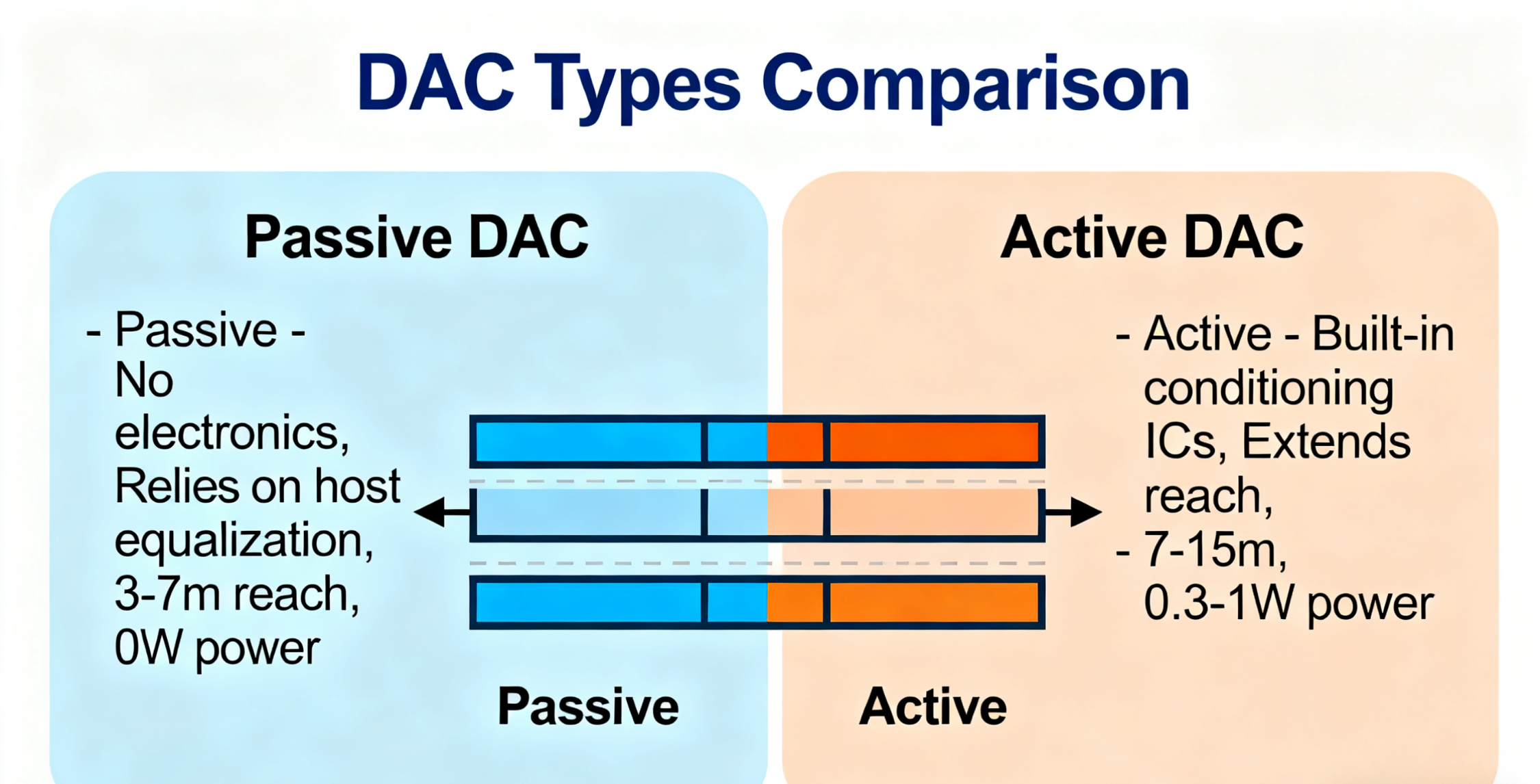
Passive DACs are simple twinax cables with no active signal conditioning electronics inside the assemblies. They rely on the host port’s receiver/transmitter circuitry for equalization.
-
Active DACs (sometimes called active-copper or equalized DACs) contain electronic components—drivers, retimers or equalizers—that condition and re-shape signals to extend the usable copper reach and maintain signal integrity at higher speeds.
This core technical distinction (no electronics vs built-in conditioning) underpins every practical difference between passive and active DACs.
Realistic reach: what to expect in deployment
A primary practical difference is reach. Industry guidance and vendor datasheets converge on these conservative, deployment-tested ranges:
-
Passive DACs: reliable up to about 3–7 meters depending on data rate and AWG; most vendors list passive QSFP28/100G passive twinax typically at 3 m, and SFP+ passive twinax commonly up to ~3–7 m for 10G links.
-
Active DACs: extend reach by adding signal conditioning; typical commercial active DACs commonly deliver 7–10 meters for 10G/25G/40G links and are often rated up to ~10–15 m in specific products and configurations. For longer reaches (tens of meters) Active Optical Cables (AOC) or fiber transceivers are recommended.
When planning cabling, assume passive for very short, rack-local interconnects and choose active only when passive lengths are insufficient. Vendor datasheets should be the final authority for any stock-length decision; different AWG, cable construction and rate all affect achievable lengths.
Power, heat and reliability tradeoffs
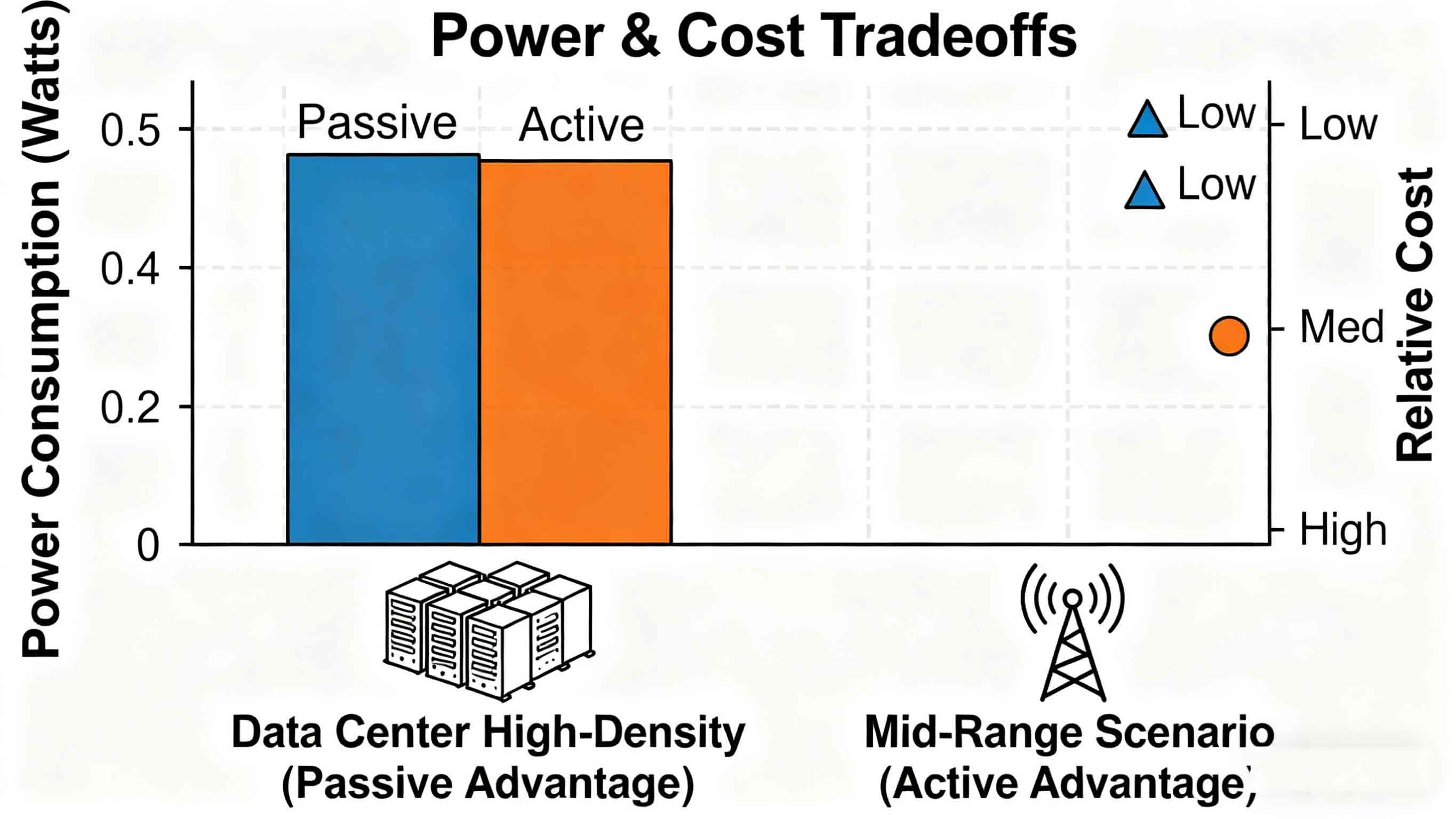
Because passive DACs have no on-board electronics they consume essentially no extra power and add virtually no heat to dense switch panels. Active DACs draw additional power for their conditioning ICs—typical per-cable power consumption can range from a few tenths of a watt to around 1 W depending on speed and implementation. That extra power can matter at hyperscale density. Conversely, active DACs relieve the host silicon from extreme equalization demands, which can reduce error rates when using longer copper runs.
In short: pick passive when minimizing power and thermal load is a priority and distances are very short; pick active when a few extra watts are justified by a need for extended reach or better BER performance over copper.
Performance, latency and signal integrity
Both passive and active DACs provide deterministic, low-latency copper links—latency differences are negligible for almost all practical workloads. The performance question is primarily about bit error rate (BER) over distance and under stress: active DACs use equalization/retiming to keep BER low at longer lengths, while passive DACs depend on port ASIC equalization and are therefore more sensitive to host-side capabilities. When running higher baud-rate lanes (25G/28G per lane in QSFP28), active conditioning becomes more valuable to preserve eye margin.
Cost and procurement considerations
-
Unit price: passive DACs are the least expensive per link because of their simpler construction. Active DACs cost more due to extra components and testing.
-
Total system cost: using active QSFP or SFP assemblies to consolidate cabling can reduce the number of switch ports required, which sometimes offsets higher cable cost at scale.
-
Compatibility: some switch vendors enforce vendor-coded EEPROMs and will only enable line-rate on “approved” or programmed DACs. If you plan to buy third-party cables to save cost, verify vendor compatibility lists and testing guarantees. Always check the switch vendor’s documentation for supported cable types and any required firmware versions.
Use cases: when each type is the right choice
-
Passive DAC — best when:
All links are rack-local (server NIC ↔ ToR) and under ~3–5 m, power/heat must be minimal, and cost per port is the dominant factor. Passive is the obvious winner for dense, short-reach 10G deployments and many 25G/40G rack-local connections. -
Active DAC — best when:
You need copper reach beyond what passive can guarantee (7–10 m), or host ASICs lack sufficient equalization for the distances you require. Active DACs are a practical copper option when you want to avoid switching to fiber for moderate distances inside a large room or between nearby racks. -
When neither is appropriate: for distances above ~15–30 m, or when electromagnetic interference is a concern across cable trays, choose Active Optical Cables (AOC) or transceivers with fiber optic cabling.
Best practices for procurement and deployment
-
Measure actual path length (including routing inside racks) and choose passive only if length comfortably under vendor limit.
-
Confirm switch/NIC support and any EEPROM programming or vendor code requirements.
-
Lab-test a subset of cables at full line rate and under thermal stress to verify BER and link stability before large roll-out.
-
Factor power and density into port budgeting—active DACs increase per-port power draw.
-
Standardize part numbers (including AWG and assembly length) to simplify spares and lifecycle management.

Conclusion
The Passive DAC Vs Active DAC choice is not philosophical — it’s practical. Passive DACs deliver the best price/performance for short, rack-local links where power and heat are constrained; active DACs buy you extra meters and better signal integrity at modest power and cost. Use vendor datasheets and lab testing to confirm reach and compatibility, and favor passive for short, high-density deployments and active when you need the extra copper reach without moving to fiber.
WOLON’s Direct Attach Copper Cable (DAC) portfolio includes rigorously tested passive and active assemblies across SFP+, QSFP+, and QSFP28 form factors. Each WOLON DAC cable is factory-tested for BER and signal integrity, clearly labeled with length and passive/active type, and available in both vendor-programmed and vendor-neutral EEPROM options to match mixed-vendor environments.

Whether you need ultra-low-power passive DACs for dense ToR deployments or equalized active DACs for extended rack-to-rack links, WOLON offers stock lengths, custom lengths, and production-grade QA backed by a practical warranty tailored to data-center operations.