
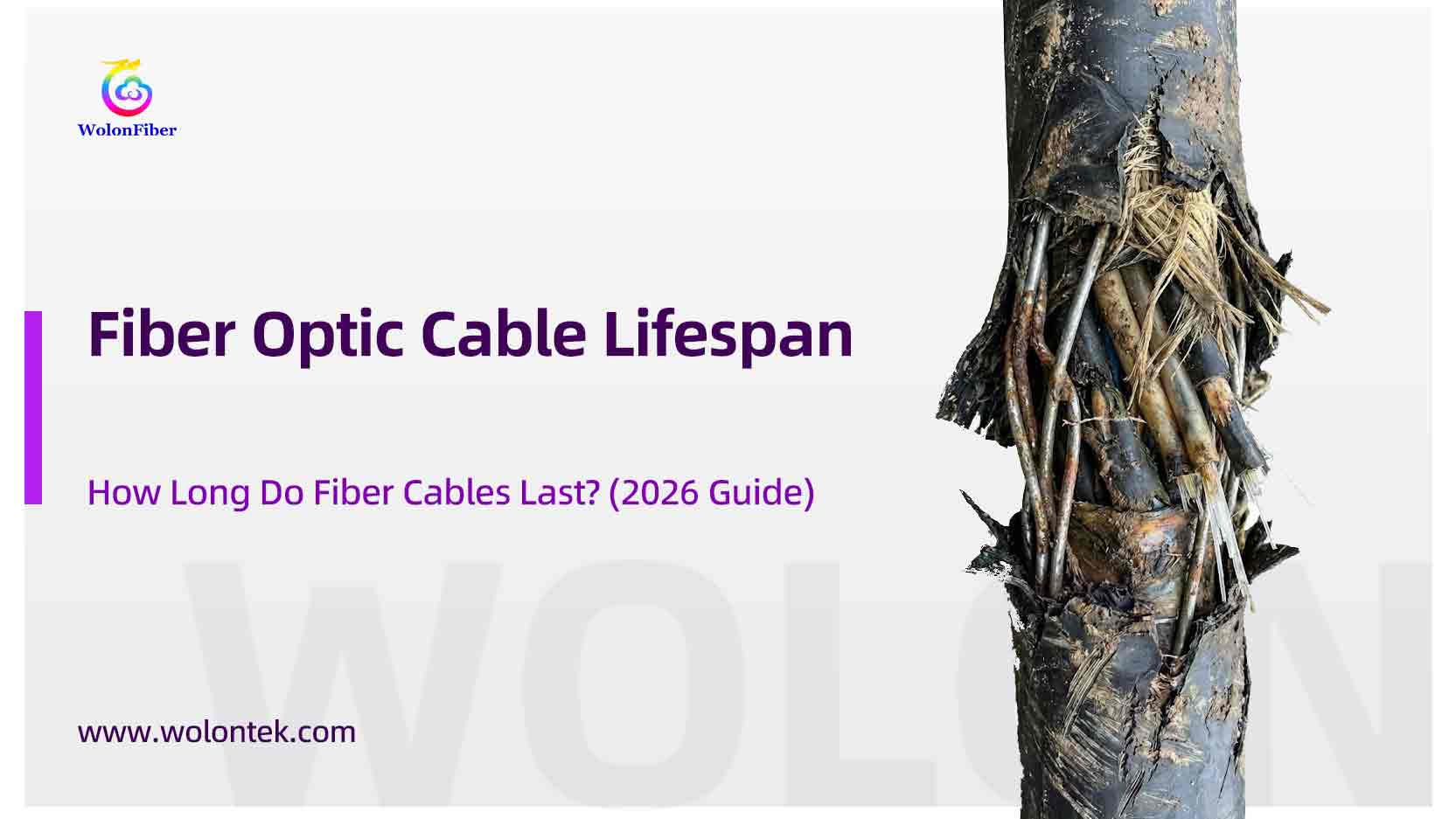
When you invest millions in a fiber optic cable network, you are buying a long-term asset. The industry standard says Fiber Optic Cable Lifespan should last 25 years.
But ask any veteran network engineer, and they will tell you a different story. Some fiber optic cables fail in 5 years, turning brittle and suffering from high attenuation. Others, installed in the 1990s, are still running 10G traffic perfectly today.
Why the difference? The glass core itself is incredibly stable. The problem is usually the protection around the glass.
In this guide, we explore the real fiber optic cable lifespan, the science behind why they fail (Hydrogen Darkening), and how to ensure your network actually survives until 2050.
The Short Answer: Theoretical vs Real Lifespan
-
Theoretical Lifespan: 30 to 50 Years. In a perfect vacuum, the silica glass (SiO2) core does not degrade.
-
Industry Standard Warranty: 20 to 25 Years. Manufacturers like Wolontek design cables to remain within attenuation specs for this period.
-
Real-World Reality: 10 to 40 Years. This depends entirely on installation stress, water protection, and UV exposure.
Key Takeaway: Fiber doesn’t usually “stop working” suddenly like a burnt-out lightbulb. Instead, its attenuation (signal loss) increases slowly over time until the link becomes unstable.
What Kills Fiber Optic Cable?
If glass is so durable, why do cables fail?
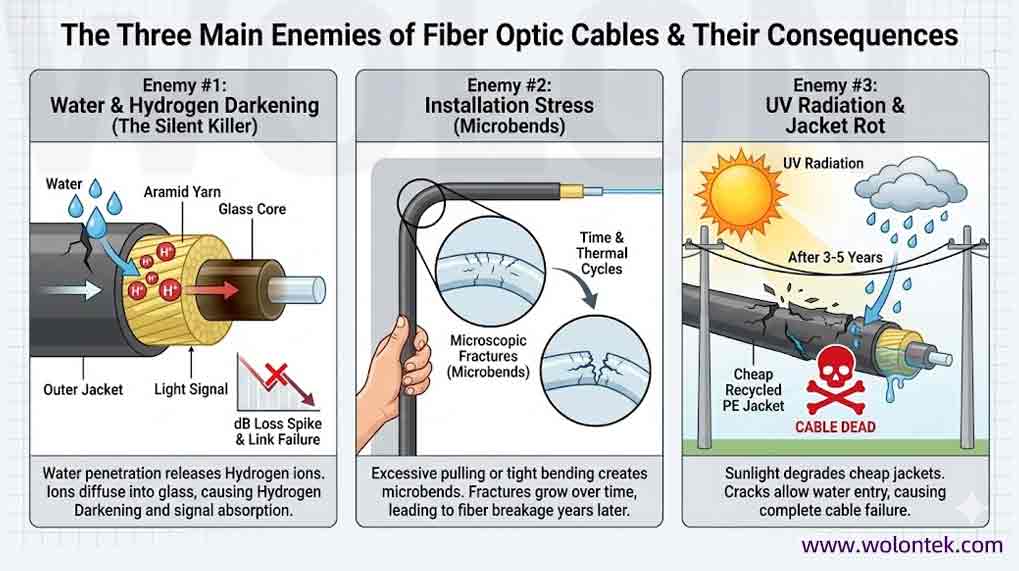
Enemy #1: Water & Hydrogen Darkening (The Silent Killer)
This is the most common cause of premature failure in Outdoor Cables. If water penetrates the cable jacket, it reacts with the aramid yarn or metal armor to release Hydrogen ions.
The Chemistry: These Hydrogen ions diffuse into the glass core, bonding with the silica structure.
The Result: “Hydrogen Darkening.” The fiber starts absorbing light instead of transmitting it. Your dB loss spikes, and the link fails.
Enemy #2: Installation Stress (Microbends)
A fiber optic cable’s lifespan is often decided on Day 1. If an installer pulls the cable too hard (exceeding the Maximum Tensile Load) or bends it too tightly, they create microscopic fractures in the glass cladding.
The Consequence: These “Microbends” grow over time due to thermal expansion/contraction, eventually causing the fiber to snap years later.
Enemy #3: UV Radiation & Jacket Rot
For aerial cables (like ADSS), the sun is the enemy. Cheap cable manufacturers use Recycled PE (Polyethylene) for the outer jacket to save money.
The Consequence: After 3-5 years of sunlight, the jacket cracks. Once the jacket cracks, water enters, and the cable is dead.
Lifespan by Environment: Indoor vs. Outdoor vs. Submarine
Where you install the cable dictates how long it lasts.
How to Spot an “Aging” Fiber Optic Cable?
You don’t need to wait for a total outage to know your cable is dying. Look for these warning signs:
- Rising Attenuation: Periodic OTDR tests show the dB loss/km is increasing year over year. (e.g., jumping from 0.20dB/km to 0.28dB/km).
- Brittle Jacket: If you touch the outer sheath and it feels hard or chalky (instead of flexible), UV damage has occurred.
- Water in Closures: If you open a splice closure and find water inside, assume the connected cables have begun to absorb moisture.
How Wolontek Ensures a 25-Year Lifespan
At Wolontek, we don’t build cables to last until the warranty expires. We build them to last. Here is our manufacturing difference:
✅ 1. 100% Virgin HDPE Jacket
We never use recycled plastic for outdoor cable jackets. We use 100% Virgin High-Density Polyethylene (HDPE) containing Carbon Black. This effectively blocks 99% of UV radiation, preventing cracking for decades.
✅ 2. Hydrolysis-Resistant Grease
To prevent Hydrogen Darkening, we flood the loose tubes with a premium thixotropic gel. This gel doesn’t just block water; it chemically stabilizes the environment around the fiber to prevent hydrogen generation.
✅ 3. Tier-1 Glass Only
We source our fiber cores only from Corning, YOFC, or FiberHome. We do not use “second-hand” or unknown glass brands that have high micro-bend sensitivity.

Conclusion: “Buy Nice or Buy Twice”
The cost of the fiber cable itself is usually only 10% of your total project cost (Installation, Permits, and Labor make up the rest). Saving 5% on “cheap cable” today risks the entire 100% investment.
⏳ Do You Want a Network for 5 Years or 25 Years?
Cheap cables degrade under UV and moisture. Repairing a broken link costs 100x more than buying the right cable initially.
Choose Wolontek’s “Physics-Engineered” cables (Double Jacket / Gel-Filled) to guarantee a 25+ year lifespan.
Available: Anti-Rodent, ADSS (High Voltage), and Direct Burial specs.
FAQ: Fiber Cable Longevity
Q1: Does fiber optic cable degrade over time?
A: Yes, but very slowly. The main degradation is an increase in attenuation (signal loss) due to hydrogen absorption or physical stress on the cable materials.
Q2: Which lasts longer: Fiber or Copper?
A: Fiber generally lasts longer. Copper corrodes (oxidizes) quickly when exposed to moisture. Fiber is glass and does not rust, making it more durable in harsh environments—provided the protective jacket holds up.
Q3: Can I extend the life of my existing fiber network?
A: Yes. Regular maintenance is key.
Inspect splice closures annually for water leaks.
Fix sagging aerial cables to reduce tension stress.
Keep patch panels clean to prevent connector damage.