
If you are planning a fiber optic installation, you are likely staring at a datasheet and wondering: “Do I need OS1 or OS2 fiber?”
Both are Single Mode. Both have yellow jackets. Both use 9-micron cores. So, are they interchangeable? Absolutely not.
Choosing the wrong one can lead to signal loss over long distances, incompatibility with modern WDM systems, or water damage in outdoor ducts. In this guide, we break down the technical differences between OS1 vs OS2 fiber, and reveal why the “Outdoor Grade” OS2 might actually be cheaper than you think.
OS1 vs OS2 Fiber: The Quick Cheat Sheet
If you don’t have time to read the physics, here is the executive summary comparing OS1 vs OS2 fiber.
What is OS1 Fiber?
OS1 (Optical Single-mode 1) is the older specification defined by ISO/IEC 11801.
-
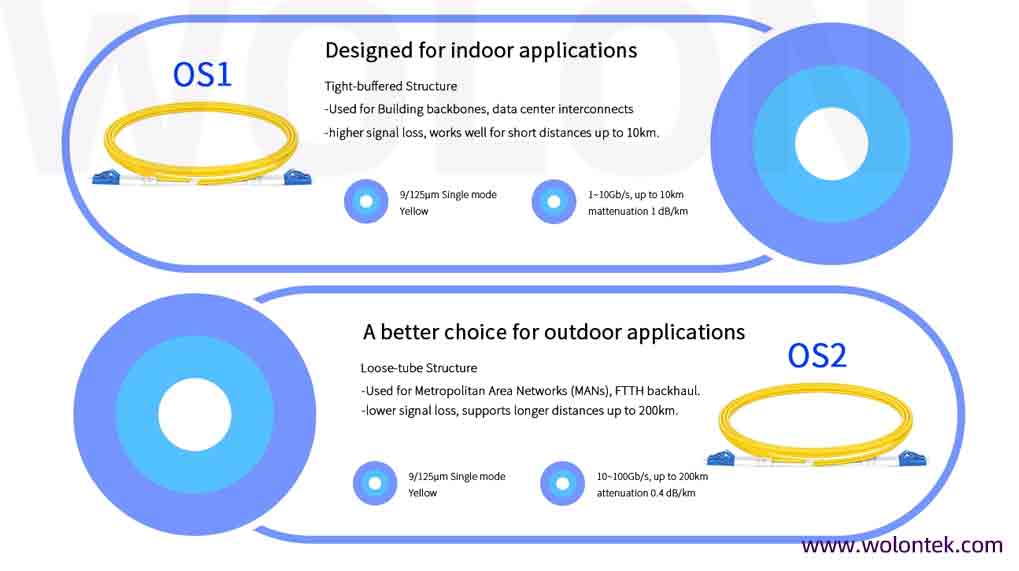
The Design: It is almost always “Tight Buffered”. This means the plastic coating is applied directly over the glass fiber core.
-
The Limitation: Because the glass is tightly bound, it suffers from higher stress and micro-bending loss (approx. 1.0 dB/km).
-
The “Water Peak”: OS1 glass typically has high attenuation at the 1383 nm wavelength (caused by water ions). This makes it unsuitable for full-spectrum CWDM transmission.
-
Typical Use: Standard indoor yellow patch cords (2mm/3mm) and short campus LANs inside a building.
What is OS2 Single Mode Fiber? (Modern Standard)
OS2 Single Mode Fiber is the modern specification (ISO/IEC 24702) designed for high-performance, long-haul networks.
-
The Design: It typically uses a “Loose Tube” or “Blown” construction. The fiber floats freely inside a gel-filled or air-filled tube, isolating the glass from pulling stress and moisture.
-
The Glass: It uses G.652.D (Low Water Peak) glass.
-
The Performance: It has incredibly low attenuation (<0.4 dB/km), allowing signals to travel 20x further than OS1.
If you are looking for OS2 Single Mode Fiber for a project, you are essentially looking for G.652.D glass packaged in an outdoor or universal jacket.
OS1 vs OS2 Fiber Specs: 3 Critical Differences
Why does OS2 perform so much better? Here is a deep dive into the technical specs.
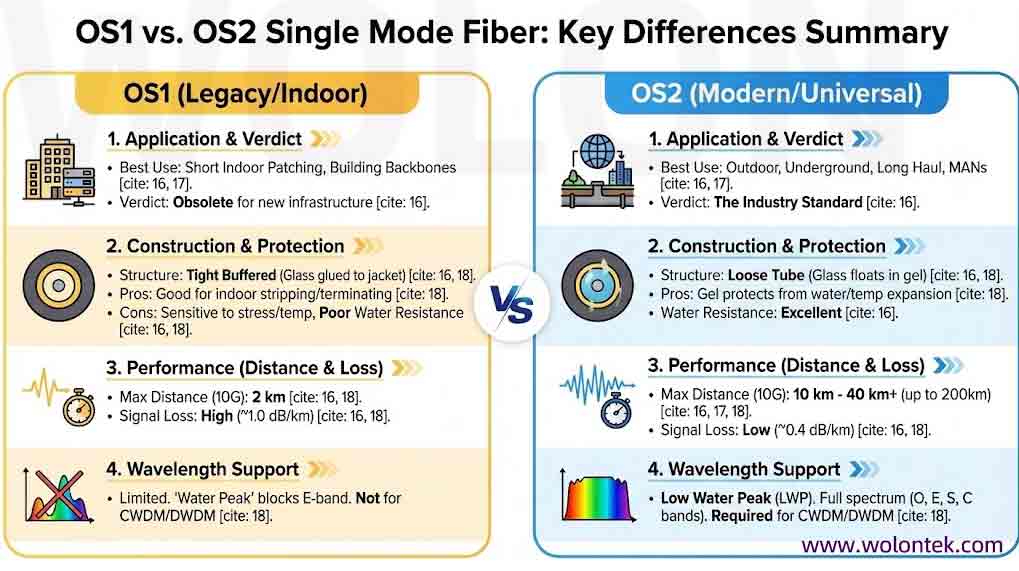
1. Attenuation & Distance
This is the most critical difference for network engineers.
-
OS1: Losing 1.0 dB/km means your signal degrades quickly. It maxes out at 2 km for 10 Gigabit Ethernet.
-
OS2: With only 0.4 dB/km loss, OS2 Single Mode Fiber can easily support 10G up to 10km (LR) or 40km (ER).
2. Wavelength Support (CWDM/DWDM)
This is where OS2 truly shines.
-
OS1 is limited. The “Water Peak” attenuation blocks the E-band (1360-1460nm).
-
OS2 is “Low Water Peak” (LWP). It opens up the entire spectrum: O, E, S, and C bands (1260nm – 1625nm).
-
Why this matters: If you plan to use CWDM or DWDM to multiplex channels in the future, you MUST use OS2. OS1 will fail at certain wavelengths.
-
3. Construction: Tight Buffer vs Loose Tube
-
OS1 (Tight Buffer): Great for stripping and terminating indoors, but sensitive to temperature changes and physical stress.
-
OS2 (Loose Tube): The gel-filled tube protects the fiber from water ingress and temperature expansion, making it the only choice for outdoor, buried, or conduit installations.
Factory Insider: The Price Myth
Many installers assume that “Outdoor Grade” OS2 is expensive and “Indoor” OS1 is cheap. In 2026, this is false.
Because OS2 Single Mode Fiber (G.652.D) is the standard used by global Telecoms for city infrastructure, it is produced in massive quantities. This “Scale Effect” drives the price down significantly.
Let’s look at the Real Market Data. We compared the price of a standard US Distributor against Wolon‘s Factory Cost (based on our 2026 Raw Material Sheet).
???? Factory Insider: The Real Cost of OS2 Fiber
| Product Type | Big Brand / Distributor Retail Price |
Wolontek Factory Direct Price |
Your Potential Margin (Savings) |
|---|---|---|---|
| OS2 Bulk Cable Simplex 3.0mm, G.652.D |
$0.35 – $0.50 /m High Markup |
~$0.04 /m | 90% |
| OS2 Patch Cord 3 Meters, SC/UPC Duplex | $12.00 – $18.00 /ea | ~$1.50 – $2.00 /ea | 85% |
| OS2 Fiber Spool 1km Raw Cable | $450.00+ /km | ~$45.00 /km | 90% |
???? The “Data Source” (Raw Material Cost):
According to our internal manufacturing data, the raw cost for premium G.652.D (Import Yarn) is exactly 271 RMB/km (approx. $41 USD/km).
Looking for rock-bottom cost? Our Standard Edition (Domestic Yarn) drops to 177 RMB/km—that’s less than $0.03 per meter. Why pay $0.50?
Conclusion: Which Fiber Should You Buy?
The industry has spoken: OS1 is effectively obsolete for new structured cabling. For any new installation—whether it is connecting racks in a data center or burying cable under a street—OS2 Single Mode Fiber is the future-proof choice.
-
It handles moisture better.
-
It supports WDM/CWDM wavelengths.
-
It costs virtually the same (or less).
FAQ: OS1 vs OS2 Single Mode Fiber
Q1: Can I use OS2 fiber indoors?
A: Yes, absolutely. This is a common myth. While OS2 is “Outdoor Grade” in terms of performance (water resistance, long distance), it is perfectly fine to use indoors. You just need to make sure the cable jacket meets your local fire codes (e.g., LSZH for Europe/Asia or Plenum/Riser for the US). In fact, using OS2 indoors future-proofs your building for 40G/100G upgrades.
Q2: Is OS2 backward compatible with OS1?
A: Physically, yes. Both OS1 and OS2 use a 9-micron glass core, so you can splice or patch them together. However, mixing them is not ideal for high-performance networks. The higher attenuation of the OS1 segment will act as a “bottleneck,” limiting the overall distance and signal quality of the link.
Q3: Is G.652.D the same as OS2?
A: Closely related, but not exactly the same.
OS2 is the ISO/IEC cabling standard (defines how the cable performs).
G.652.D is the ITU-T glass standard (defines how the fiber core is made).
Reality: Almost all modern OS2 cables are built using G.652.D Low Water Peak glass. So for buying purposes, they are often used interchangeably.
Q4: Why is your OS2 cable so much cheaper than distributors?
A: It’s about the supply chain. Distributors mark up cable by 300-500% to cover their warehousing and sales commissions. At Wolon, you are buying directly from the production line. As shown in our cost breakdown, the raw G.652.D glass is produced in massive quantities for telecom use, bringing the factory cost down to roughly $0.04 per meter. We pass those savings to you.
Q5: What happens if I use OS1 for a long distance run (>2km)?
A: It will likely fail or suffer from high error rates. OS1 has high attenuation (~1.0 dB/km). Over a 5km run, you would lose 5dB of signal just from the cable, leaving very little margin for connectors and splices. OS2 loses only ~2dB over the same distance, leaving plenty of “headroom” for a stable connection.