
Choosing between armored and non-armored fiber comes down to one simple question: what risks will your cable face in the real world? This article cuts straight to the point—definitions, real differences, where each type belongs, installation and cost trade-offs, and a practical checklist so you can decide quickly and confidently.

What is an Armored Fiber Cable?
An armored fiber optic cable is a strong fiber cable with extra protection. This protection is usually metal or polyethylene. It guards against tough environments and physical damage. I recommend armored cables for any installation where you expect potential damage or interference. They offer much better protection than standard cables.
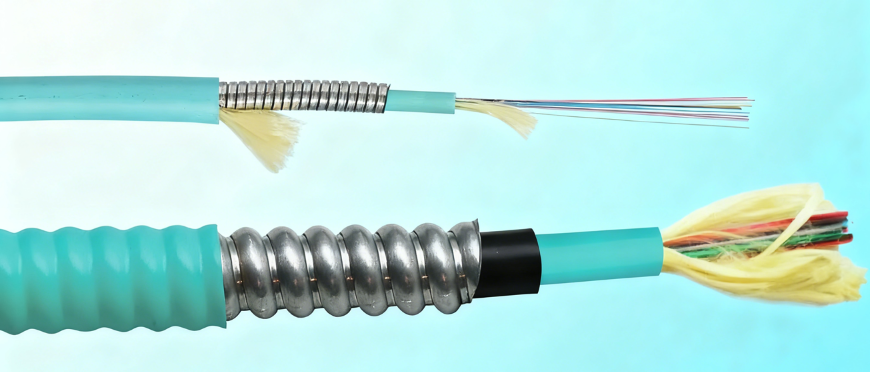
Structure and Key Components
Fiber Core: The light-carrying center.
Cladding: Surrounds the core and confines light for efficient transmission.
Inner Jacket: Flame-resistant layer that holds strength members and buffer coatings.
Armor Layer: Metal shield (steel or aluminum) for crush, cut, and rodent protection.
Strength Members: Aramid (Kevlar) or fiberglass rods that resist pulling.
Outer Jacket: PE or PVC shell that resists chemicals, moisture, abrasion, and UV.
Protective Features That Matter
- The armor wraps tightly to provide high crush, tension, and impact resistance while remaining workable.
- Armored cables excel against compression, side pressure, and rodent chewing—common causes of field outages.
Types of Armored Fiber Cables
Interlocking Armor (AIA): Aluminum spiral armor — flexible and good for indoor/outdoor runs.
Corrugated Armor (Stainless Steel Micro-armor): Coated stainless strip — excellent for direct burial and harsh outdoor environments.
Cable Construction Options
Tight-buffered: Best for indoor use; easy to handle and terminate.
Loose-tube (loose-buffered): Designed for outdoor use with central strength members and water-blocking features for environmental protection.
Where You Can Use Armored Fiber Cables
1.Available pre-terminated (armored patch/trunk) for quick indoor installs or field-terminated for custom outdoor lengths.
2.Ideal where cables face dust, oil, gas, moisture, rodents, or mechanical threats.
Summary Table: Key Elements
| Component | Material | Function | Example Use |
|---|---|---|---|
| Core Fiber | Glass (silica) | Data transmission | All |
| Strength Member | Kevlar/aramid | Tensile support | Indoor/outdoor |
| Armor Layer | Steel/Aluminum | Crush, rodent, mechanical barrier | All |
| Inner Jacket | PVC/PE/LSZH | Impact/flame protection | Varies |
| Outer Jacket | PVC/PE | Weather and chemical shielding | All |
What is a Non-Armored Fiber Cable?
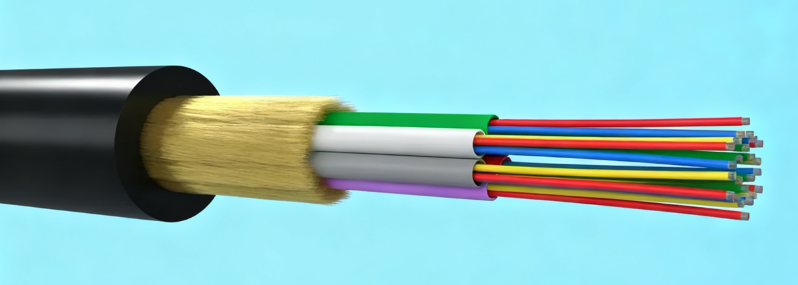
A non-armored fiber cable is a lightweight and flexible fiber optic cable. It does not have a metal or heavy-duty armor layer. Instead, it has a simple structure. This includes an optical fiber core, protective coatings, strength members, and an outer jacket. The jacket is usually made of polyethylene (PE) or PVC.
Key Features and Design
Compact & Lightweight: Significantly smaller and lighter than armored types — useful in crowded pathways.
Jacket Thickness: Typical PE jackets; small-diameter designs enable space savings.
Cost Savings: Lower material, shipping, and storage costs.
High Flexibility: Easier routing and tighter bend tolerance.
Performance: Available in single-mode and multimode; armor does not change optical properties.
Where to Use Non-Armored Fiber Cables
- Best for indoor environments: data centers, office buildings, server rooms, and telecom closets.
- Suitable where the route is protected and mechanical risks are low. Use conduit if exposure to hazards is possible.
Advantages and Limitations
Advantages: Lightweight, flexible, cost-effective, easy to store and install.
Limitations: No built-in protection against crushing, impacts, moisture, or animals—requires conduit or other protection in risky environments.
Typical Applications
Choose non-armored for protected indoor runs prioritizing flexibility and cost. Choose armored for direct burial, industrial sites, exposed outdoor spans, or routes with known mechanical or animal threats.
Summary Table: Key Construction Elements
| Component | Material(s) | Function |
|---|---|---|
| Core | Glass/Plastic | Light transmission |
| Cladding | Glass/Plastic | Light confinement |
| Primary Coating | Acrylate/Polyimide | Fiber protection |
| Strength Members | Aramid yarn, Fiberglass | Mechanical strain relief |
| Water Blocking | Swellable yarn, Gel | Moisture protection |
| Jacket | PVC, PE, LSZH, MDPE | Outer protection from environment |
Non-armored fiber cables work best for installations where flexibility matters. Low weight, fire code compliance, and easy handling are key. Based on my experience, they are ideal when you don’t need the brute physical resistance that armored constructions deliver.
When armor is truly worth it
Choose armored fiber when one or more of the following conditions apply:
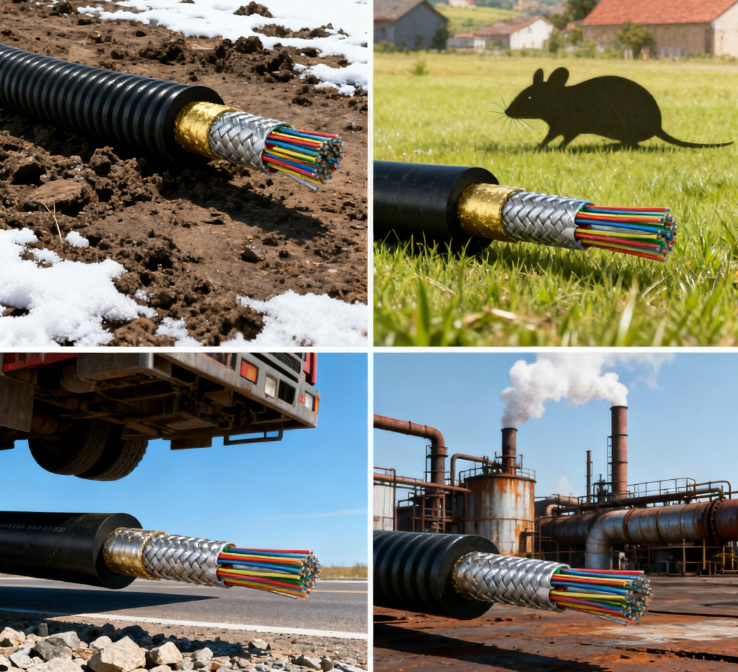
1.Direct burial or exposed outside-plant runs. Corrugated steel or armored designs are built to be buried without conduit and to survive ground movement, frost heave and occasional impact. If you plan to bury without a conduit or route through aggressive outside environments, armor is recommended.
2.Rodent or animal threat. In rural or mixed urban environments with documented rodent/animal cable damage, interlocking metal armor or dedicated rodent-resistant jackets reduce outage risk and maintenance visits.
3.High crush or mechanical load risk. If the cable will run under heavy traffic, near excavation, or across machinery where crushing risk exists, choose corrugated or steel tube armor for crush resistance.
4.Industrial sites with abrasion or chemical exposure. Metal armoring plus appropriate outer jackets (LSZH, PE, or specialized chemical resistant jackets) extend service life in harsh plants and chemical zones.
Summary Table: Where to Choose Armored Fiber
| Application Area | Why Use Armored Cable? |
|---|---|
| Direct burial/underground pathways | Crush & rodent protection, no need for conduit |
| Industrial plants/factories | Mechanical, chemical, and EMI resistance |
| Military & high-security deployments | Tamper, blast, and extreme weather durability |
| Data centers, raised floors/trays | Accident/crush proof in high-traffic environments |
| Offshore & marine networks | Water/salt/corrosion-resistant; mechanical abuse |
| Aerial utility installations | UV, weather, and impact robustness |
When non-armored is the better option
Non-armored fiber is typically the right call when:
- The run is completely inside buildings, inside dedicated cable trays, or inside conduit where mechanical hazards are controlled.
- You need tight bend radii, higher port density, and easier handling during installation (data centers, telecom rooms).
- Weight and flexibility matter — e.g., long aerial spans that are engineered for light, non-armored fiber or when minimize conduit size/cost.
- You’re optimizing for lower material cost and the environment provides protection (buried in conduit, indoor trays).
Trade-offs to consider
- Cost vs. total installed cost: Armored cable can cost more per meter, but avoiding conduit, reduced repair visits, and longer life under abuse sometimes make it cheaper in the total lifecycle. Run a simple installed-cost comparison that includes material, conduit, labor, and expected maintenance before choosing. Typical ruggedized/armored cable material costs and installed ranges can vary widely by region and spec. Recent industry guides estimate armored/ruggedized cable material in a higher price band than plain single-mode or OM3/OM4 multimode.
- Bend radius and handling: Some armors mean a larger minimum bend radius. If your route includes many tight bends, confirm the armored cable’s specs; otherwise you risk microbending loss or fiber fracture.
- connector and patching implications: Armored distribution cables sometimes require different termination practices and strain-relief fittings—factor termination labor and accessory costs into your design.
- Grounding and bonding: Metallic armor may need grounding in some installations. Coordinate with your electrical/earthing plan—armored cable can create a continuous metallic path that must be considered in bonding schemes.
Final recommendation — how to decide fast
1.Map the route and list real hazards (rodents, traffic, frost, chemical exposure).
2.Compare total installed cost (cable + conduit + labor + expected maintenance).
3.Check manufacturer datasheets for the armor type you’re considering (CST vs. AIA) and confirm burial/aerial ratings.
If hazards are present or the cost of an outage is high, choose armored. If the run is protected, indoors, or requires maximum flexibility and lowest material cost, choose non-armored.
Looking for reliable armored optical cables? Choose WOLON — trusted manufacturing + on-site support you can count on.
We’ve got rugged options for harsh environments: corrugated steel tape or interlocking aluminum tape armor, aramid strength members, and multiple jacket choices (PE/PVC/LSZH). Perfect for direct burial or data center backbone setups.
Every cable passes strict optical & mechanical tests before shipping. Custom lengths, pre-termination services, installation guidance, and fast tech support — we’ve got you covered.
Want to cut failure risks, extend link life, and simplify maintenance? Contact Wolon sales now for samples, technical docs, and tailored quotes. Let’s minimize your network operational risks for good.
