IntroductionEngineers, purchasing managers and installers often see the terms Transceiver, optical module and fiber optic module used interchangeably — and that causes confusion. This article answers the question directly and precisely: what each term usually means, where they overlap, and what practical differences matter when you design, buy, or troubleshoot a network. All claims below are grounded in industry sources and MSAs (multi-source agreements) so you can rely on them in B2B purchasing and technical decisions.
Short definitions (clear and practical)
optical transceiver — a compact device that contains both a transmitter and a receiver to convert electrical signals to optical signals and back. It is the unit that actually sends and receives light on a fiber link. Typical form factors include SFP, SFP+, QSFP, CFP, etc.
Fiber optic / optical module — a broader term. In many vendors’ usage an “optical module” is an optical transceiver used in a pluggable format (a “module”), but in other contexts a module can be a larger, more feature-rich circuit assembly that contains a transceiver plus extra electronics (gearboxes, FEC engines, DSPs, or on-board optics for Coherent links). In short: all pluggable transceivers are Optical modules, but not all modules are just simple transceivers.
(Practical takeaway: when a datasheet says “optical module,” check whether it means a hot-pluggable transceiver (SFP, QSFP, etc.) or a more integrated assembly with additional electronics.)
Comparison Table
|
Aspect |
Optical Transceiver |
Fiber Optic Module |
|---|---|---|
|
Stand-alone operation |
Yes (active device) |
No (requires host device) |
|
Hot-swap support |
Sometimes |
Most support it |
|
Examples |
Single/Dual Fiber BIDI |
SFP, QSFP, QSFP28 |
|
Data rates |
1G–400G |
1G–400G |
|
Typical applications |
Telecom, legacy/remote access |
Data center, modular systems |
Functional difference (what actually changes)
At the functional level the distinction comes down to scope:
-
a transceiver focuses on signal conversion: electrical ⇄ optical. It contains lasers, photodiodes, and the necessary front-end electronics. This is what sits in a switch port or on a transponder card to put light on fiber.
-
A module may include the transceiver plus extra functions: clock recovery, baud-rate gearbox (converting between electrical lanes and optical lanes), Forward Error Correction (FEC), DSPs for coherent optics, and sometimes power management or monitoring chips. These extra functions change cost, power consumption and supported reach.
Because of this, two products that look similar can behave very differently on reliability, range and interoperability: a simple pluggable transceiver for short-reach 10GbE is very different from a coherent CFP2 module that embeds complex DSPs for 100+ km links.

Form factor and standards (why compatibility matters)
Most networking gear accepts pluggable modules that conform to MSAs (Multi-Source Agreements). Common MSAs and form factors you’ll see in enterprise/data-center environments are SFP, SFP+, QSFP family and CFP/OSFP for higher speeds. Those MSAs define mechanical dimensions, electrical pinouts and basic management interfaces so modules and host ports from different vendors interoperate. If a product is called an “optical module” and adheres to an MSA, it’s functionally a pluggable transceiver in practice.
(Practical note: always match form factor + MSA + optical specification — e.g., SFP+ 10G LR with LC single-mode and the correct wavelength — to avoid incompatibility.)
Performance & deployment differences you must watch
When choosing between modules/transceivers consider these real-world parameters:
Data rate and lane mapping — SFP/SFP+ (1G/10G), SFP28 (25G), QSFP (40G/100G variants) — the electrical to optical lane mapping matters for host compatibility.
Optical reach & interface — short-reach (SR) multimode optics vs. long-reach (LR) single-mode optics differ in laser type and wavelength.
Feature set — modules with on-board FEC, DSP or coherent optics cost more but enable longer reach and higher spectral efficiency.
Hot-swap & management — pluggable transceivers are typically hot-swappable and expose SFF-8472 / digital diagnostic monitoring (DDM/DOM); larger modules can expose richer telemetry or require specific host firmware.
Optical Transceiver vs. Fiber Optic Module: Summary Comparison Table
Here’s a summary table comparing optical transceivers and fiber optic modules. This chart shows key technical features, common uses, performance specs, and value points.
Core Comparison Table
|
Aspect |
Fiber Optic Module |
Optical Transceiver |
|---|---|---|
|
Product Examples |
SFP (1G), SFP+ (10G), QSFP (40G), QSFP28 (100G), QSFP-DD (400G), XFP, CFP |
10/100/1000BASE-T media converter, standalone SC/LC interface devices |
|
Form Factor |
Compact, pluggable (hotswappable). Fits into network devices. |
Standalone box. External unit. Connects via cable. |
|
Power Source |
Gets power from host (switch, router, server) |
Has its own power source. Includes housing and power unit. |
|
Hot-swappability |
Yes, you can replace or upgrade live. Little to no downtime. |
No. You need downtime to replace it. |
|
Speeds Supported |
1G, 10G, 25G, 40G, 100G, 400G, 800G |
Mostly 100M/1G. Some reach 10G. |
|
Typical Applications |
Data center backbones. Enterprise core networks. 5G fronthaul/midhaul. Scalable high-density setups. |
Small office Ethernet extensions. Campus networks. Video surveillance. Copper-fiber bridging. Industrial links. |
|
Distance Range |
Multi-mode: 100–400m. Single-mode: 2km–100km (varies by model). |
2km–20km standard (single-mode). |
|
connector Type |
LC (most common). MPO/MTP (parallel). Works with MMF/SMF. |
SC/LC. May need adapters for device matching. |
|
Diagnostics |
Has Digital Diagnostics Monitoring (DDM/DOM). Tracks voltage, temp, TX/RX optical power, bias in real time. |
Basic LEDs for link and activity. No advanced diagnostics. |
|
Protocol/Standard Support |
Supports Ethernet, Fibre Channel, OTN, CPRI, SDH, DWDM. Can upgrade modules for different protocols. |
Supports basic Ethernet. Fixed speeds. Fewer protocols. |
|
Upgrade/Future-proofing |
Modular design. Swap modules for higher speed or different protocol. Causes little service interruption. |
Less flexible. You must change the whole device. |
|
Reliability/MTBF |
High reliability (MTBF >100,000 hours). Built for 24/7 use. |
Good for non-critical or edge use. Fails more often in harsh conditions. |
|
Typical Price |
Costs more upfront. Adds value through hot-swap, diagnostics, reliability. Price jumps for 100G+ or special modules. |
Budget-friendly for simple connections and short-range setups. |
|
Special Features |
Hot-swap capability. Digital monitoring. High port density. Protocol agility. Energy-efficient designs. |
Plug-and-play. Rugged models for industry. Copper-to-fiber bridging. |
|
Personal Evaluation |
I believe these are a must for future-proof, scalable, reliable core networks. Worth the extra cost for critical systems. |
I choose these for cost-effective, quick expansion at the access/edge or in harsh campus settings. |
How to read datasheets without getting tripped up
1.Find the form factor (SFP / QSFP / CFP / OSFP). That tells you mechanical and host expectations.
2.Read the optical spec (wavelength, connector, fiber type, link budget). That governs reach.
3.Check for in-module functions (FEC, gearbox, DSP). If listed, treat the product as a richer optical module rather than a bare transceiver.
4.Confirm MSA and vendor compatibility notes. Some vendors lock gear to branded optics; others are open.
Practical decision guide
You need simple port expansion in a switch or server: pick a standardized pluggable transceiver (SFP/SFP+/QSFP) matching speed and fiber type.
You need long-haul, DWDM, or coherent transport: choose an optical module with onboard DSP/FEC (these are modules that go beyond basic transceivers).
You need density and low cost for short links (within rack or between racks): low-cost SR transceivers on multimode fiber are appropriate.
onclusion (two-line summary)
A transceiver is the basic conversion engine (electrical ⇄ optical); an optical/fiber-optic module is a broader packaging term that may simply denote a pluggable transceiver or a more capable assembly containing extra electronics. Always read the datasheet: the form factor, optical specification and in-module features determine whether a product meets your technical and commercial needs.

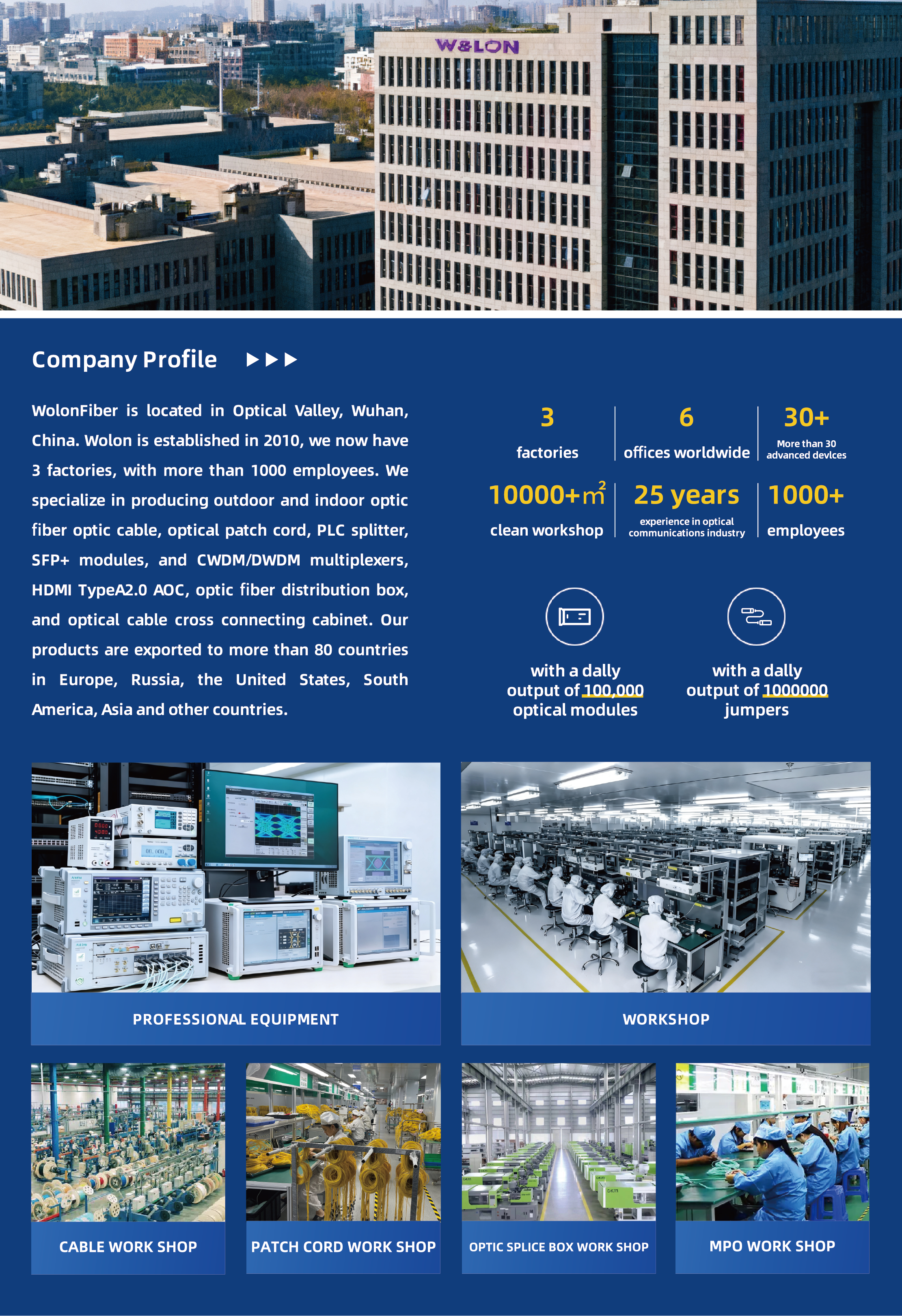
WOLON’s optical module lineup covers both high-density pluggable transceivers and advanced Optical Modules for long-reach transport. Whether you need cost-efficient SFP/SFP+ modules for data-center uplinks or DSP-enabled modules for metro and long-haul DWDM links, WOLON offers factory-tested optics with full test reports, DOM support, and global warranty. Contact WOLON to specify the exact form factor, wavelength and reach for your project — we’ll recommend the module that minimizes CAPEX while meeting your performance and reliability goals.