Every time a fiber optic cable snakes around a sharp corner or squeezes into a cable tray, it risks losing light—and with that, signal quality. Modern networks, however, increasingly rely on fibers engineered to tolerate tight bends without measurable performance loss. This post explains, in plain but technically accurate terms, what bend-insensitive fiber is, how it works, where it matters most, and the practical trade-offs you should know before specifying it for a project.
What “bend-insensitive” actually means
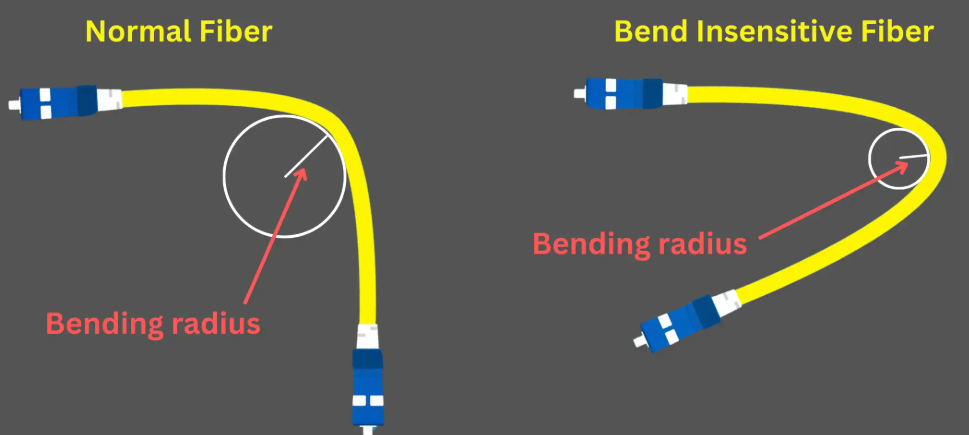
Bend-insensitive fiber (BIF) is a class of optical fiber specially designed to minimize macrobending and microbending losses when the fiber is routed around tight radii or compressed in confined spaces. Ordinary Single-mode fiber was designed for gentle routing (larger bend radii); bend-insensitive variants change the fiber’s internal structure so that light remains confined to the core even when the glass is sharply curved. This reduces the risk of increased attenuation and service faults in real-world installations.
How it works — the trench (and other) tricks
There are several engineering approaches to reduce bend loss. The most common in commercial single-mode fibers is a trench-assisted or ring-assisted refractive-index profile: a narrow annular region (a “trench” or “moat”) of slightly lower refractive index is placed around the core. That trench acts like a secondary barrier, reflecting light that would otherwise leak into the cladding and guiding it back toward the core. Advanced designs tune trench geometry (depth, width and distance from the core) to push resonant coupling away from operating wavelengths and thereby minimize loss under tight bending. Research and industry summaries describe trench designs as the standard practical solution for low bending losses.
Standards and practical bend radii
The International Telecommunication Union defines categories of bend-insensitive single-mode fiber under ITU-T G.657. Those categories give designers clear, testable minimum bend radii for different use cases:
-
G.657.A1 — G.652.D compatible, improved bend tolerance; typical minimum design radius ~10 mm.
-
G.657.A2 — greater bend resistance for access and drop installations; typical minimum design radius ~7.5 mm.
-
G.657.B2 / B3 — ultra-bend tolerant fibers, with 5 mm design radii for the most space-constrained scenarios.
These standardized classes let you match fiber type to installation constraints while maintaining splice and connector compatibility where required.
Standards and Performance Table
|
ITU-T G.657 Type |
Minimum Bend Radius |
Typical Attenuation at 1550 nm |
|---|---|---|
|
A1 |
10 mm |
≤0.75 dB/turn |
|
A2 |
7.5 mm |
≤0.5 dB/turn |
|
B3 |
2.5–5 mm |
≤0.15 dB/turn |
Where bend-insensitive fiber makes the biggest difference
Choose bend-insensitive fiber when cable routing or density will force tight bends, or when long-term reliability matters in confined spaces:
-
FTTH/FTTP drop and indoor risers — installers frequently must route fiber through tight conduits, under floor voids, or around building corners where standard fiber would suffer macrobend loss.
-
Data centers and high-density patching — ultra-dense racks and small form-factor connectors create conditions where G.657-class fibers reduce port-to-port loss and rework.
-
Retrofit and multi-dwelling unit (MDU) installs — reusing existing pathways or pulling around multiple corners benefits from fibers that tolerate repeated bends.
-
Industrial, automation, and tight mechanical assemblies — robotics, sensors and aerospace harnesses sometimes require extreme flexibility (B-class fibers).

Installation realities — testing, handling, and mistakes to avoid
Even bend-insensitive fiber has limits. “Bend-insensitive” does not mean “indestructible”: tight bends repeated under load, crushing, or sharp kinks can still introduce microbends or localized defects that increase attenuation or make splices unreliable. Best practices include:
-
Respect manufacturer static and dynamic bend radius ratings; dynamic routing (moving cables) typically requires a larger radius than static bends.
-
Use proper routing hardware (bend radius limiters, finger ducts) to protect fibers at cabinet and tray transitions.
-
Measure insertion loss and return loss after installation (visual fault locator, OTDR or power meter tests) to confirm that bends haven’t created excess loss before commissioning.
Performance trade-offs and compatibility
Bend-insensitive fiber is engineered to balance flexibility and optical performance. For many G.657.A fibers, manufacturers ensure backward compatibility with standard G.652.D in splice loss and mode field diameter so that hybrid trunks and drops can be mixed with negligible penalty. Ultra-tight-bend B-class fibers sometimes require closer attention at splices because mode field differences can slightly affect fusion-splice loss; reputable vendors publish splice-loss guidance and compatibility data. When performance at specific wavelengths (e.g., 1310 nm, 1550 nm) or for high-speed applications matters, check vendor datasheets and test samples.
ROI and decision checklist — when to specify bend-insensitive fiber
Here’s a short checklist to help decide whether to specify bend-insensitive fiber for a job:
1.Will the fiber route include bends smaller than 30 mm? If yes, strongly consider BIF.
2.Is the installation in a high-density environment (data center, MDU, MDF/IDF closets)? Then G.657.A2 or better can reduce rework.
3.Must the fiber be fully compatible with existing G.652.D trunks? Choose G.657.A1/A2 for proven compatibility.
4.Are repeated moves or mechanical stresses expected (robotics, moving panels)? Consider B-class fibers with proven dynamic performance and follow the vendor’s dynamic bend limits.
Final practical tip
Specifying bend-insensitive fiber is often a low-cost insurance policy: the incremental material cost is typically small compared with the labour and network-downtime cost of troubleshooting bend-related faults in the field. For new installs and any retrofit that squeezes fiber into tight corridors or dense panels, G.657-class fiber reduces risk and future maintenance.

For projects that demand both compact routing and carrier-grade reliability, WOLON’s bend-insensitive cable series offers G.657-class single-mode fibers (A1/A2/B2 options) manufactured to ITU-T specifications and factory-tested for splice compatibility and bending loss.
Our product family includes indoor/outdoor tight-buffered and armored variants with verified static bend radii down to 7.5 mm (A2) and 5 mm (B-class options), factory-measured attenuation, and full test reports to simplify acceptance testing and reduce field rework. Contact WOLON for sample reels and splice-loss guidance tailored to your network topology.