
OM Fiber Types Overview
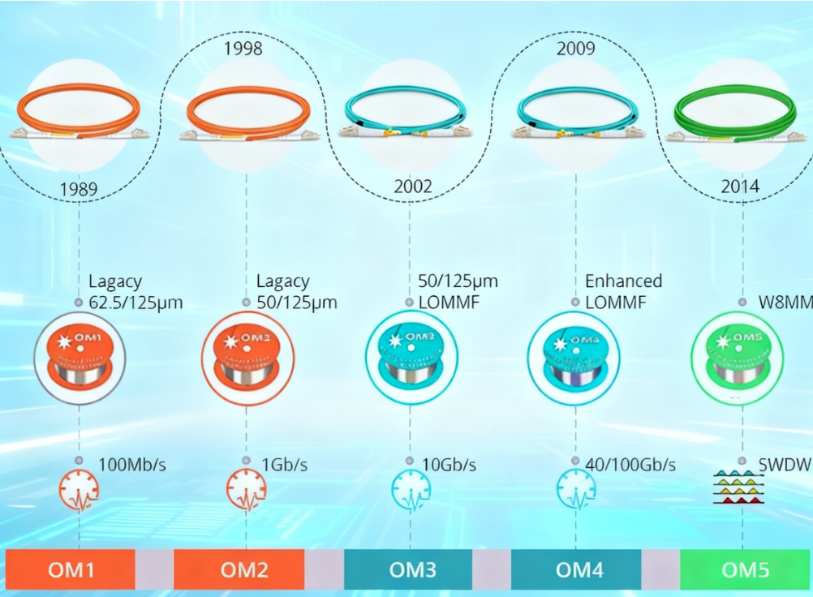
OM (Optical Multimode) fiber comes in five generations. Each one is built for specific bandwidth and distance needs. OM1 fiber through OM5 fibe show steady improvements in multimode fiber optics. They differ in core size, light source types, and what they can transmit.
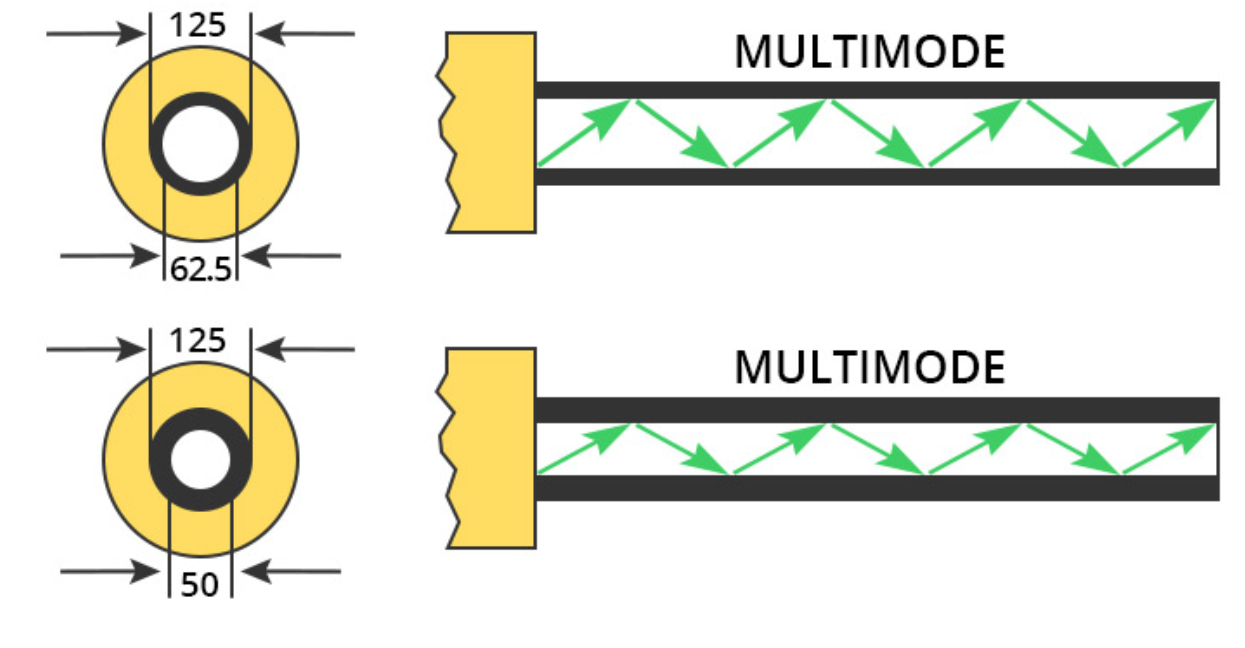
Core Size Evolution
OM1 has a 62.5 µm core. OM2 through OM5 use a smaller 50 µm core. This smaller size improves how light signals travel. It also supports higher bandwidth. The 50 µm standard now dominates modern data centers.
Bandwidth Performance Hierarchy
-
OM1: 200 MHz·km at 850 nm
-
OM2: 500 MHz·km at 850 nm
-
OM3: 2000 MHz·km at 850 nm
-
OM4: 4700 MHz·km at 850 nm
-
OM5: 4700 MHz·km at 850 nm, plus 2470 MHz·km at 953 nm
OM5 adds multi-wavelength support. It can handle at least 4 WDM channels across the 850–953 nm range. Each channel runs at 28 Gbps.
Visual Identification System
Jacket colors help you spot fiber types instantly. Orange means OM1/OM2. Aqua marks OM3/OM4. Lime Green is for OM5. This color system makes network installation and maintenance easier.
Light Source Compatibility
OM1 and OM2 work with LED sources. OM3, OM4, and OM5 use VCSEL (Vertical-Cavity Surface-Emitting Laser) technology. VCSEL gives you better performance and efficiency.
Multimode Fiber Key Specs Table (OM1–OM5)
Distance Reach at Different Speeds
10GBASE-SR Performance
OM1 fiber reaches 33 meters. OM2 extends this to 82 meters. OM3 fiber jumps to 300 meters. OM4 fiber and OM5 fiber achieve 550 meters max distance.
40G and 100G Applications
OM1 fiber and OM2 fiber don’t support these higher speeds. OM3 fiber handles 100 meters. OM4 fiber pushes this to 150 meters. OM5 fiber matches OM4 at 150 meters with SWDM tech.
400G New Networks
OM3 fiber, OM4 fiber, and OM5 fiber support 400G speeds. OM3 fiber limits you to 30 meters. OM4 fiber reaches 50 meters. OM5 fiber delivers the longest reach at 150 meters through SWDM channels.
Bandwidth Specs at 1300 nm
OM1 fiber provides 500 MHz·km at 1300 nm wavelength. OM2 fiber maintains the same 500 MHz·km rating. This 1300 nm spec matters for LED-based legacy systems. Modern VCSEL systems focus on 850 nm performance.
SWDM Tech Advantage
OM5 is the sole fiber with SWDM (Short Wavelength Division Multiplexing) capability. It operates across four wavelengths from 850 nm to 953 nm. Each wavelength carries 28 Gbps data streams. This tech triples your 400G reach compared to OM4. You don’t need extra fiber cables.
Bandwidth and Data Rate Capabilities
Bandwidth shows how much data your fiber optic OM1 through OM5 cables can handle each second. Picture a highway—wider roads carry more traffic. Each OM generation boosts this capacity.
Legacy Fiber Limitations
OM1 fiber delivers 200 MHz·km maximum bandwidth. Your data speeds max out at 10 GbE for just 33 meters. Anything faster than 8 Gbps fails to work properly.
OM2 fiber bumps this up to 500 MHz·km. You get 10 GbE reach up to 82 meters. Both fiber types stop dead at 8 Gbps speeds. Modern 40G, 100G, or 400G applications won’t run on these older standards.
Modern High-Speed Options
OM3 fiber breaks the 8 Gbps barrier with 2000 MHz·km bandwidth at 850 nm. You get 10 GbE for 300 meters. 40/100G works for 100 meters. Even 400G runs at 30 meters.
OM4 fiber doubles this performance at 4700 MHz·km. Your 10 GbE links now span 550 meters. 40/100G traffic travels 150 meters. 400G applications reach 50 meters without issues.
SWDM Multiplexing Power
OM5 fiber matches OM4’s 4700 MHz·km at 850 nm. The real change comes from multi-wavelength support. You get an extra 2470 MHz·km at 953 nm wavelength. Turn on all four SWDM channels at once. Your effective bandwidth jumps to 28,000 MHz·km. Each wavelength runs at 28 Gbps on its own. You can transmit 400GBASE-SR4.2 signals across 150 meters—triple the OM4 distance. OM5 handles new 800GBASE-SR8 specs for future needs.
Speed vs. Distance Trade-Off
Every OM fiber follows one rule: higher speeds mean shorter reach. OM4 runs 10G for 550 meters but drops to 50 meters at 400G. OM5 fixes this with wavelength division. You keep 150-meter links at 100G or 400G speeds. SWDM channels split the load across multiple light frequencies. This stops signal loss over longer distances.
Maximum Distance Chart by Fiber and Application
Match your fiber type to your distance needs and network speeds. The table below shows all critical distance specs across OM1 through OM5 and singlemode fiber for 2025 Ethernet standards.
Application-Specific Distance Limits
10GBASE-SR Deployments
OM1 fiber optic cabling gives you 33 meters for standard 10G Ethernet. Extended reach up to 300 meters? You need specialized transceivers outside typical Ethernet standards. OM2 pushes Ethernet reach to 82 meters. Extended non-standard reach hits 600 meters. OM3 delivers a clean 300-meter span for all 10G applications. OM4 and OM5 max out 10GBASE-SR at 550 meters. Perfect for floor-to-floor backbone connections in large facilities.
40G and 100G Network Builds
OM1 and OM2 don’t support 40GBASE-SR4 or 100GBASE-SR4 protocols. Your migration path starts at OM3. It handles 100 meters for these speeds. OM4 extends this to 150 meters using traditional parallel optics. OM5 matches the 150-meter distance. Plus, it adds SWDM capability for cleaner cable management.
400G and Next-Gen Infrastructure
OM3 reaches 30 meters for 400G requirements. Too short for most data center rows. OM4 improves this to 50 meters for 400GBASE-SR8 deployments. OM5 triples OM4’s reach to 150 meters through 400GBASE-SR4.2 SWDM channels. OM5 becomes your single multimode choice for dense 400G and future 800G rollouts. No need to switch to singlemode.
Singlemode AdvantageSinglemode fiber removes distance limits. You get 500 meters with 400GBASE-DR4 transceivers. You get 10 kilometers using 400GBASE-LR4 optics. Campus interconnects, data center-to-data center links, and metro applications all need singlemode infrastructure. The trade-off? Higher transceiver costs and more precise termination requirements.
All distances show maximum supported reach per current 2025 IEEE and TIA standards. Actual performance depends on transceiver quality, cable insertion loss, and connector cleanliness. Plan for 10–15% margin below maximum specs for production deployments.
jects on existing orange-jacket infrastructure. Don’t spec OM1 or OM2 for fresh builds. They can’t handle today’s bandwidth demands.

Data Center Deployment Patterns
OM3 Budget-Friendly Server Connections
OM3 leads in cost-controlled data center builds. Use it for server-to-top-of-rack (ToR) switch links in medium-sized facilities. Most deployments span 100–300 meters between racks. OM3 handles 100GBASE-SR4 across server rows without premium pricing. Small to mid-tier cloud providers pick OM3 when 400G isn’t on the roadmap yet.
OM4 High-Density Enterprise Standards
OM4 powers most enterprise data centers in 2025. HPC clusters need its 550-meter 10G reach. They also need its 150-meter 100G capability. Financial trading platforms deploy OM4 for dense rack setups. So do virtualization farms and corporate campuses. You get backward compatibility with OM3 transceivers. Your network scales from 100G to 200G without ripping out cables. Migration to 400G stays possible at 50-meter distances.
Next-Generation AI and Cloud Infrastructure
OM5 SWDM Multiplexing Advantage
OM5 targets AI/ML training clusters and cloud-scale fabrics. GPU-to-GPU communication needs 400G or 800G speeds with minimal cable bulk. OM5 cuts your fiber count by 75% versus OM4 at the same bandwidth. One 8-fiber OM5 trunk replaces a 32-fiber OM4 bundle through SWDM channels. Hyperscale providers install OM5 for cable tray space savings. It also improves rack airflow. This fiber type becomes required for 800GBASE-SR8 deployments.
Campus and Long-Haul Scenarios
Singlemode Fiber for Distance Requirements
Building-to-building links go beyond multimode limits. Singlemode fiber handles data center interconnects (DCI) across campus or metro distances. You reach 500 meters with 400GBASE-DR4 optics. Extend to 10 kilometers using 400GBASE-LR4 transceivers. Hyperscale cloud backbones need singlemode infrastructure. So does wide-area network (WAN) aggregation. Higher transceiver costs trade off against unlimited growth potential.
Selection Decision Matrix
Upgrading existing infrastructure? Stick with OM1/OM2 if you’re matching current fiber types. Building 100G or 200G intra-rack connections? OM4 gives the best performance-per-dollar ratio. Planning 400G or 800G with high port density? OM5 SWDM cuts cable bulk and future-proofs your investment. Need inter-building links or unlimited distance growth? Singlemode fiber is the right choice.
Application Notes
Pick your fiber type based on actual deployment scenarios, not just spec sheets. Real-world constraints matter more. Rack density, cable pathway capacity, and transceiver inventory determine the right choice for each project phase.
2025 Deployment Decision Framework
Legacy Infrastructure Management
Keep fiber optic OM1 and OM2 where they already exist in audio-visual systems or campus buildings. Run maintenance and minor extensions on these orange-jacket installations. Never specify OM1 or OM2 for new construction projects. Their 200–500 MHz·km bandwidth can’t support modern data rates. Basic 1G works. Limited 10G applications might work. Anything beyond that won’t.
Cost-Optimized Data Center Builds
Choose OM3 for budget-friendly 10GBASE-SR and 100GBASE-SR4 top-of-rack setups. Most server-to-switch distances stay under 100 meters. OM3 delivers this performance at 30–40% lower cost than OM4. Small enterprise facilities get solid ROI with OM3. Colocation providers benefit too. This works best if 400G migration isn’t planned within 5 years.
High-Density Scalable Platforms
Deploy OM4 as your standard for data center runs between 150–550 meters. HPC clusters need OM4’s 4700 MHz·km bandwidth. Dense virtualization farms need it. Financial trading platforms need it too. You get clean upgrade paths from 100G to 200G without replacing cables. Most 2025 enterprise builds use OM4 for balanced cost and future capacity.
AI and Hyperscale Infrastructure
Specify OM5 for GPU-to-GPU fabrics, 400GBASE-SR4.2 SWDM links, and tight cable pathways. AI training clusters running 400G or 800G speeds gain major benefits. OM5 cuts fiber count by 75% through wideband multiplexing. Cloud providers install OM5 where cable tray space costs more than premium fiber pricing. Plan OM5 once rack power density exceeds 20 kW per cabinet.
Pre-Deployment Action Checklist
Confirm all transceivers support your chosen fiber type’s wavelength range. OM3/OM4/OM5 require VCSEL optics at 850 nm. Verify MPO/MTP connector compatibility for parallel optics applications. Test insertion loss budgets before setting maximum distance specs. Reserve 10–15% margin below published IEEE limits for stable production. Document jacket color codes in your cable management database. This speeds up future troubleshooting.

Frequently Asked Questions (FAQ)
Q: What is the main difference between OM4 and OM5 fiber?
A: While both OM4 and OM5 offer the same bandwidth (4700 MHz·km) at 850 nm, OM5 is designed with SWDM (Short Wavelength Division Multiplexing) capability. This allows OM5 to support multiple wavelengths (850–953 nm) on a single fiber, enabling it to carry up to 400G or 800G signals over longer distances (150m) with significantly fewer fiber strands than OM4.
Q: Can I use OM3 fiber for 400G networks?
A: Yes, but with significant limitations. OM3 fiber supports 400G speeds only up to 30 meters. For most modern data center rows or AI clusters, this reach is too short. OM4 (50m) or OM5 (150m) are recommended for 400G deployments to ensure stable connectivity and future scalability.
Q: What do the different fiber jacket colors mean?
A: The TIA industry standard color codes help identify fiber generations:
Orange: OM1 and OM2 (Legacy LED-based)
Aqua: OM3 and OM4 (Laser-optimized VCSEL)
Lime Green: OM5 (Wideband SWDM) Always check the cable print to confirm specifications, especially between OM3 and OM4 which share the Aqua jacket.
Q: Is OM5 fiber backward compatible with OM3 and OM4?
A: Yes, OM5 uses the same 50-micron core size as OM3 and OM4, making it fully backward compatible. You can connect OM5 cabling to existing OM3/OM4 infrastructure. However, the link will perform at the specifications of the lowest-rated fiber (e.g., an OM5 to OM3 link will be limited to OM3 bandwidth and distance).
Q: Which fiber type is best for AI and Hyperscale data centers?
A: OM5 is the preferred choice for AI and Hyperscale environments. Its support for SWDM technology allows for high-speed 400G/800G connections using fewer fibers (reducing cable congestion) and provides the longest multimode reach (150m), which is critical for connecting distributed GPU clusters and high-density server racks.