Quick summary
MPO patch cords (also called MTP in some branded variants) are multi-fiber, high-density jumpers used everywhere from ToR (top-of-rack) connections to hyperscale backbone trunks. They save rack space, speed deployment, and are available in various fiber counts (8–72+) and lengths from 0.5 m up to 30 m+ (custom lengths available). High-quality MPO assemblies target insertion loss ≤ 0.35 dB for each connector end.
What is an MPO patch cord and why choose one?
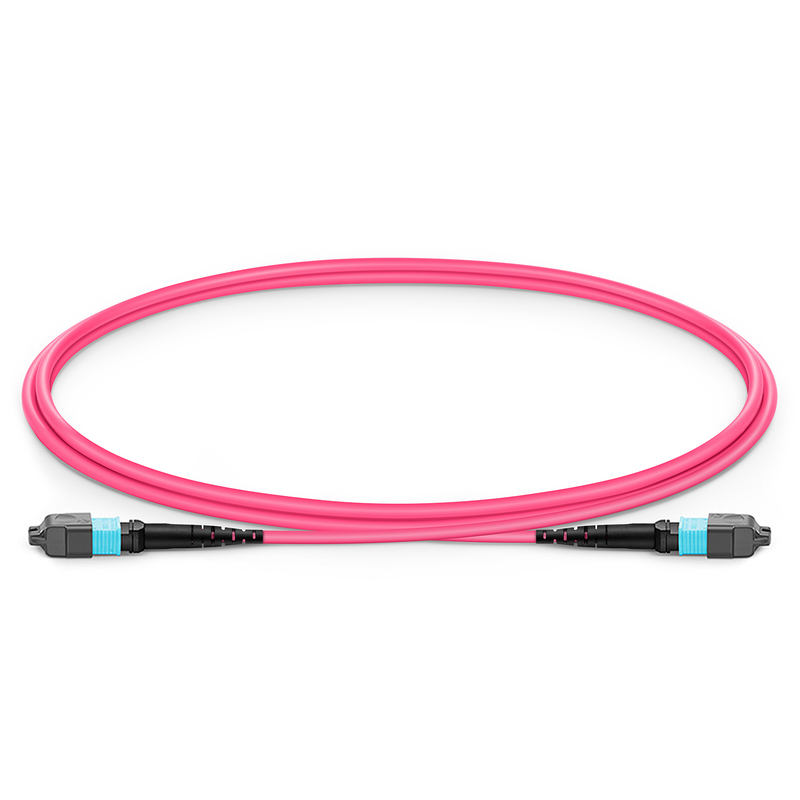
An MPO patch cord is a single cable with an MPO-style multi-fiber connector on one or both ends. These connectors pack many fibers into one ferrule so you can move dozens of channels with a single plug — ideal for 40G/100G/400G and beyond. MPO connectors are factory-terminated and typically delivered tested and ready to plug in, eliminating field fusion splices for most deployments.
MPO vs MTP — are they the same?
Functionally they serve the same role: multi-fiber connectors. “MTP®” is a branded, engineered version of the MPO connector with higher mechanical tolerances and guide-pin improvements; many vendors use the terms interchangeably, but MTP® often indicates a premium, lower-loss assembly. Check vendor datasheets if exact mechanical specs matter for your deployment.
Polarity: Type A / Type B / Type C — which one do I need?
-
Type A (straight-through) — fiber 1 → 1, 2 → 2, etc. Used where system wiring assumes direct mapping.
-
Type B (crossed / reversed) — fiber 1 ↔ 12, 2 ↔ 11, etc. Common when both ends use the same keyed orientation or for certain pinned/pinned mating requirements.
-
Type C (pair-flipped) — swaps fiber pairs (1↔2, 3↔4 …), used in some parallel optics breakouts. Less common but necessary in specific architectures.
Practical tip: Confirm transceiver wiring (pinned vs unpinned) and panel orientation before ordering polarity. A wiring mismatch is one of the biggest on-site headaches.
Standard lengths — what’s stocked vs custom?
-
Common stocked lengths: 0.5 m, 1 m, 2 m, 3 m, 5 m, 7 m, 10 m, 15 m, 20 m, 25 m, 30 m. Breakout cords often include additional stepped lengths (e.g., 0.5m, 1m, 2m, 3m, 4m, 6m, 9m, 14m, 19m, 24m, 29m).
-
Maximum stocked: many vendors stock up to 30 m for MPO-MPO; trunk and specialty cables may go longer or be factory-made to custom lengths.
When to order custom lengths: long cross-row runs, precisely routed rack paths, or breakout harnesses where slack must be tightly controlled. Expect slightly longer lead times for custom assemblies.
Insertion loss & return loss — what are realistic expectations?
-
Typical target (high quality): IL ≤ 0.35 dB per mated MPO connector for both single-mode and high-performance multimode assemblies. Vendors publish “typical” and “maximum” IL — aim for typical ≤0.35 dB and maximum ≤0.50 dB when possible.
-
Return loss: single-mode APC MPOs target ≥ 60 dB; multimode PC polish values are lower (typical RL ≥ 20–25 dB).
Why this matters: higher IL or unstable IL across mating cycles will reduce link budget and can push a marginal design out of spec for 100G/400G links.
Bend radius and cable handling — the rules to follow
-
General guideline: minimum bend radius = ≥ 20× cable diameter (no-load). Under tension or installed in trays, many manufacturers recommend 36–44 mm minimum for common 2–3.6 mm diameters; always check the vendor spec for your exact cable.
-
Practical handling tips: avoid sharp kinks, use proper routing panels and bend-radius guides, do not exceed installation/operating tension specs (e.g., 200 N for many 12-fiber, 440 N for 24-fiber trunk designs — check datasheet).

Physical & environmental specs
Cable jackets: LSZH/LS0H, OFNP (plenum), UV-resistant outdoor jackets, armored/tape options.
Temp range: common rated ranges −40°C to +65°C for most factory cables.
Durability: typical mating cycles ~500 (verify vendor spec). Some ruggedized connectors offer IP68 or MIL-DTL series options for harsh environments.
Which fiber type should I pick?
Multimode: OM4 is the go-to for 40/100/400G in short distances (OM4 typically supports 100G up to ~100–150m depending on transceiver and encoding; OM5 extends some parallel optics ranges).
Single-mode: use G.657.A2 (bend-resistant) for longer runs or where tight bending is expected.
Common mistakes to avoid
1.Ordering wrong polarity relative to transceivers/panel (measure twice, order once).
2.Buying low-spec, untested MPOs for mission-critical trunk runs — saves money up front, costs in troubleshooting later.
3.Ignoring bend-radius and installation tension limits — many “field returns” are due to microbends and excessive stress.
Quick MPO Selection Checklist
1.Fiber type: OM4/OM5 or SM (G.657.A2)
2.Fiber count: 12, 24, 16, 32, 48, etc.
3.Polarity: Type A/B/C (confirm with system wiring)
4.Connector: MPO (female/male), MTP® if specified for premium tolerances
5.Length: pick a stocked length or specify custom; document cable path precisely
6.IL/RL targets: typical IL ≤ 0.35 dB; RL per single/multi spec.
7.Jacket & rating: plenum, LSZH, armored, outdoor options.
FAQ
Q: Can I use MPO for 400G?
A: Yes — MPOs (24- or 32-fiber variants) are widely used for 400G parallel optics and breakout scenarios; pick the correct fiber count and transceiver type.
Q: Are MPO trunks field repairable?A: Not easily — MPOs are usually factory-terminated. Field repair requires specialized fusion splicing or replacement assemblies. For large runs, prefer factory-made trunks.
Q: Do I need pinned or unpinned MPOs?
A: It depends on the mate: pinned (male) plugs mate to unpinned (female) adapters. Many panel/transceiver combos dictate which side is pinned — confirm before ordering.