

If you are upgrading a data center to 40G, 100G, or even 800G, you can’t avoid MPO fiber.
It is the standard for high-density transmission. But let’s be honest: buying MPO fiber cable is stressful. Unlike simple LC patch cords, MPO has three specific traps that cause project delays: Polarity, Gender (Pins), and Fiber Count. Get one wrong, and your $50,000 switch won’t link up.
We also see many RFQs asking for “MPT Fiber.” (Note: This is usually a typo for MTP®, the high-performance brand of MPO, or simply generic MPO. We cover both here).
In this engineer’s guide, we strip away the jargon and explain exactly how to specify MPO Fiber correctly so your network lights up on the first try.
What is MPO Fiber? (And is it the same as MTP?)
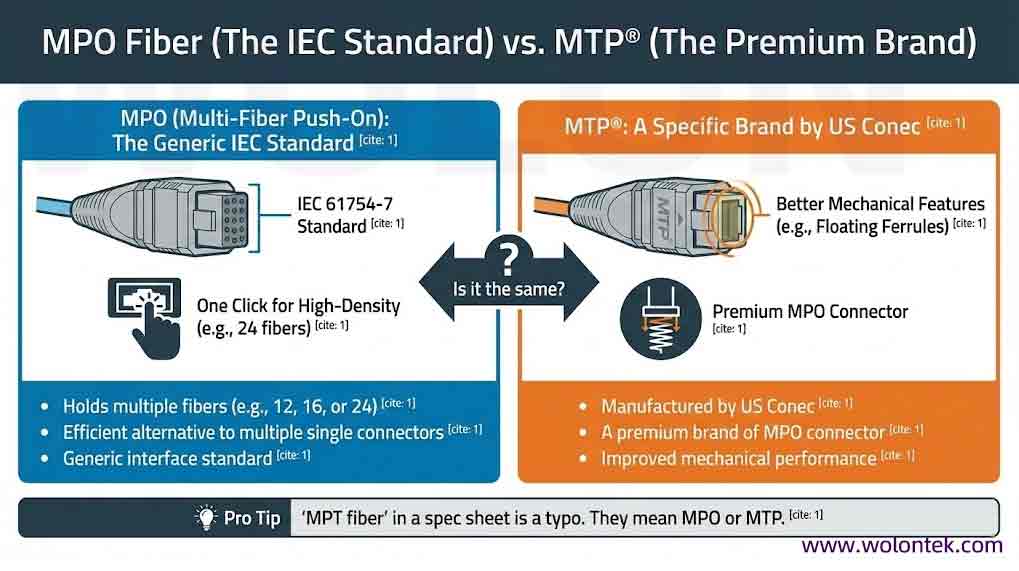
MPO stands for Multi-Fiber Push-On. It is an IEC standard connector (IEC 61754-7) that holds multiple optical fibers (usually 12, 16, or 24) in a single rectangular ferrule.
Why do we use it? Because plugging in 24 separate LC connectors for a 100G link takes too much space. MPO does it in one click.
MPO vs MTP (The Confusion):
MPO: The generic interface standard.
MTP®: A specific brand of MPO connector manufactured by US Conec. It has better mechanical features (like floating ferrules).
Pro Tip: If you see “MPT fiber” in a spec sheet, it is a typo. They mean MPO or MTP. As a factory, we manufacture assemblies using both generic MPO and premium US Conec MTP connectors.
The “Gender” Trap: Male vs Female
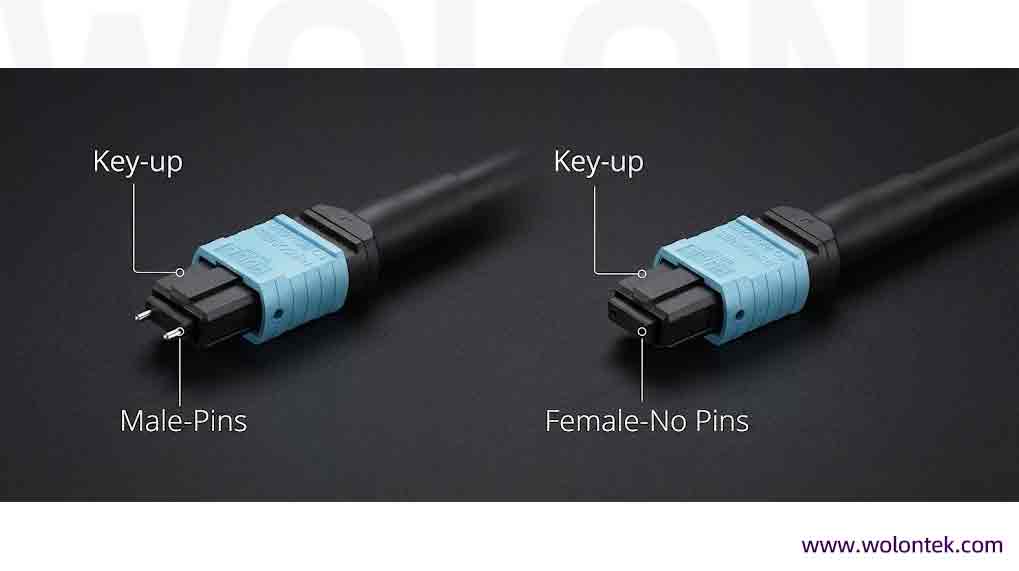
This is the #1 reason for returns in the MPO world. MPO connectors do not “click” together like LC connectors. They rely on Guide Pins for alignment.
Sourcing Cheat Sheet:
Transceivers (QSFP) usually have Male pins inside. -> You need a Female cable.
Cassettes/Patch Panels usually have Male pins inside. -> You need a Female cable.
Trunk Extension: Connecting two cables together? You need Male to Female.
The “Polarity” Headache: Type A, B, or C?
Since an MPO fiber cable has 12 or 24 strands, we need to ensure the light leaving “Tx 1” on Side A arrives at “Rx 1” on Side B. This path is called Polarity.
There are three TIA-568 standard methods. Buying the wrong one means your signal is crossed.
Type A (Straight-Through): Pin 1 goes to Pin 1. (Usually used for backbone links).
Type B (Cross-Over): Pin 1 goes to Pin 12. (The standard for 40G/100G SR4 transceivers). <– Most Common for QSFP connections!
Type C (Pair-Flipped): Complex pair flipping. (Rarely used in modern DC).
Don’t Guess. If you are connecting two QSFP+ transceivers directly, you almost certainly need Type B (Female-Female). If you are uncertain, send us your network topology diagram.
⚠️ Troubleshooting: Don’t Let Light Go Nowhere The TIA-568 standard is complicated, and mixing patch cords (Type A vs Type B) is the most common cause of link failure we see.
Want to see real-world examples of crossed signals and how to solve them?[Read our troubleshooting handbook: MPO Polarity Guide – Common Errors, Case Studies, and Quick Fixes]
MPO-12 vs. MPO-16: The 400G/800G Shift
For years, the 12-fiber MPO (MPO-12) was king. But with the arrival of 400G and 800G AI Clusters (using NVIDIA or Broadcom chips), we are seeing a new connector: MPO-16.
MPO-12: 1 row of 12 fibers. Key is in the center. Used for 40G/100G.
MPO-16: 1 row of 16 fibers. Key is offset (to the side). Used for 400G-SR8.
Warning: You cannot plug an MPO-16 into an MPO-12 port. The offset key prevents it. Be sure to check your transceiver type (e.g., SR8 vs SR4) before ordering cable.
Factory Insider: How to Spot “Bad” MPO Fiber
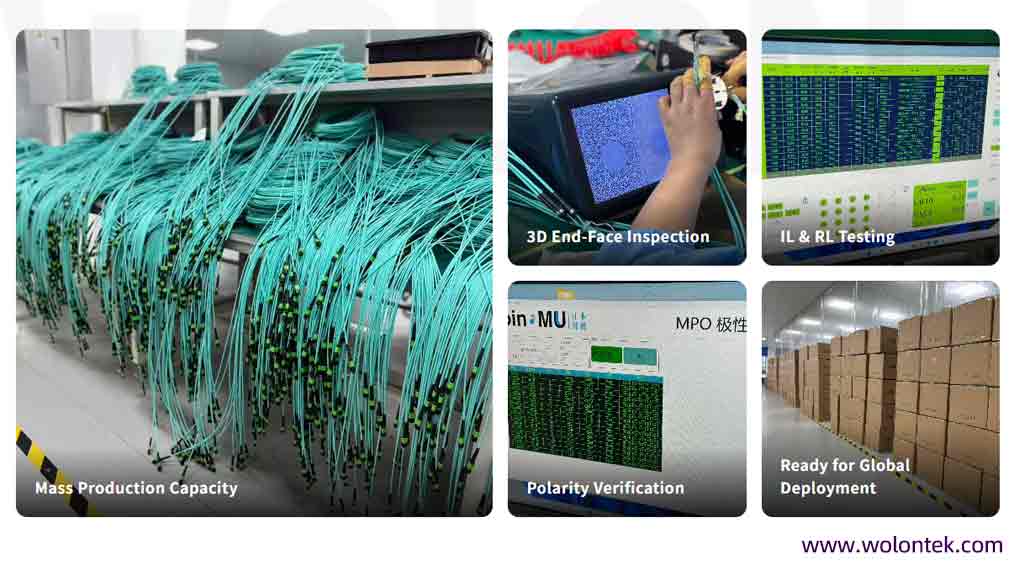
Not all MPO cables are created equal. Poorly manufactured MPO fiber causes high Bit Error Rates (BER). At Wolon, we use 3D Interferometry to test every single connector.
What we check (and what you should ask for in the report):
1.Radius of Curvature: Is the ferrule face curved correctly to ensure physical Contact?
2.Fiber Height: Do all 12 fibers protrude equally? If Fiber #4 is too short, it won’t touch the other side, and that channel will fail.
3.Insertion Loss (IL): For Data Centers, demand Elite / Low Loss grade (≤0.35dB). Standard loss (0.7dB) eats up too much budget.

Conclusion: Let Us Handle the Complexity
Sourcing MPO Fiber Cable isn’t just about length and jacket color. It’s about getting the Gender, Polarity, and Performance Grade right for your specific active gear.
Don’t risk downtime with a “Type A” cable when you needed “Type B.”
Confused by Pins & Polarity? Let Us Handle It.
Connecting a Cisco Nexus to a Patch Panel? Or an Arista to a Server?
Don’t guess. Send us your equipment list. Our engineers will determine the exact Polarity and Gender (Pinned/Unpinned) to prevent a hardware crash.
Available in OM3, OM4, OM5, and OS2 specifications.
FAQ: MPO Fiber Essentials
Q1: Is “MPT Fiber” a real thing?
A: No, “MPT” is a common typo in the industry. Users usually mean MTP® (the high-performance connector brand by US Conec) or generic MPO (Multi-Fiber Push-On). If you see “MPT Fiber” on a bill of materials, you should source MTP/MPO cable.
Q2: Can I plug an MTP connector into an MPO adapter?
A: Yes, absolutely. MTP connectors are fully compliant with the IEC 61754-7 standard. They are 100% intermateable with generic MPO connectors. Think of MTP as the “Pro Version” of MPO—it fits the same port but offers lower signal loss and better durability.
Q3: Do I need to clean MPO connectors before plugging them in?
A: Yes! This is non-negotiable. Because MPO has a large surface area with multiple fibers, even a speck of dust can block a 100G signal or crack the glass core. Always use a “One-Click” MPO cleaner to clean both the cable connector and the transceiver port before mating.
Q4: What is the difference between MPO-12 and MPO-16?
A:
MPO-12: Uses 12 fibers (1 row). Key is in the center. Standard for 40G/100G.
MPO-16: Uses 16 fibers (1 row). Key is offset (to the left). Standard for 400G SR8 AI networks.
Warning: They are not compatible. You cannot plug an MPO-16 into an MPO-12 port.
Q5: Which fiber mode should I choose for MPO: OM4 or OS2?
A: It depends on your distance and budget.
OM4 (Multimode/Aqua/Violet): Best for short distances inside the data center (up to 100m/150m). Cheaper transceivers.
OS2 (Singlemode/Yellow): Best for long distances (>500m) or high-speed 400G/800G links (DR4/FR4). More expensive electronics but future-proof.