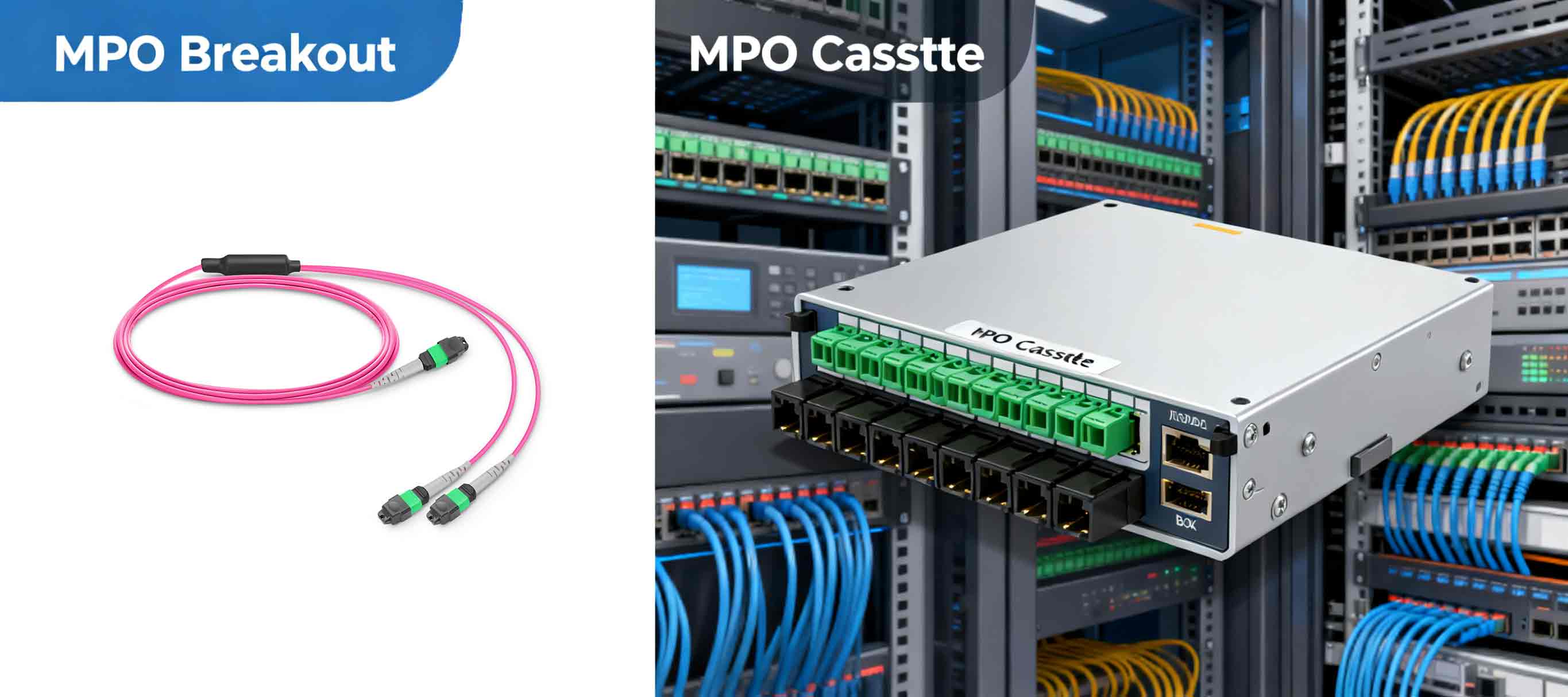
Introduction to MPO Breakout vs MPO Cassette
MPO (Multi-fiber Push-On, aka MTP® in some brands) is the backbone of modern high-density fiber cabling. Two common ways to deploy MPO infrastructure are MPO breakout cables and MPO cassettes. Both convert high-count trunks into equipment-side connections, but they serve very different operational needs. This guide breaks down design, performance, costs, management, and the right use cases so you can choose the best option for your rack, row, or entire data hall.
What is an MPO Breakout Cable?
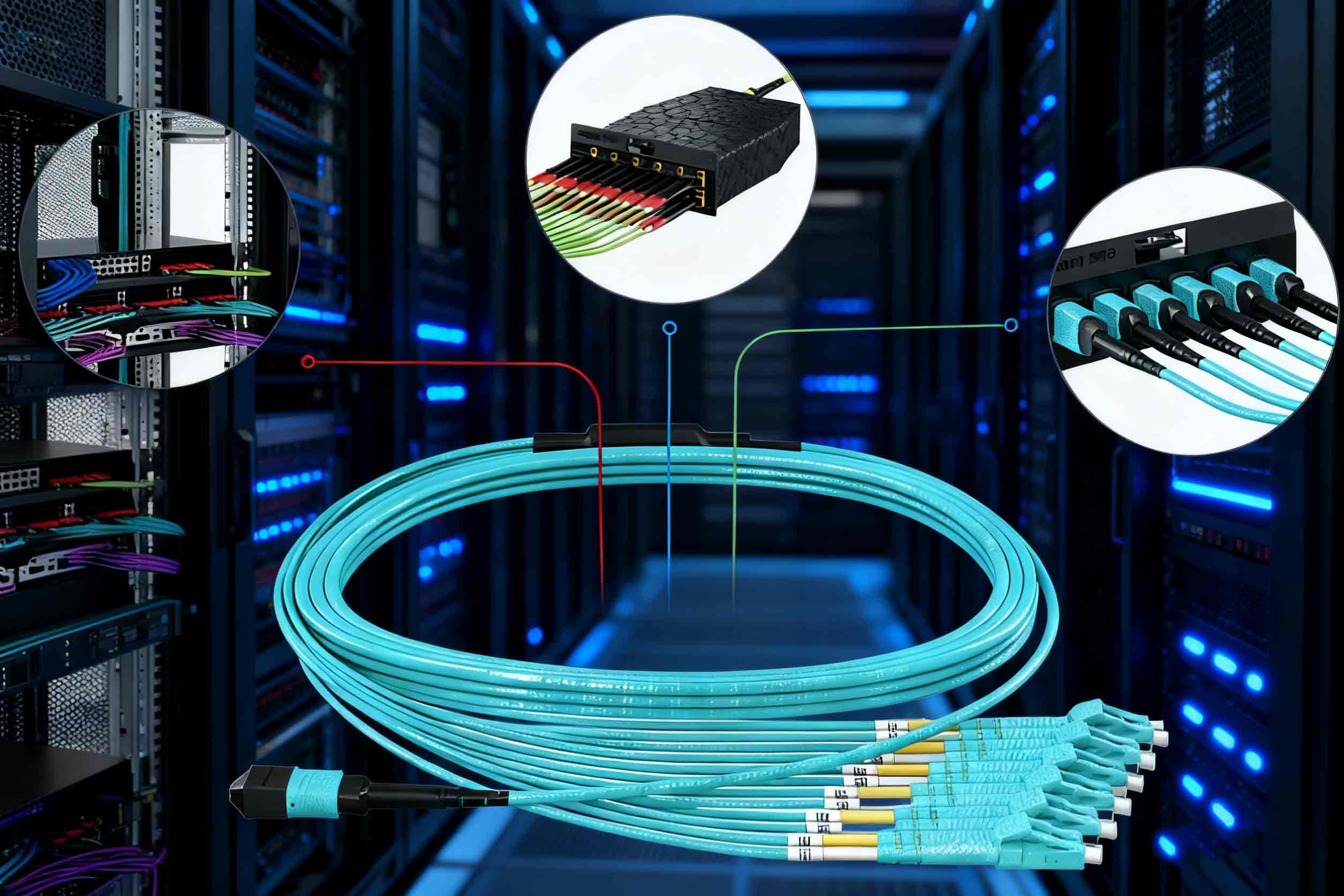
Definition: A single MPO connector at one end that “fans out” into multiple individual duplex connectors (LC, SC, etc.) at the other end.
How it works: One high-count trunk (e.g., 12-fiber) plugs into a switch or cassette, while the breakout end connects directly to multiple devices or patch ports. For example, a 12-fiber MPO → 12 × LC duplex can connect one 100G MPO port to twelve 10G/25G SFP+/SFP28 ports (depending on transceiver mapping).
Strengths
-
Fast, plug-and-play — minimal hardware.
-
Low initial cost for simple point-to-point links.
-
Ideal for top-of-rack (ToR) or direct switch-to-server runs.
Limitations
-
Lower flexibility for reconfiguration — changing topology usually requires replacing cables.
-
Can become messy at scale (many breakout cords in a rack).
-
Traceability and moves/adds can be harder in large, dynamic environments.
What is an MPO Cassette?
Definition: A modular, pre-terminated unit that converts an MPO trunk to multiple duplex ports (LC/SC) presented at the cassette’s front panel. Cassettes are mounted inside patch panels or enclosures.
How it works: MPO trunk cables plug into the cassette’s rear MPO ports; operators patch equipment via front-facing LC/SC ports. Cassettes act as the structured cabling cross-connect between backbone trunks and equipment patch cords.
Strengths
-
Clean, organized front-panel presentation — excellent cable management.
-
High flexibility — swap or replace cassettes without touching trunk runs.
-
Easier day-to-day operations: moves, adds, and changes (MACs) are simpler.
-
Better physical protection for fibers (reduced risk of snagging or damage).
Limitations
-
Higher upfront cost (cassettes + enclosures/patch panels).
-
Slightly more insertion loss since each cassette adds mating points.
-
Requires planning for panel space and inventory.

Quick Feature Comparison
|
Feature |
MPO Breakout Cable |
MPO Cassette |
|---|---|---|
|
Deployment style |
Direct device-to-device |
Panel-based, modular |
|
Initial cost |
Lower |
Higher (cassettes + panels) |
|
Reconfigurability |
Low (replace cable) |
High (swap patch cords or cassettes) |
|
Cable management |
Harder at scale |
Clean and structured |
|
Insertion loss |
Fewer connections → lower loss |
Additional mating points → slightly higher loss |
|
Best for |
ToR, small/static deployments |
Large, dynamic, structured cabling |
Performance & Standards
Fiber types: OM3/OM4 multimode and OS2 singlemode are commonly used. Select the fiber grade to suit reach requirements.
Insertion loss: Breakouts typically introduce fewer mating points and therefore slightly lower loss; cassettes add extra connectors and adaptor interfaces — plan link budgets accordingly. Use low-loss MPO/cassette options for tighter budgets.
Polarity & keying: Follow TIA/EIA polarity standards (Type A/B/C) carefully. Incorrect polarity causes link failures even if physical connections look correct.
Testing: Always insist on factory test reports (insertion loss, continuity, polarity) for pre-terminated assemblies and test after installation.
Cost and ROI: Short term vs long term
Small enterprise / static racks: Use MPO breakout cables for quick, low-cost ToR connections.
Growing colocation or cloud sites: Use MPO cassettes in patch panels to centralize management and speed MACs.
High-density aggregation / hyperscale: Cassettes are preferred for cleanliness, airflow, and scalability. Keep spare cassette ports for future capacity.
Mixed strategy: Many facilities use a hybrid approach — breakouts for short, predictable runs and cassettes for backbone patching and aggregation points.
Deployment checklist
-
Define growth plan — how often will topology change?
-
Map physical routes and rack elevations — plan cassette sloting early.
-
Choose fiber grades and low-loss components if link budgets are tight.
-
Standardize polarity and labeling across the site.
-
Purchase factory-tested assemblies and request test reports.
-
Document patching and maintain an asset inventory (cassette IDs, trunk IDs).
FAQ
Q: Do cassettes always add unacceptable loss?
A: No — modern low-loss cassettes are engineered to meet link budgets for 40G/100G/400G applications. But validate per-link loss when planning long multimode or singlemode runs.
Q: Which is faster to install?
A: Breakouts are faster for a single rack. Cassettes reduce total install time for larger structured systems because they simplify multiple patching operations.

Conclusion
Choose MPO breakout cables for fast, low-cost point-to-point links and small, static deployments. Choose MPO cassettes when you need modularity, neat cable management, and operational agility at scale. In many real-world builds a hybrid approach is the best balance between CAPEX and long-term OPEX.