Quick summary
MPO-12 fiber-Connector = single row of 12 fibers. Best when you need broad device compatibility, easier step-wise upgrades and lower upfront cost.

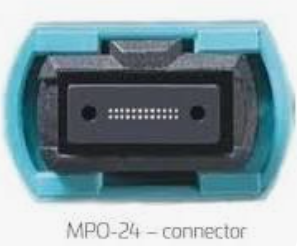
MPO-24 fiber-Connector = two stacked rows (2×12) in the same connector footprint, doubling fiber density and saving rack/panel space — ideal for hyperscale, cloud and AI clusters.
Why MPO matters
MPO (Multi-Fiber Push-On, sometimes branded MTP®) lets you move many fiber channels through one compact connector — a must for modern high-density switch fabrics and parallel optics used in 40G, 100G, 400G and emerging 800G/1.6T links.
Key technical facts
-
Connector footprint: ≈ 12.5 mm × 7.6 mm (MPO family sizes remain similar even as fiber counts increase).
-
Fiber layout: MPO-12 = single row of 12; MPO-24 = two rows of 12 (2×12).
-
Typical insertion loss: modern low-loss MPO assemblies target ~0.25–0.35 dB/channel; standard multimode MPOs often spec ≤ 0.35–0.5 dB depending on construction and polish. High-precision low-loss MPOs can be better.
-
Return loss: commonly > 20 dB for compliant assemblies.
Density & space savings — the practical difference
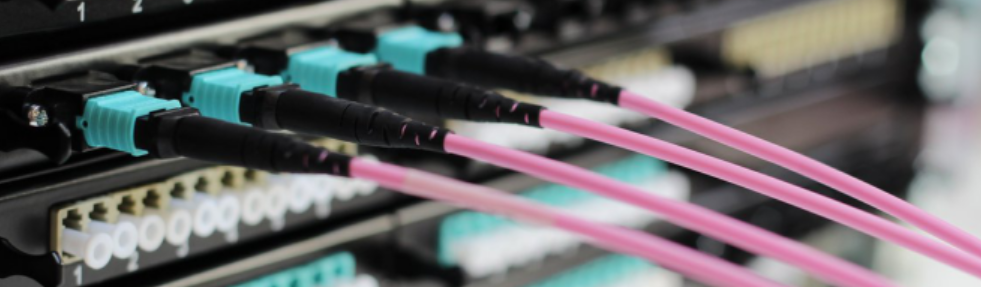
Because MPO-24 packs twice the fibers per connector, trunk and panel density improves substantially. In practice, a 144-fiber trunk built from MPO-24 subunits occupies about 30% less rack/panel area than the same capacity built with MPO-12 subunits — fewer connectors, fewer ports, less cable bulk. That’s why hyperscale sites prefer MPO-24 for space-constrained, high-throughput deployments.
When to choose MPO-12-Connector
Choose MPO-12 when:
-
You need broad compatibility with existing 40G/100G parallel modules and planned incremental upgrades.
-
Budget and per-connector cost matter at small/medium scale.
-
You prefer maximum flexibility for breakout and mixed deployments (easy MPO→LC breakouts).
-
Your density needs are moderate (enterprise, colocation, smaller cloud nodes).
Why: MPO-12 typically has slightly lower nominal insertion loss and is widely supported by legacy and current equipment, making phased upgrades simpler.
When to choose MPO-24-Connector
Choose MPO-24 when:
-
You must maximize fiber density and minimize panel/cable bulk (hyperscale, AI/ML clusters, 5G aggregation).
-
You expect fast future growth to 400G/800G and want fewer trunks to manage.
-
You want to reduce long-term operational overhead (cleaning, inspections, patching).
Why: MPO-24 reduces connector count and cabling complexity at scale, often lowering total cost-of-ownership despite higher per-connector price.
Link examples
-
100G (SR4): typically uses MPO-12 (or 8-fiber parallel variants) — MPO-12 fits many 100G parallel optics use cases.
-
400G (SR8 / SR16): common transceivers use MPO-16 for SR8 (16 fibers) and MPO-24 or higher assemblies are used for aggregation / future growth scenarios.
-
800G and beyond: MPO-24 and multi-row higher-density trunks are the natural fit for these parallel optics designs and for consolidating multiple lower-speed links into single trunks.
Side-by-side
|
Feature |
MPO-12 |
MPO-24 |
|---|---|---|
|
Fibers per connector |
12 (1×12) |
24 (2×12) |
|
Typical insertion loss |
≤ ~0.35 dB (low-loss types) |
≤ ~0.5 dB (standard) — low-loss variants match MPO-12. |
|
Return loss |
> 20 dB |
> 20 dB |
|
Rack/panel density |
Standard |
Highest — up to ~30% less area for same fiber count. |
|
Best fit |
Enterprise / budget / phased upgrades |
Hyperscale / cloud / AI / futureproof cores |
|
Upgrade path |
Easy, broadly compatible |
Best long-term density & TCO at scale |
Practical deployment tips
-
Always buy factory-tested, pre-terminated assemblies with per-link test reports (insertion loss & polarity). This reduces install risk.
-
Use low-loss MPO variants (precision ferrules, MT alignment) if you need longer multimode reach or are close to transceiver budgets. Senko and other vendors publish low-loss MPO options.
-
Follow polarity & keying standards (TIA and vendor guidance) to avoid mispatching when doing breakouts or mix-and-match panels.
-
Plan spare fibers — MPO-24 trunks often leave spare fibers for expansion (e.g., an 800G link using 16 fibers leaves 8 spares). That future-proofs capacity.
FAQ
Q — Will MPO-24 always cause more loss than MPO-12?
A — Not necessarily. Older standard MPO-24 assemblies often show slightly higher insertion loss, but modern low-loss MPO designs and tighter ferrule tolerances narrow the gap — some vendors report ≤0.35 dB per channel for both types when using premium parts.
Q — Can I migrate a 12-fiber trunk to 24-fiber later?
A — Technically yes, but best practice is to plan for the final density early: trunks, cassettes and panel layouts differ. MPO-24 gives more future headroom, but migration is possible with correct adapters/cassettes.
Conclusion
For enterprise / cost-sensitive projects and straightforward 40G/100G deployments → MPO-12-Connector.
For hyperscale, cloud, AI, or any build where rack/panel density and long-term TCO matter → MPO-24-Connector. Plan with low-loss assemblies and factory test data to ensure performance headroom for 400G/800G transitions.