
DAC Vs AOC ?Direct Attach Copper (DAC) and Active Optical Cable (AOC) are the two dominant short-reach cabling choices for modern data centers. DAC (copper twinax) delivers the lowest latency and the lowest per-link power and purchase cost for short links; AOC (fiber with on-cable optics) provides longer reach, immunity to electromagnetic interference (EMI), and easier cable management at higher upfront and operating cost. The best practical architecture mixes both: DAC for intra-rack / ultra-short links and AOC for inter-rack, end-of-row and EMI-sensitive runs.
DAC and AOC cables plug directly into the same SFP/QSFP ports used by optical transceivers. If you aren’t familiar with the port standards themselves (e.g., the difference between SFP+ and SFP28 ports), we recommend starting with our [Optical Module Architecture Guide] to understand the form factors first.
DAC Vs AOC :Distance & Speed
-
DAC (passive): Typical practical reach is up to ~5 meters for 100G QSFP28 passive twinax; many passive DAC product specs list 0.5–5 m as standard. Higher-speed DAC (400G/800G) is usually limited to even shorter distances (a few meters), and passive 400G twinax often tops out near ~3 m.
-
DAC (active): With in-cable retimers/repeaters, active DAC can extend to ~7–15 m depending on speed and design, but cost and power rise compared with passive DAC.
-
AOC: Typical multimode AOC products cover from 1 m up to 100 m on OM3/OM4 fiber; some advanced AOC solutions (and vendor-specific implementations for 400G/800G) extend to several hundred meters. For common 100G multimode setups, 70–100 m on OM3/OM4 is typical.
Takeaway: For links under ~5–7 m, DAC is the lowest-cost, lowest-latency option. For anything beyond that range—especially >10 m—AOC becomes the practical choice.
DAC Vs AOC :Latency, power and thermal impact
-
Latency: Pure copper DAC offers the smallest conversion latency because it is a direct electrical path; measured differences are often sub-microsecond vs. AOC, making DAC preferable for the most latency-sensitive workloads. AOC adds tiny microseconds for optical/electrical conversion, which is negligible for most applications.
-
Power consumption: Passive DAC draws almost no active power (typically <0.15 W per link). Active DACs draw modest power (<1 W). AOCs consume more power per cable—commonly in the 1–2 W range (some vendor documents list up to ~2.5 W per end for certain assemblies). At hyperscale, this per-port difference compounds into meaningful OPEX and cooling differences.
Takeaway: For energy- and cooling-sensitive deployments at scale, passive DACs reduce operational cost; AOCs increase per-port power but deliver reach and flexibility.
DAC Vs AOC :Signal integrity & EMI
-
AOC: Optical medium is inherently immune to EMI and crosstalk; BER stays low across long multimode runs. This is valuable in electrically noisy environments or when long, long runs are required.
-
DAC: Copper runs are susceptible to EMI and attenuation as length increases; bit-error rates can rise with distance and in high-noise racks. Good shielding and short lengths mitigate most issues for intra-rack use.
Takeaway: Use AOC where EMI or electrical separation is a concern; use DAC where cable length and electrical noise are controlled.
DAC Vs AOC :Physical handling and cable management
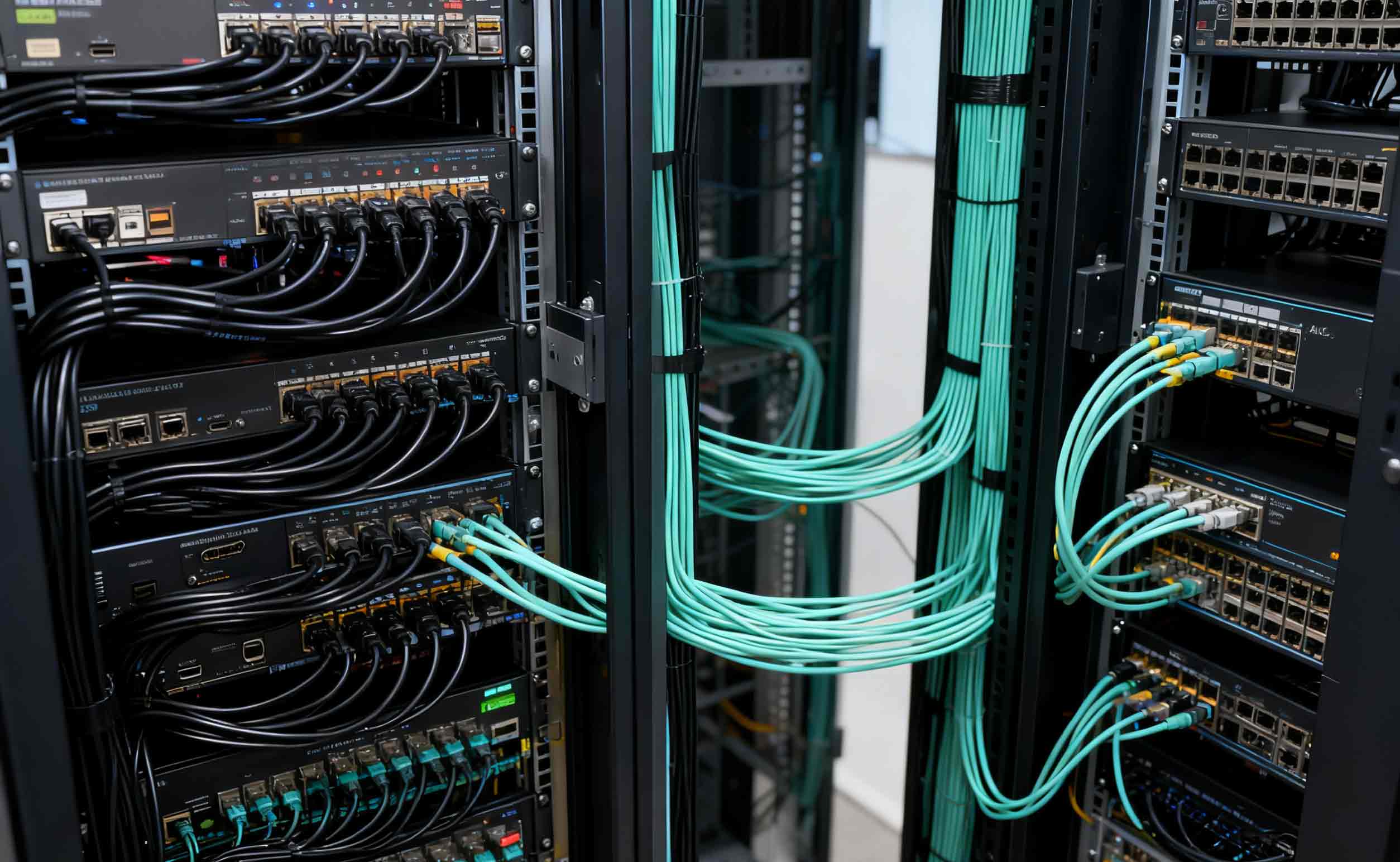
AOC assemblies tend to be significantly lighter and thinner than equivalent copper twinax assemblies; bend radius is tighter and routing in dense rack environments is easier. Copper DACs become bulky and harder to route as data rates and conductor gauge increase, potentially affecting airflow and port strain.
DAC Vs AOC :Is AOC Worth the Extra Cost?
-
Purchase price: Passive DACs are the least expensive per link; active DACs cost more, and AOCs are typically 2×–3× the cost of equivalent passive DAC links at the same speed and short-to-medium lengths.
-
Operating cost: Power and cooling differences (AOC > active DAC > passive DAC) create ongoing OPEX differentials—at hyperscale, saved watts per port can justify choosing DAC for vast numbers of short links.
-
Lifecycle: Passive copper has no lasers or optics to age, often translating to longer mean time between failures for the cable itself; AOCs include active optical components whose lifetime must be considered in replacement planning.
Takeaway: For dense, short, high-count deployments, passive DAC yields the best TCO; for longer runs or easier cable management, AOC’s higher CAPEX and OPEX can be justified.
Practical deployment guidance
-
Intra-rack / ToR server → switch (≤5 m): Passive DAC is typically the best option (lowest latency, lowest cost and power).
-
Adjacent racks / EoR (≈5–30 m): Active DAC may be feasible for some designs, but AOC is commonly chosen for flexibility and EMI immunity.
-
Longer inter-rack / spine-leaf / cross-room (>30–100+ m): AOC is the practical choice; multimode AOC supports 70–100 m (OM3/OM4) and vendor-specific AOCs or single-mode solutions extend farther.
Conclusion
A clear, use-case driven decision yields the best results: choose passive DAC where distances are short and cost, latency and energy efficiency matter most; choose AOC where reach, EMI immunity, lightweight routing and consistent signal integrity across meters matter most. Many modern data centers use a hybrid approach—DAC for dense rack fabric and AOC for inter-rack/inter-row links—to optimize both CAPEX and OPEX.
Frequently Asked Questions (FAQ)
Q1: What is the difference between Passive DAC and Active DAC?
A: A Passive DAC contains no active electronics; it is simply a copper wire acting as a direct electrical connection, which minimizes power and latency but limits distance to ~3-5m. An Active DAC (ACC) contains a signal booster or retimer chip in the connector headers to compensate for signal loss, allowing it to reach longer distances (up to ~7-15m) but consuming slightly more power.
Q2: Can I use a generic DAC cable to connect a Cisco switch to a HP server?
A: It depends on the coding. This is called a “Dual Compatibility” or “Cross-Compatible” requirement. You cannot use a standard Cisco-coded cable because the HP end might reject it. You need a vendor like Wolon to customize the DAC with Cisco codes on one end (A) and HPE codes on the other end (B) to ensure the link comes up on both sides.
Q3: Is DAC really faster than AOC?
A: Strictly speaking, yes. DAC is purely electrical, so it avoids the optical-electrical-optical (O-E-O) conversion process required by AOCs. This saves approx. 0.1 microseconds of latency. While this is negligible for general office networks, it is a critical advantage for High-Frequency Trading (HFT) and massive supercomputing clusters where every nanosecond counts.
Q4: Can I cut an AOC or DAC cable to shorten it?
A: No. Both DAC and AOC are “pre-terminated” assemblies. The cables are permanently fused inside the connector modules at the factory. Cutting the cable will destroy the assembly. If you need adjustable lengths, you should use separate SFP Transceivers with standard Fiber Patch Cords.
Q5: What is a “Breakout” DAC/AOC?
A: A Breakout cable connects a high-speed port to multiple lower-speed ports. For example, a 100G QSFP28 to 4x 25G SFP28 breakout DAC allows you to connect one 100G switch port to four separate 25G servers. This is a standard method for increasing port density in Top-of-Rack (ToR) architectures.