
If you are upgrading a network switch or deploying fiber to the home (FTTH), you will inevitably face the connector choice: LC vs SC.
While both are proven fiber connectors, they are not interchangeable on SFP modules. Choosing the wrong one can lead to costly restocking fees or project delays. This guide cuts through the jargon to explain the real technical differences, the specific use cases for each (Standard Enterprise vs. PON), and how to choose the right form factor for your Wolon SFP transceivers.
Note: The connector type (LC vs SC) is just the physical interface. To understand the internal differences like Wavelength, DDM, and Transmission Distance, make sure to read our [Ultimate Guide to SFP Modules] first.

Quick comparison table — LC vs SC (at-a-glance)
| Feature | ???? LC SFP Module (Industry Standard) |
⬜ SC SFP Module (Legacy / Rugged) |
|---|---|---|
| ???? Ferrule Size | 1.25 mm (Small Form-factor) |
2.5 mm (Larger, legacy size) |
| ???? Density | High Density Fits 2 LC ports in space of 1 SC. Ideal for patch panels. |
Lower Density Takes up more panel space. |
| ???? Durability (Mating Cycles) |
~500 Cycles (Standard use) |
~1,000 Cycles (Robust push-pull design) |
| ???? Insertion Loss | ~0.2 – 0.5 dB (Depends on polish quality) |
~0.2 – 0.5 dB (Similar performance) |
| ???? Best Application |
✅ Data Centers & Telecom The default for 10G/25G/40G/100G transceivers. |
????️ Field Termination & PON Common in older gear, GPON/EPON, or BiDi modules. |
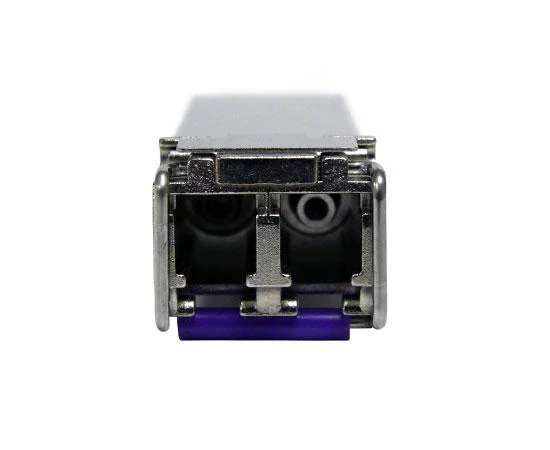
What is an LC SFP module?(The Enterprise Standard)
The LC (Lucent Connector) is the dominant interface for modern networking. It features a 1.25 mm ferrule, which is half the size of the older SC connector.
Why LC Won the Data Center War
-
High Density: Because of its small footprint, manufacturers can fit 48 or even 96 LC ports on a single 1U switch.
-
SFP/SFP+ Native: Almost all standard Duplex (2-fiber) SFP transceivers—whether 1G, 10G, or 25G—are designed with an LC interface.
-
Secure Latching: It uses a clip mechanism similar to an RJ45 Ethernet jack, providing a secure “click” that confirms the connection.
Verdict: If you are connecting switches in a rack or building an enterprise LAN, you almost certainly need LC SFP Modules.
What is an SC SFP module?
TheSC (Subscriber Connector)
uses a larger 2.5 mm ferrule and a simple “Push-Pull” locking system. While it was once the standard for everything, its large size made it obsolete for high-density switches.
Where is SC Still Used?
You rarely see SC ports on standard dual-fiber SFPs anymore. However, SC remains king in Single-Fiber (BiDi) and PON (Passive Optical Network) applications:
-
FTTH/ISP Networks: GPON/EPON OLT and ONU modules often use SC connectors because they are robust and easy for field technicians to handle with gloves on.
-
Simplex BiDi Modules: Some older bidirectional transceivers use a single SC port to transmit and receive on one fiber strand.
Verdict: You generally only choose SC SFP Modules if you are an ISP deploying Fiber-to-the-Home (FTTH) or connecting to legacy telecom equipment.

Technical Deep Dive: Does Connector Type Affect Speed?
A common myth is that one connector is “faster” than the other. The Truth: The connector type (LC or SC) has zero impact on bandwidth. Both can handle 1G, 10G, or even 100G.
What matters is Insertion Loss (IL) and Return Loss (RL):
-
Standard Loss: ~0.3 dB per mated pair.
-
Wolon Quality: At Wolon, we test our SFP interfaces using 3D Interferometers to ensure the ceramic ferrule end-face geometry is perfect. This keeps insertion loss typically below 0.2 dB, regardless of whether you use LC or SC.
Practical differences that matter to buyers
-
Rack / patch-panel density — If you’re filling a 1U switch or dense patch panels, LC almost always wins. Fewer adapters, neater cable management, and easier upgrades to higher-speed optics (25G/40G/100G) that rely on LC-compatible breakout cabling.
-
Inventory & adapters — If your building already uses SC cabling, buying SC SFPs or LC-SC adapters may be cheaper than ripping and re-cabling — but if you’re starting fresh, pick LC to match contemporary optics.
-
Field repairs & terminations — SC’s push-pull is easier for quick field work and is still common in some outside-plant / FTTH deployments. LC requires a slightly steadier hand and specific mechanical splice/polish kits.
-
Life cycle & mating frequency — If a port will be frequently unplugged, check the vendor mating-cycle spec: some SC parts are rated for more cycles, but high-quality LC connectors are more than adequate for typical office/data-center use.

Decision Guide: Which SFP Module Should You Buy?
To make the right decision, look at your hardware and your application:
Scenario A: Enterprise or Data Center Upgrade
-
Equipment: Cisco/Aruba/Juniper Switches, Servers.
-
Choice: LC SFP Module.
-
Reason: Your switch faceplate is designed for high density. An SC connector physically won’t fit into a standard duplex SFP cage.
Scenario B: ISP / Telecom / FTTH Deployment
-
Equipment: OLTs (Optical Line Terminals), ONUs, or Outdoor Cabinets.
-
Choice: Likely SC SFP Module (Simplex).
-
Reason: SC connectors are more rugged for field technicians and are the standard for single-fiber BIDI/PON links.
Scenario C: Connecting to Old Fiber Panels
-
Situation: Your wall jacks are SC, but your new switch is LC.
-
Choice: Buy LC SFP Modules for the switch, and use an LC-to-SC Patch Cord. Do not try to hunt for “SC SFPs” just to match the wall; it’s easier and cheaper to convert the cable.
Why Source SFP Modules from Wolon?
Choosing between LC and SC is just step one. Ensuring compatibility and reliability is step two.
As a dedicated manufacturer, Wuhan Wolon Communication offers more than just off-the-shelf parts:
-
Broad Compatibility: We code our SFP EEPROMs to work seamlessly with Cisco, Huawei, HPE, Juniper, and 100+ other brands.
-
Precision Manufacturing: Whether you need the high density of LC or the ruggedness of SC, our ferrules are polished to strict radius of curvature standards to minimize signal loss.
-
Custom Solutions: We supply rare configurations, including SC BiDi SFPs and Industrial Grade modules for harsh environments.
Stop Guessing. Start Connecting. Unsure if your project needs BiDi SC or Duplex LC?
FAQ: SFP Connectors
Q: Can I plug an SC cable into an LC SFP port?
A: No. The SC connector is twice the size of the LC port. You must use a fiber patch cord with LC on one end (to plug into the SFP) and SC on the other end (to plug into your fiber patch panel).
Q: Why are SC connectors preferred for FTTH?
A: The “Push-Pull” design of the SC connector is easier to grip and unplug, which is beneficial for field technicians working in outdoor cabinets or customer homes where high-density is not a priority.
Q: Does Wolon sell LC-to-SC Adapter Cables?
A: Yes. We are a one-stop shop. We can supply the SFP transceivers (LC or SC) and the matching high-grade fiber patch cords (Jumpers) in any length or mode (OS2/OM3/OM4).