
SFP vs RJ45 Module Ethernet: 5 Key Advantages & Best Use Cases Explained
Network designers constantly choose between modular transceivers (SFP/SFP+) and fixed copper RJ45 ports. The right choice affects reach, power, latency, cost and future-proofing. This article explains what an SFP module is, what an RJ45 (copper) module or port is, compares them side-by-side with accurate technical numbers, and highlights five real advantages and the best use cases for each option. All key technical claims are referenced to vendor/specification sources.
Quick differences (at-a-glance)
| Aspect | SFP Module (optical or copper SFP) | RJ45 Module / 10GBase-T (built-in or SFP+ RJ45) |
|---|---|---|
| Media | Fiber (MM/SM) or copper via SFP-T RJ45 | Copper (twisted pair Cat5e/6/6a/7) |
| Typical max reach | MMF: up to 300 m (OM3) / 400 m (OM4) for 10G SR;
SMF: kilometers. |
Copper: 100 m for 1G over Cat5e/6; 10GBase-T
practical: 30–100 m depending on cable category (Cat6a/Cat7 shorter/longer). |
| Power consumption | Optical SFP+ typically ~0.7–1.5 W; 1G SFP copper ~1.2 W. | 10GBase-T SFP+ / RJ45 typically ~2–5 W per port (varies by implementation), significantly higher than optical SFP+. |
| Latency | Very low (optical): minimal added latency | Slightly higher encoding/PHY latency on 10GBase-T |
| Cost (port/module) | Module cost + fiber cable; modules vary widely | Cheaper cables for short runs; built-in RJ45 ports avoid module cost |
| Flexibility | Hot-pluggable media choice (fiber/copper/transceivers) — MSA compliant but vendor compatibility caveats exist. | Fixed; no hot-swap of medium (unless using separate SFP+ RJ45 transceivers) |
| Best for | Long distance, high density, future upgrades | Short runs, desktop/office links, legacy copper infrastructure |
What is an SFP module?
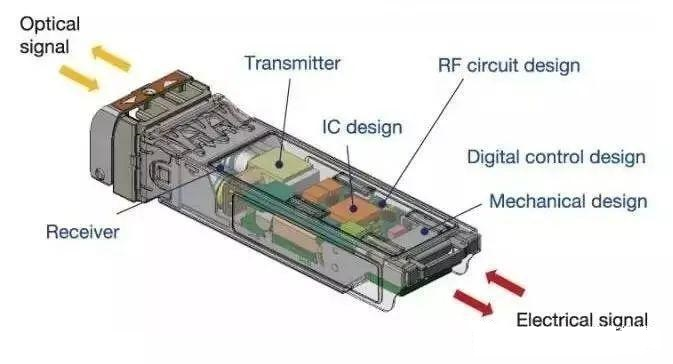
SFP (Small Form-factor Pluggable) is a hot-pluggable transceiver standard that lets a switch/router port accept a media-specific module — optical (various wavelengths/reaches) or copper (RJ45 SFP). It’s the compact successor to GBIC and is covered by industry MSAs so different vendors produce compatible modules.
*Want to learn more?:What Is an SFP Module? (Comprehensive Guide Including Fiber Optic Connector Classification)
Pros
Media flexibility: Same port can host optics for short/long reach or a copper SFP for 100m. Great for mixed environments.
High density: SFP/SFP+ modules allow many high-speed links in small switch chassis.
Long reach using fiber: 10G SR optics can do ~300 m (OM3) / 400 m (OM4); single-mode LR/ER optics reach kilometers. Vital for campus and data-center interconnects.
Lower port power (optical): Optical SFP+ transceivers commonly draw <1 W in many modern modules, saving rack power at scale.
Cons
Higher upfront complexity: You must choose and stock modules and matching cables (LC, duplex etc.).
Vendor compatibility / lock-in risk: Some vendors check module vendor IDs and can reject third-party optics; MSAs exist but device firmware or vendor policies sometimes block generic modules (workarounds or vendor-certified modules are common).
Cost for short copper runs: If you only need 1-2m links, fiber + optics may be overkill vs. RJ45.
What is an RJ45 module?
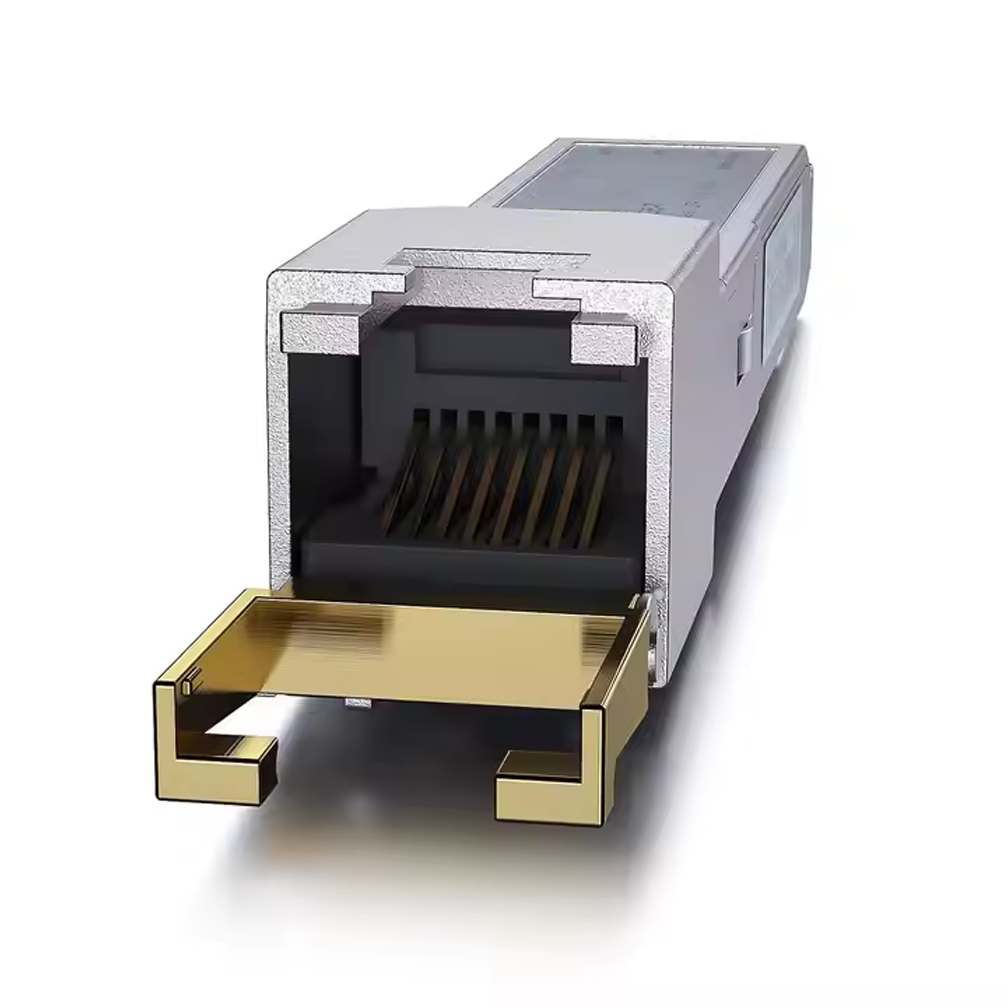
RJ45 is the standard 8P8C connector for twisted-pair Ethernet. “RJ45 module” in this context refers to either a fixed RJ45 port on a switch or a copper SFP (SFP with RJ45 jack) / SFP+ 10GBase-T transceiver that provides RJ45 connectivity in a modular slot.
Pros
Simplicity & ubiquity: Offices and desktops are wired for RJ45; cables and termination are inexpensive and easy to service.
Good for short runs: 1 Gbps up to 100 m over Cat5e/Cat6; many enterprises still use copper for access links.
No optics inventory: If ports are native RJ45, you don’t buy SFPs for copper links.
Cons
Reach limits: Copper is constrained to 100 m for 1G; 10G over copper often needs Cat6a/Cat7 and still may be limited (many 10G SFP+ copper modules are only rated for 30 m on Cat6a/Cat7).
Higher power for 10G: 10GBase-T PHYs historically consume several watts per port — meaningful OPEX in dense deployments.
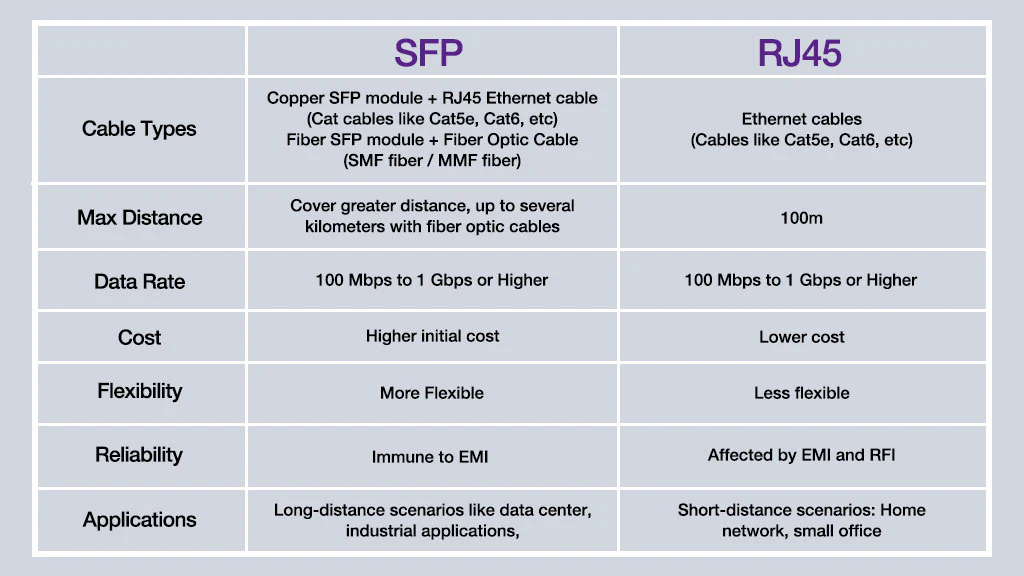
5 Key Advantages :SFP module vs RJ45 module
1. Distance & noise immunity — SFP wins
Optical SFPs support multimode/mode and single-mode fiber with reach from hundreds of meters to tens of kilometers; fiber is immune to EMI and ground loops. Example: 10GBASE-SR (SFP+) supports ~300 m (OM3) / 400 m (OM4).
2. Power efficiency at scale — SFP often wins
10G optical SFP+ modules commonly consume under 1 W, whereas 10GBase-T (RJ45) PHYs/transceivers typically draw 2–5 W per port depending on chipset and distance — significant when multiplied across racks.
3. Flexibility & future proofing — SFP wins
The same SFP slot can host different media types (1G/10G optical, 1G copper, CWDM/DWDM optics) for upgrades or mixed infrastructure — ideal for long-term network roadmaps.
4. Simplicity & cost for short runs — RJ45 wins
For desktop or short wiring closet links (≤100 m), RJ45 is cheaper in cable cost and simpler to troubleshoot; no optics to manage. For many access layers this is still the practical choice.
5. Compatibility & operational risk — mixed
SFP’s flexibility is powerful but can create operational headaches (module inventory, vendor compatibility). Some OEMs intentionally block third-party optics; budget teams must weigh module cost vs. vendor lock-in risk. RJ45 avoids that specific pain.
Best use cases
Choose SFP optical when: uplinks between switches, data center leaf-spine interconnects, campus backbone, and any link where distance, EMI immunity or future-proofing matters. Use multimode SFP+ (SR) for short OM3/OM4 campus links and single-mode (LR) for campus/data-center >2 km.
Choose copper RJ45 when: office desktops, PoE endpoints, or patch panel runs ≤100 m where cost and simplicity trump reach. For 10G to the desktop, evaluate cable grade (Cat6a/Cat7) and the power/cooling cost tradeoffs.
Hybrid approach (recommended): Use RJ45 for access (edge) and SFP optical for aggregation/uplink. This balances cost, manageability and scalability.
Summary
- SFP modules (optical) = best for reach, low latency, lower optical port power and future-proofing in aggregation and data-center layers.
- RJ45 (copper) = simple, cheap and ubiquitous for short access links; but expect shorter reach and higher power at 10G rates.
- For most enterprise networks a hybrid model (RJ45 at edge, SFP optical uplinks) is the optimal tradeoff.
“Want to learn more about optical transceiver architecture? Check out our [Ultimate Guide to SFP Modules].”
If you’re specifying transceivers or mixed-media switches, Wuhan Wolon Communication (WOLONfiber) can supply MSA-compliant SFP optical transceivers(1.25G-800G) and 1G/10G SFP RJ45 copper modules tailored for campus and data-center deployments. We can help you pick the right mix to minimize OPEX (power/cooling) while meeting reach and upgrade goals — tell us your network diagram and target speeds and we’ll propose a bill-of-materials.
Frequently Asked Questions (FAQ)
Q1: Can I connect an SFP port to a standard RJ45 port?
A: You cannot connect them directly with a patch cable because the physical interfaces are different. However, you can connect them functionally by inserting a Copper SFP (RJ45 SFP) module into the SFP slot. This converts the SFP slot into a standard RJ45 jack, allowing you to use regular Cat5e/Cat6 cables to connect to the other device’s RJ45 port.
Q2: Which is better for 10G networks: SFP+ optical or 10GBASE-T RJ45?
A: For data centers and switches (aggregation layer), SFP+ optical is generally better because it has lower latency (typically <1 μs vs. 2+ μs for copper), consumes significantly less power (<1W vs. 2-5W), and generates less heat. 10GBASE-T RJ45 is better for cost-effective connections to servers or desktops within very short distances (usually <30m-100m) where you want to use existing copper cabling.
Q3: Does a 10G SFP+ RJ45 copper module really get hot?
A: Yes, 10G copper SFP+ modules run significantly hotter than optical modules. Converting 10G signals for transmission over copper twisted pairs requires more power (often 2.5W or more per module). When populating a switch with these modules, it is crucial not to fill adjacent ports in a high-density row without checking the switch vendor’s thermal guidelines to prevent overheating.
Q4: Can I use Cat6 cable for 10G SFP+ copper connections?
A: Yes, but with distance limitations. A standard 10GBASE-T SFP+ module can typically support 10 Gbps over Cat6 cables up to 30 meters (approx. 98 feet). For distances up to 80-100 meters, you must use Cat6a or Cat7 cabling. Always check the specific distance rating of the module you are buying.
Q5: Are SFP modules compatible with all switch brands?
A: Not automatically. While the physical form factor is standardized (MSA), many switch manufacturers (like Cisco, HP, or Juniper) code their firmware to reject “unauthorized” third-party modules. To ensure compatibility, you must purchase modules that are specifically coded for your switch brand. WOLON provides MSA-compliant modules with custom coding to ensure they work seamlessly with your specific equipment.