Choosing the right optical wavelength is one of the quickest ways to determine how far a Transceiver can reliably carry data. Engineers decide among 850 nm, 1310 nm and 1550 nm based on reach, fiber type, cost and the physical limits that affect signal fidelity. This article explains why wavelength matters, compares the three bands, and gives clear selection guidance for real-world networks.
Physical principles that set reach limits
Attenuation (optical loss)
Attenuation is loss of optical power per kilometer. Lower attenuation at a wavelength means more signal remains at the receiver for the same transmitter power, which directly increases possible reach.
Dispersion (pulse spreading)
Dispersion causes pulses to spread in time and limits maximum data rate for a given distance. Chromatic dispersion (wavelength-dependent group delay) is especially relevant for high-bit-rate, long links.
Modal dispersion (multimode fiber specific)
On multimode fiber (MMF), different propagation modes travel different path lengths and arrive at different times. This modal dispersion is the main reason 850 nm MMF links are limited to short reaches despite acceptable attenuation.
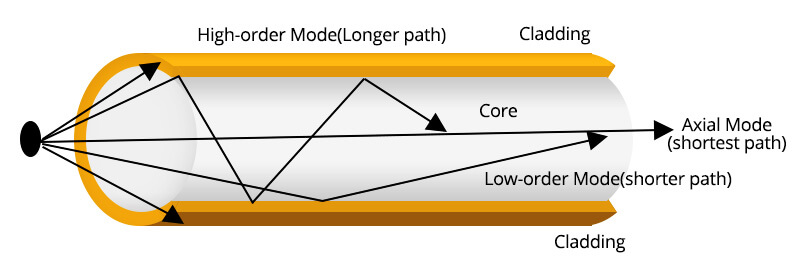
Wavelength-by-wavelength practical comparison
850 nm — Short reach, multimode specialty
-
Typical use: VCSEL-based modules (e.g., 1000BASE-SX, 10GBASE-SR).
-
Fiber: Multimode (OM1–OM5).
-
Limiting factor: Modal dispersion and modal bandwidth of the cable, not attenuation.
-
Typical reach: Hundreds of meters (e.g., ~100–400 m depending on OM grade and module class).
-
Best for: Data centers, intra-building and campus short links where cost-per-port and density matter.
1310 nm — Mid-range, low-dispersion compromise
-
Typical use: Short-to-medium single-mode links (e.g., 1000BASE-LX, 10GBASE-LR).
-
Fiber: Single-mode (9/125 µm).
-
Advantage: Near-zero chromatic dispersion for standard SMF reduces pulse broadening compared with 1550 nm at similar distances.
-
Typical reach: Around 10 km for many LR-class modules.
-
Best for: Metro/campus single-mode links that need medium reach without complex dispersion management.
1550 nm — Long reach, amplifier-friendly
-
Typical use: Long-haul, DWDM and amplifier-enabled links.
-
Fiber: Single-mode (9/125 µm).
-
Advantage: Lowest intrinsic attenuation in SMF and compatibility with optical amplifiers (EDFAs, Raman), enabling very long spans.
-
Consideration: Chromatic dispersion is larger than at 1310 nm and often needs management for very long, high-rate links.
-
Typical reach: Tens to hundreds of kilometers (40 km is common for many ER-class modules without inline amplification); much longer with amplification and DWDM techniques.
-
Best for: Metro aggregation, long-haul transport and DWDM systems.
Standards and real-world reach examples
Practical reach depends on more than wavelength: fiber grade (OM3/OM4 vs OS2), connector/splice loss, transmitter power, receiver sensitivity and whether amplification or dispersion compensation is used. Typical vendor/RFC-style rules of thumb:
-
850 nm (SR): ~100–400 meters on OM3/OM4 (module-dependent).
-
1310 nm (LR): ~10 km on standard 9/125 µm SMF.
-
1550 nm (ER / DWDM): commonly rated for 40 km or greater; with amplification/DWDM, far longer reaches are routine.
How to choose — network design tradeoffs
Reach vs cost
850 nm MMF transceivers and an MMF cable plant are usually less expensive per port than single-mode LR/ER optics. Use 850 nm when reach fits MMF constraints (data centers, short campus links). For metro/long-haul, 1550 nm is cost-justified by enabling long spans and reducing regeneration.
Fiber availability and future-proofing
If existing MMF is present, 850 nm is simplest short-term. For new builds expected to scale beyond a few hundred meters or to carry DWDM traffic, install OS2 single-mode and plan for 1310/1550 nm optics.
Data rate and dispersion
At very high symbol rates over long distances, chromatic dispersion at 1550 nm becomes a limiting factor; 1310 nm’s near-zero dispersion can simplify some designs. For ultra-long DWDM links, dispersion compensation or Coherent optics are standard.
Summary
How Wavelength (850/1310/1550nm) Affects Transceiver Reach:
-
850 nm: reach limited mostly by modal dispersion on MMF → hundreds of meters; cost-effective for short links.
-
1310 nm: near-zero chromatic dispersion on SMF → reliable mid-range links (~10 km) with modest attenuation.
-
1550 nm: lowest attenuation and amplifier support → longest reaches (tens to hundreds of km), with dispersion management required for very long/high-rate links.

WOLON’s optical transceiver lineup—produced by Wuhan Wolon Cloud Network Communication Technology Co., Ltd.—covers 850 nm SR modules for cost-sensitive, short-reach MMF deployments, 1310 nm LR modules for robust 10 km single-mode links, and 1550 nm ER/DWDM modules for metro and long-haul applications. All modules are factory-tested to industry standards, include DDM/DOM where required, and are offered with competitive volume pricing and dependable technical support from WOLON. Choose WOLON for pragmatic, high-quality optics that balance performance and cost across data-center, campus and metro networks.