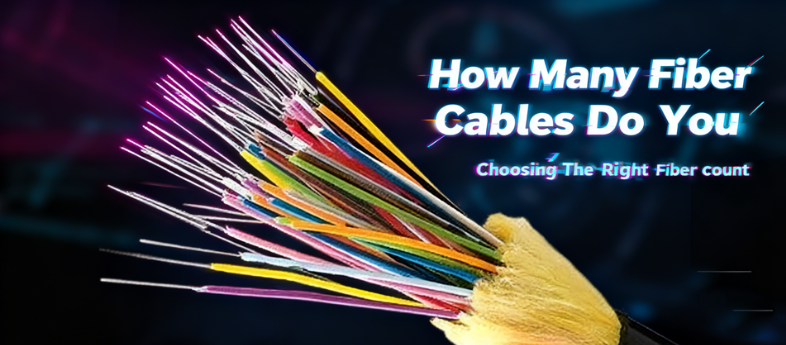
Picking the correct number of fibers for a project is more practical than glamorous — but get it wrong and you pay for the mistake for years. This guide walks you through the simple decision steps engineers use, the common strand counts on the market, and clear rules-of-thumb for different project types so you choose a cable that fits both today’s needs and tomorrow’s growth.
Start with requirements, not assumptions
Begin by listing what the network must support now and in five years: how many endpoints, expected link speeds (1G/10G/100G+), whether links will be point-to-point or use multiplexing (DWDM), and whether you’ll use multi-fiber MPO trunks or duplex LC connections. Count active ports, planned expansion, and spare strands for recovery and testing. Treat provision for growth as a line item — adding a little extra initially often costs far less than pulling new fiber later. (Corning selection guidance; FOA background).
Common strand counts and why they exist
Manufacturers commonly offer cables in multiples that simplify manufacturing and management: low-count options (2, 4, 6, 12) for simple duplex or small distribution runs; medium trunk sizes (24, 48, 72) for enterprise backbones and campus links; and high-density cores (144, 288, 432, 864+) for metropolitan or carrier backbone and long-haul aggregation. MPO/MTP trunk formats frequently use 8, 12, 24 or 48 fiber arrays to match modular optics and cassette systems. These standard increments keep inventory predictable and connectors compatible.
Practical rules-of-thumb by application
Below are concise recommendations you can apply immediately.
-
Office / Small campus links (horizontal and riser): For individual runs to a closet or a riser, duplex (2-fiber) or 12-fiber bundles with subunits are typical. A 12-fiber subunit lets you reserve a few strands for growth without overwhelming the patch field.
-
Data center top-of-rack and spine/leaf: Data centers favor MPO trunks and modularity. Use 12- or 24-fiber trunks for 40G/100G breakout or direct 400G lanes; consider 8- or 16-fiber variants where equipment supports them. Plan trunk architecture to minimize mid-span splicing and to match Transceiver breakout ratios. Reserve about 10–20% spare capacity to support reorganizations.
-
Campus backbones / carrier access: For campus distribution, 24, 48 or 72 fiber trunks are a common sweet spot: they balance manageability with room for new buildings and services. If you expect heavy future growth or many new service types, step up to 144.
-
FTTH / last-mile: FTTH deployments use many configurations; small-count drop cables (1–12) feed homes while feeder/backbone cables commonly use 24, 48, 72, or 144 cores depending on cluster size. Design fiber runs to allow easy mid-span access and splicing; centralized splitters require planning for sufficient feeder pairs.
-
Long-haul and submarine: These routes typically use very few physical fibers — often a single fiber pair — because each pair carries huge capacity via DWDM and advanced Coherent optics. In these networks, high per-fiber capacity reduces the need for many strands.
Future-proofing without overspending
“Future-proof” doesn’t mean buying the largest possible cable. It means making a defensible prediction and leaving room for reasonable growth. Use these tactics:
-
Buy modularity: Prefabricated trunk + cassette architectures let you change breakouts or optics without repulling cable. MPO trunks sized to common optics (12/24) maximize flexibility.
-
Provision spares: Aim for a modest spare percentage (10–25%) at major handoffs — enough for testing, repairs, and small expansions.
-
Match architecture to traffic: If you plan to rely on DWDM and coherent optics, a lower fiber count with aggressive wavelength use can be economical; for many endpoints with simple LAN ports, physical strands matter more.
Connector and management considerations
Choosing a higher strand count increases physical cable diameter, requires larger trays, and changes splice and patch management. Keep cable routing, bend radius, and rack space in your calculations. MPO trunks reduce connector labor but require careful polarity and testing workflows. Always design cable trays and splice enclosures to accept the largest cable you might install.
Cost vs. value: where to spend wisely
Cable cost per meter rises with fiber count, but the labor and service cost of repulling is usually far higher. If the project is hard to access later (underground ducts, conduits under roads, buildings with limited access), invest in extra cores now. Conversely, if the link is easy to maintain and future demand is uncertain, conservatively provision and rely on modular upgrades. Use lifecycle cost (initial cable + predicted maintenance + repull probability) rather than sticker price alone.
Simple calculation example
Estimate current required strands, add spares, and then select the nearest standard cable size:
-
Count active duplex links: e.g., 30 duplex links = 60 fibers.
-
Add 20% spares for testing and future needs: 60 × 1.2 = 72 fibers.
-
Choose the nearest standard cable size (72 or 96) or use grouped 12-fiber subunits (6 × 12 = 72). This keeps termination tidy and aligns with manufacturers’ offerings. (Manufacturer sizing conventions and typical sub-uniting.)
Testing and documentation aren’t optional
Whatever count you select, label every fiber, document routes, and test end-to-end with OTDR/OLTS. Spare fibers are only useful if you can find them quickly. Good labeling and a simple route map reduce mean-time-to-repair and make future expansions painless.
For projects where the right fiber count makes the difference between smooth upgrades and costly rework, choose WOLON’s engineered fiber cable solutions. WOLON supplies indoor, outdoor, and armored cables in standard and custom counts (2, 6, 12, 24, 48, 72, 144 and higher), available as loose-tube or tight-buffered constructions and pre-terminated MPO/LC assemblies to match your architecture. Every cable is factory-tested with serialized test reports, labeled for immediate identification, and documented with as-built drawings to simplify future moves and repairs. Need modular trunking, 12-fiber subunits, or a high-density splice plan? WOLON provides BOM support, pre-terminated trunks, and on-site testing/commissioning services to ensure your fiber count decision is implemented correctly — today and for tomorrow’s growth.