
Understanding fiber‑optic color codes is essential for any technician tasked with installing, maintaining, or troubleshooting modern fiber networks. By adopting the TIA/EIA‑598C standard, you gain a universal “language” of colors that speeds identification, reduces miswiring, and enhances safety across cable jackets, connectors, buffer tubes, and splice trays.
Importance of Fiber Optic Color Codes
-
Error Reduction: A standardized palette prevents costly mis‑splices and cross‑connections, especially in high‑density cables.
-
Operational Safety: Clear visual cues ensure technicians quickly distinguish fibers and components, minimizing risky mistakes.
-
Global Consistency: Whether cables originate in North America, Europe, or Asia, the same 12‑color sequence applies—so any technician can interpret it correctly.
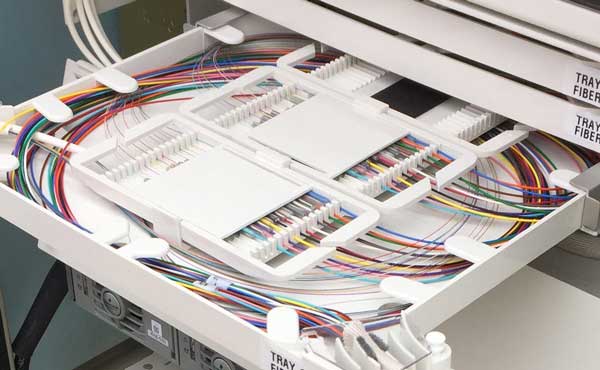
Fiber Optic Color Code:color codes in splice tray
Fiber Optic Color Code:Standard Fiber Color Sequence (TIA-598-C)
| # Fiber No. | Color Code |
|---|---|
| 1 | Blue |
| 2 | Orange |
| 3 | Green |
| 4 | Brown |
| 5 | Slate |
| 6 | White |
| 7 | Red |
| 8 | Black |
| 9 | Yellow |
| 10 | Violet |
| 11 | Rose |
| 12 | Aqua |
 Speed Up Your Splicing Work
Tired of sorting poorly colored fibers? WolonFiber’s 12-Color Fiber Optic Pigtail Packs are manufactured strictly to the TIA-598-C standard with vibrant, easy-to-identify colors. Perfect for fast, error-free termination in your ODF or splice closures. Available in OS2/OM3/OM4 at factory-direct wholesale pricing.
Get a Quote for Bulk Pigtails
How to Identify Fibers in High-Count Cables (>12 Fibers) For cables with more than 12 strands (e.g., 48, 96, or 144 fibers), the industry uses a “Tube and Fiber” system. The 12-color sequence is applied twice: first to the outer Buffer Tube, and then to the individual Fiber inside it. Example: What color is Fiber #34? Divide 34 by 12. It falls into the 3rd tube (Green Tube). It is the 10th fiber within that tube (Violet Fiber). Therefore, Fiber #34 is the Violet fiber in the Green tube.
Fibers 13-16 are specified for 16 fiber MPO connectors as follows: 13: Olive, 14: Magenta, 15: Tan, 16: Lime.
| # No. | Color Code |
|---|---|
| 1 | Blue |
| 2 | Orange |
| 3 | Green |
| 4 | Brown |
| 5 | Slate |
| 6 | White |
| 7 | Red |
| 8 | Black |
| 9 | Yellow |
| 10 | Violet |
| 11 | Rose |
| 12 | Aqua |
| 13 | Olive |
| 14 | Magenta |
| 15 | Tan |
| 16 | Lime |
Fiber Optic Color Code Calculator
Based on TIA-598-C Standard (1-144 Fibers)
 Need Custom Jacket Colors or OEM Printing?
Standard compliance is critical for project sign-offs. As a leading manufacturer with a 400+ person facility in Wuhan, WolonFiber extrudes custom cable jackets in any RAL color and prints your branding directly on the cable. Low MOQs. CE/RoHS Certified.
Consult Our Engineers for Custom Cables

Jacket Color Indicators
Colored outer jackets and/or printed legends can be used on in‑building distribution cables, interconnect cords, or breakout cables to indicate the cable’s classification and fiber specifications. (Outdoor cables are typically black to resist UV exposure, with their markings printed on the jacket.)
For cables containing only one fiber type, if a colored jacket is used for identification, the colors must follow those specified in Table 3; other hues may be chosen provided the jacket’s printing clearly states the fiber classification, with the color selection agreed upon by the manufacturer and user.
Unless otherwise noted, in‑building cables containing multiple fiber types must carry a printed legend on the jacket specifying the number and types of fibers inside. Table 3 presents the preferred nomenclature—for example, “12 Fiber, 8 x 50/125, 4 x SM.” Some manufacturers use black jackets for hybrid or composite cables.
When the jacket printing is relied upon to identify fiber types and classifications, the nomenclature of Table 3 should be used. Additional distinctive designations for new fiber types may be added to Table 3 at a later date.
-
Yellow: Single‑mode (OS1/OS2)
-
Orange: Multimode OM1/OM2 (62.5/125 µm & 50/125 µm)
-
Aqua: Laser‑optimized multimode OM3/OM4
-
Lime Green: Wideband multimode OM5
-
Blue: Polarization‑maintaining single‑mode
-
Green: APC connectors (low back‑reflection)
-
Black: Outdoor/armored cables
| Fiber Type | Jacket Color Code | Suggested Print Nomenclature | |
|---|---|---|---|
| Non-Military App. | Military App. | ||
| Multimode (OM2) 50/125 |
Orange | Orange | OM2, 50/125 |
| Multimode (OM3 / OM4) 50/125 Laser-optimized |
Aqua | Undefined | OM3 or OM4, 850 LO 50/125 |
| Multimode (OM5) Wideband Laser-optimized |
Lime Green | Undefined | OM5 |
| Multimode (OM1) 62.5/125 |
Orange | Slate | OM1, 62.5/125 |
| Multimode (100/140) | Orange | Green | 100/140 |
| Single-mode (OS1 / OS2) Standard SM |
Yellow | Yellow | OS1, OS2, SM/NZDS |
| Polarization Maintaining Single-mode |
Blue | Undefined | Undefined |
Connector Color Coding
Since the earliest days of fiber optics, multimode cables have typically been color‑coded orange, black, or gray, while single‑mode cables are marked in yellow. However, with the introduction of metallic connectors like FC and ST—whose bodies are difficult to color‑code—colored strain relief boots have often been used instead.
| Fiber Type | Connector Body | Strain Relief / Adapter |
|---|---|---|
| 62.5/125 (OM1) Legacy Multimode | Beige |
Beige |
| 50/125 (OM2) Standard Multimode | Black |
Black |
| OM3 / OM4 Laser Optimized (50/125) | Aqua |
Aqua |
| OM5 Wideband High Speed Multimode | Lime Green |
Lime Green |
| Single-mode (UPC) Ultra Physical Contact | Blue |
Blue |
| Single-mode (APC) Angled Physical Contact | Green |
Green |
Summary:
Knowing the basics of fiber color codes is essential for beginners. It can help us visually distinguish fiber types from colored fiber sheaths, internal fibers, and fiber connectors. More importantly, mastering this knowledge can improve fiber cabling efficiency and minimize cabling time.


 Why Splice When You Can "Plug & Play"?
Managing color codes and polarity for 40G/100G networks onsite is a massive drain on your labor budget. Skip the manual splicing. WolonFiber’s Pre-Terminated MPO/MTP® Trunk Cables are 100% 3D interferometer tested in our cleanroom facilities. We handle the complex color routing and polarity—you just deploy it in minutes.
Request Factory Pricing for Pre-Terminated Trunks
What is the standard 12-color sequence for fiber optics?
Under the TIA/EIA-598-C standard, the universal 12-color sequence is: 1-Blue, 2-Orange, 3-Green, 4-Brown, 5-Slate (Gray), 6-White, 7-Red, 8-Black, 9-Yellow, 10-Violet, 11-Rose, and 12-Aqua. This sequence repeats for cables with more than 12 fibers.
How do you identify fiber number 45 in a 144-core cable?
In high-count cables, the 12-color rule applies to both the buffer tube and the fiber itself. Fiber #45 falls into the 4th tube (45 ÷ 12 = 3.75, so Tube 4 is Brown). Within that tube, it is the 9th fiber (Yellow). Therefore, fiber 45 is the Yellow fiber inside the Brown tube.
What does a yellow fiber optic cable mean?
The outer jacket color indicates the fiber's internal mode. A Yellow jacket universally signifies Single-mode fiber (OS1 or OS2), which has a 9µm core and is designed for long-distance, high-speed transmission using laser light sources.
Why are some fiber optic connectors green and others blue?
Connector colors indicate the polish angle of the fiber end-face, which is critical for safety and performance. A Blue connector means UPC (Ultra Physical Contact), which is polished flat. A Green connector indicates APC (Angled Physical Contact), polished at an 8-degree angle to reduce return loss. Warning: Never plug a green connector into a blue connector, as this will shatter the glass cores.
What color is OM3 and OM4 multimode fiber?
Both OM3 and OM4 laser-optimized multimode fibers typically use an Aqua-colored outer jacket. To visually differentiate between the two, you must read the printed nomenclature on the cable jacket. Recently, some manufacturers have introduced Erika Violet jackets specifically for OM4 to help distinguish it from OM3 in high-density data centers. If you are unsure which specification your network requires, read our complete performance breakdown: [OM3 Vs OM4 Fiber: Which “Aqua” Cable Do You Need? (2026 Speed Guide)].