
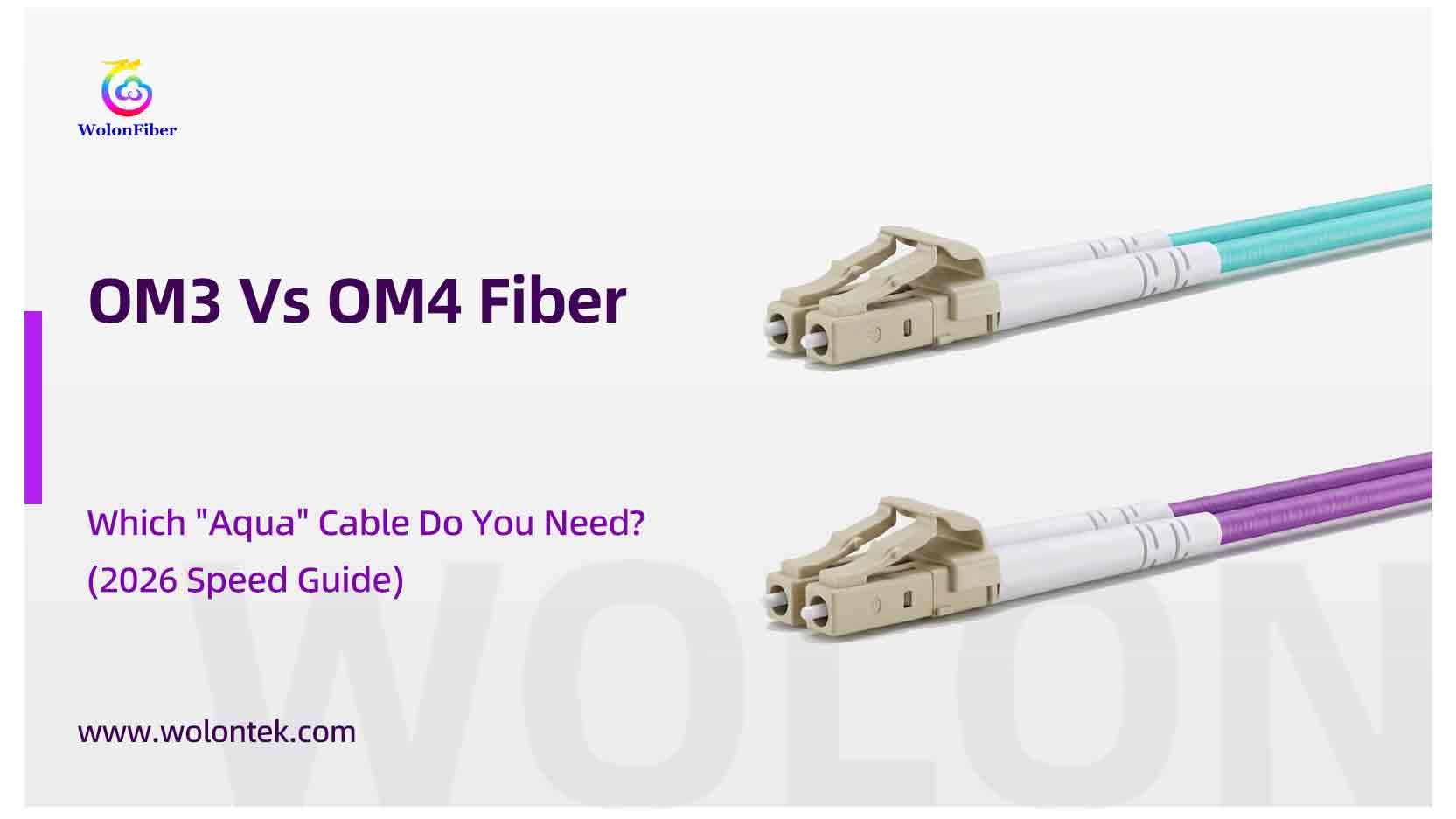
OM3 Vs OM4 Fiber: Which “Aqua” Cable Do You Need?Walk into any server room today, and you’re likely staring at a rack full of aqua-colored jackets. This creates one of the most annoying problems in fiber management: Visual Ambiguity.
You have two cables. Both are aqua. Both have 50-micron cores. But one is an OM3 that caps out at 300 meters, and the other is an OM4 that can carry a 100G signal across a large warehouse.
If you mix them up, your link might work today but fail randomly when traffic spikes.
We get asked this daily: “Is OM4 actually worth the extra cost, or is it just marketing?” Here is the engineering reality behind the “Aqua” confusion.
The Core Difference: It’s Not Size, It’s Structure
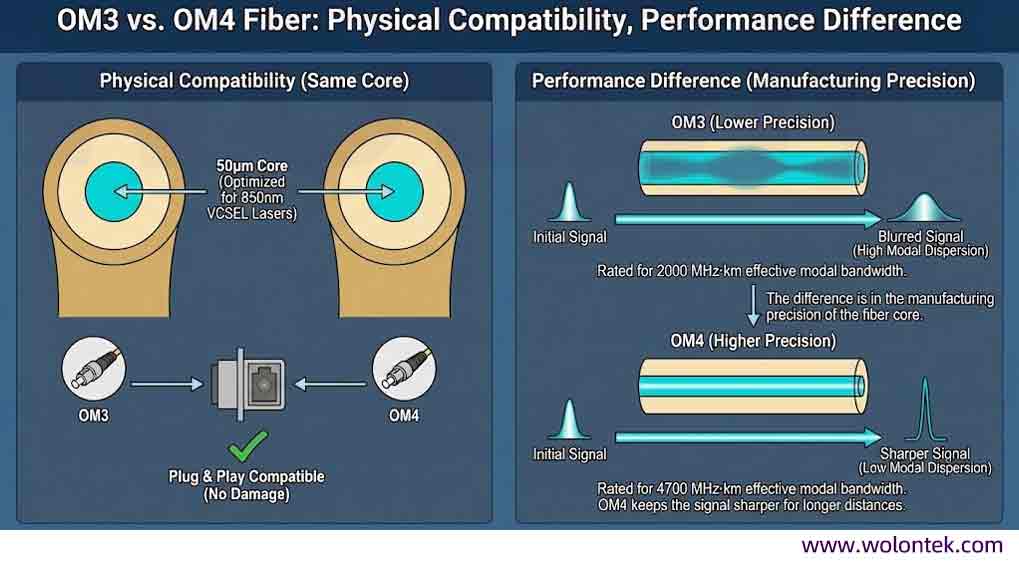
Let’s clear up a common misconception: OM3 vs OM4 are physically compatible. You can plug an OM3 connector into an OM4 adapter without damaging the glass. They both utilize a 50/125µm core optimized for 850nm VCSEL lasers.
The difference lies in the manufacturing precision of the fiber core itself.
During the manufacturing process, OM4 glass is held to a much tighter refractive index profile. This minimizes “modal dispersion”—the phenomenon where light pulses spread out and blur over distance.
-
OM3: Rated for 2000 MHz·km effective modal bandwidth.
-
OM4: Rated for 4700 MHz·km.
In plain English: OM4 doesn’t necessarily make the data travel faster; it keeps the signal sharper for longer distances.
The Specs That Matter: Distance Limits
When designing a Structured Cabling system, your decision usually comes down to a single variable: Channel Length.
Here is the breakdown for standard IEEE ethernet applications:
Reality Check: When to Spend the Extra Money?
At Wolon, we manufacture both. We’ve seen projects waste money on OM4 where it wasn’t needed, and we’ve seen projects fail because they tried to save pennies on OM3.
Here is our recommendation based on current 2026 market pricing:
1. Patch Cords (Jumpers) -> Just Buy OM4
The price difference between a 3-meter OM3 patch cord and an OM4 patch cord is negligible—often cents. Recommendation: Standardize your inventory on OM4. It eliminates the risk of a technician grabbing an “old” OM3 cord for a critical 100G link. It’s cheap insurance.
2. Backbone Trunks -> Calculate Carefully
For long runs (trunk cables), the cost difference scales up.
-
Existing 10G Networks: If your longest run is definitely under 300m (which covers 90% of enterprise office buildings), OM3 is perfectly adequate. There is no performance penalty.
-
Future-Proofing: If there is any chance you will migrate to 40G or 100G BiDi optics in the next 5 years, install OM4 now. The cost of ripping out cabling later dwarfs the material cost today.

The “Erika Violet” Solution
Because the “Aqua vs. Aqua” confusion causes real downtime, the industry is slowly adopting a new color code.
In Europe and some US data centers, OM4 is now jacketed in “Erika Violet” (a distinct purple). If you are building a greenfield site, we strongly suggest ordering your OM4 in Violet. It allows your technicians to instantly visually distinguish the high-bandwidth paths from the legacy OM3 Aqua infrastructure.
(Wolon can custom manufacture jacket colors to match your facility standards—just ask.)
Summary: The 30-Second Sourcing Cheat Sheet
If you skimmed the article, here is the quick decision matrix to save for your next project meeting:
-
For 1G Speed: Stop worrying. OM3 is more than enough for everything.
-
For 10G Speed: OM3 is the standard for runs under 300m. Use OM4 only if you need to push distance to 400m+.
-
For 40G/100G: OM4 is mandatory for any run over 100 meters. Do not risk using OM3 here.
-
For patch cords: Just buy OM4. The inventory simplicity is worth the tiny price difference.
-
Color Code: If available, ask for Erika Violet jackets for your OM4 cable to avoid future mix-ups with standard Aqua OM3.
Got a BOM List? Let’s Quote It.
Whether you need cost-effective OM3 Aqua for short office runs or future-proof OM4 Violet for your data center core, we manufacture to spec with 100% 3D Interferometry Testing.
Available in LC, SC, and MTP/MPO Terminations.
Technical FAQ: Common Field Questions
Q: Can I mix OM3 and OM4 fibers in the same link?
A: Yes, but you shouldn’t. The link will function, but it will default to the bandwidth performance of the OM3 cable. You lose the advantage of the OM4 you paid for. It’s also a documentation nightmare.
Q: Is OM5 worth it yet?
A: Only if you use SWDM (Short Wave Division Multiplexing) transceivers. For standard SR4/SR8 optics, OM4 offers nearly identical performance at a lower price point. OM5 is niche; OM4 is the standard.
Q: Does OM4 require special connectors?
A: No. OM3 and OM4 use the exact same LC, SC, and MPO connectors. The hardware is identical; only the glass inside changes.