
Fiber vs. Cable Internet 2025: A Guide to Speed, Reliability & Cost
As AI data centers and small businesses expand, choosing the right broadband connection is crucial. A common question is “Is fiber optic better than cable”? This guide compares fiber-optic cable and traditional copper internet cable (coaxial cable) across key factors: technology, speed, reliability, and cost in 2025.We’ll give clear, accessible explanations (with example scenarios) to help you decide which suits your needs best.
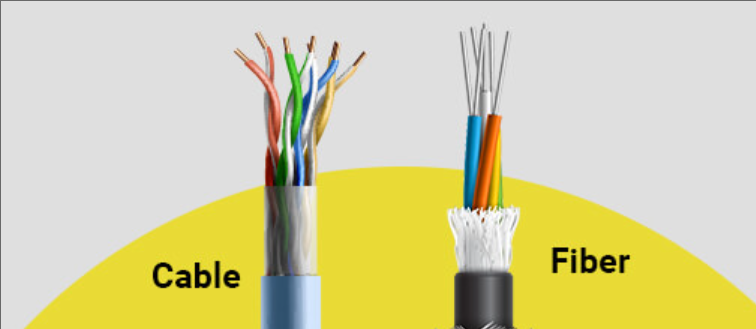
fiber vs cable
What Is a Fiber Optic Cable
A fiber optic cable uses dozens of thin strands of glass or plastic to transmit data as pulses of light.Because light travels near its maximum speed in fiber, these cables provide extremely high bandwidth and very low latency. Modern fiber networks bundle many fibers inside a single jacket, enabling huge data rates (hundreds of Mbps to many gigabits per second) with virtually identical upload and download speeds. This symmetry is ideal for AI data centers and cloud services, where vast datasets must flow quickly between storage and compute nodes. In short, fiber-optic cables are the backbone of ultra-fast, future-proof networks due to their light-based, high-capacity transmission.

What Is an Internet Cable (Copper Cable)
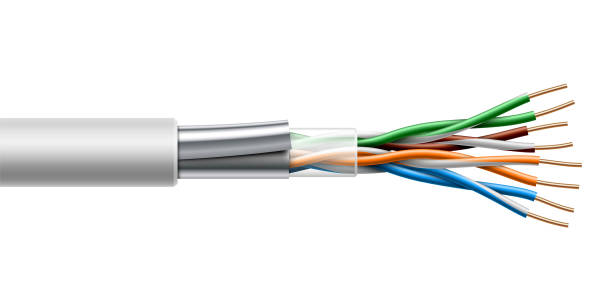
By contrast, a typical internet cable today refers to a copper coaxial cable – the same type used for cable TV. These cables carry data as electrical signals through a solid copper core surrounded by insulation and shielding.Coaxial cables are thicker and cheaper than fiber, and they have been widely deployed over decades. They can deliver high download speeds (hundreds of Mbps to ~1 Gbps), but upload speeds are generally much lower. Also, over long distances the signal weakens without amplifiers. Coaxial internet cables are common for home and business broadband, especially where fiber isn’t available, but they inherently offer less capacity and more signal loss than fiber.
Is Fiber Optic Better Than Cable? (The Verdict)
Fiber optic vs Internet:Speed Comparison
Fiber optics dramatically outpace copper in raw speed. Fiber links typically offer symmetrical speeds – e.g. 300 Mbps up to 10 Gbps down (and the same up) in modern networks. In contrast, cable (coax) internet is asymmetrical: downloads might reach ~25 Mbps–1 Gbps, but uploads are much slower (often <100 Mbps).This makes a big difference for bandwidth-heavy tasks. For example, backing up large datasets to the cloud or running distributed AI training can saturate cable uploads but stay well within a fiber link’s capacity.
Fiber Optic Cable: Symmetrical multi-gigabit speeds (e.g. 1–10 Gbps both ways)Great for heavy upload/download use .(e.g. AI workloads, 4K/8K media, large data backups).
Coaxial Cable (Copper): Asymmetrical speeds (up to ~1 Gbps down, often <50–100 Mbps up).Download-oriented (good for streaming/download), but uploads and peak-time performance can lag.
Fiber’s extra bandwidth shines under load. In real-world tests, fiber connections stay consistent even when streaming 4K video, video conferencing, gaming, and large file transfers simultaneously, whereas cable lines often slow down during peak usage.This means businesses and AI centers on fiber can keep full speed even as demand spikes, while cable users may experience bottlenecks when many users share the network.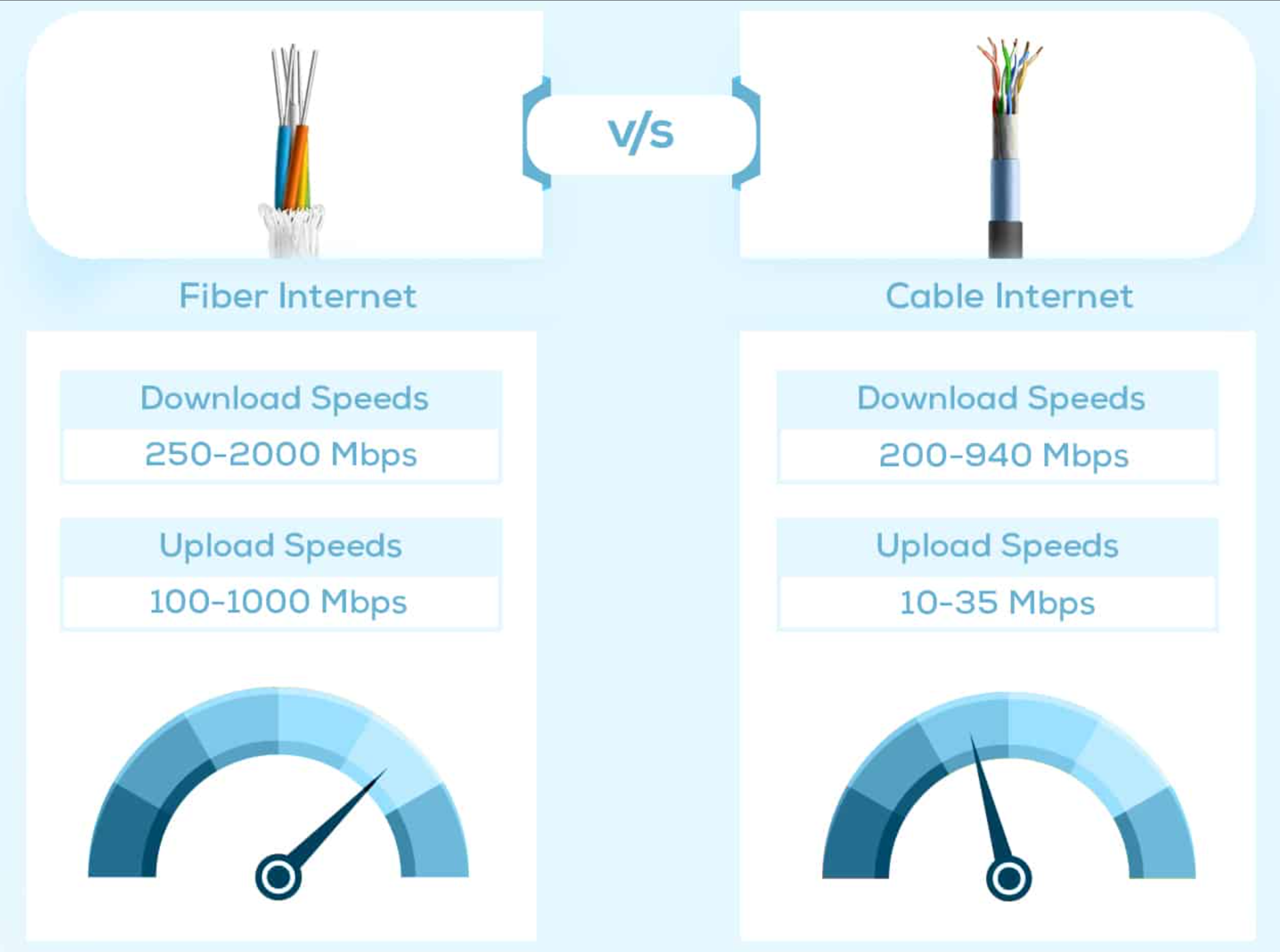
Fiber optic vs Internet:Reliability Comparison
Reliability is another area where fiber excels. Key differences include:
-
Interference Immunity: Fiber-optic cables are immune to electromagnetic interference, so nearby power lines, radio transmitters or storms won’t corrupt the signal.Copper cables (coax) can pick up interference from machinery or lightning, causing glitches.
- Signal Integrity: Fiber signals travel miles with almost no loss, requiring few or no repeaters.Copper signals weaken over distance and need amplifiers, which can introduce latency or points of failure.
- Durability: Fiber is less affected by temperature swings, moisture or corrosion. A fiber cable in harsh weather or underground will generally stay operational longer than a copper cable.
- Network Congestion: Cable internet is typically shared among many neighbors, so speeds (and reliability) dip when local usage is high.Fiber usually provides a dedicated link to each subscriber, so performance stays steady even at peak times.
Together, these factors mean fiber links have far fewer outages and slowdowns. (One study found fiber networks experienced roughly 70% fewer service interruptions than cable over a year.)For a data center or a business relying on constant connectivity, fiber’s stability translates to less downtime and smoother operation.
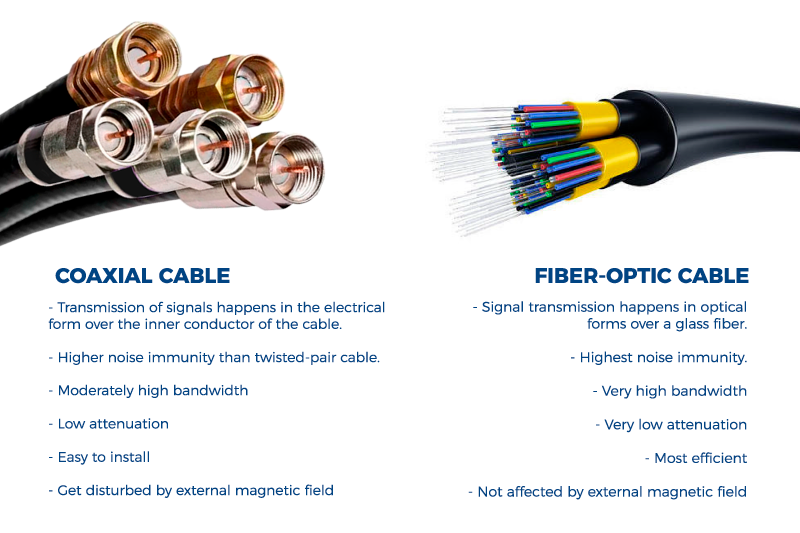
Fiber vs Cable
Fiber optic vs Internet:Installation and Cabling Cost Comparison
Fiber connections often cost more upfront, while cable internet is generally cheaper to install:
- Cable Material: As a fiber optic cable manufacturer with over 10 years of export experience, we’ve seen that while material costs for high-quality fiber remain around $3.00 per foot—compared to $0.35 for coaxial copper—the long-term ROI is higher. In our Hubei facility, we focus on optimizing the fiber core (which accounts for ~40% of the cost) to ensure durability that copper simply cannot match in AI-driven environments.
-
Installation Complexity: Installing fiber usually requires specialized technicians. Fiber lines may need to be buried or hung, increasing labor (trenching, permits, splicing). By contrast, cable internet can often use existing coax wiring inside buildings, making setup faster and less expensive.
-
Upfront Costs: An analysis estimates the average fiber installation (for a home or small office) is around $4,500 (ranging roughly $1,500–$7,000). Cable setups typically cost a fraction of that, since providers often already have infrastructure in place.
- Monthly Fees: Many cable plans also start at a lower monthly price. For example, small business cable plans might be $20–$150 per month, while fiber plans range $50–$200 per month.However, fiber’s higher speeds and reliability can deliver more value in the long run (fewer outages and faster data transfers can offset the cost).
Conclusion
In 2025, fiber optic cable generally outperforms traditional copper internet cable (coax) on speed and reliability, which is crucial for AI data centers and bandwidth-hungry businesses. Fiber’s light-based transmission offers multi-gigabit, symmetric speeds and exceptional stability.Cable’s strengths are lower initial cost and wide availability, but it shares bandwidth and has slower uploads.
Fiber is also more future-proof: as emerging applications like 8K video, virtual reality, and AI continue to grow, fiber’s vast capacity can scale without replacing the cable itself.Meanwhile, fiber deployment is accelerating – governments and providers are expanding fiber into new areas in 2025.
“Is fiber optic better than cable?” For high-demand use cases and long-term growth, fiber is usually the better choice. But for basic internet needs on a tight budget, cable remains a practical alternative. Below is a quick comparison summary:
| Feature |
Fiber Optic Cable (Glass Core) FUTURE PROOF
|
Coaxial Cable (Copper Core) |
|---|---|---|
| ⚡ Speed |
Symmetrical & Ultra-Fast
300 Mbps – 10 Gbps+ Perfect for uploads & heavy data. |
Asymmetrical (Slow Uploads)
Max ~1 Gbps down, but only ~50 Mbps up. Bottleneck for cloud backups/zoom. |
| Reliability | Immune to Interference Glass doesn’t conduct electricity. No EMI/RFI noise. Minimal signal loss over long distance. | Prone to Noise Subject to electromagnetic interference. Signal degrades significantly over distance. |
| Cost |
Higher Initial Install Requires specialized fusion splicing (~$4.5k avg install). Cable cost ~$3/ft. |
Lower Initial Cost Uses existing TV cabling infrastructure. Cable cost ~$0.35/ft. |
| Best Use |
✅ Enterprise & Data Centers AI, Cloud Services, Long-haul ISPs, and Future-proofing networks. |
⚠️ Residential / Legacy General web browsing, TV streaming, and budget-sensitive short runs. |
In summary, fiber optic internet is the faster, more reliable technology of 2025. Small businesses and especially AI-driven operations will benefit from its superior speed and stability, provided fiber service is available in their area.
✅ Ready to Upgrade Your Network Infrastructure?
Stop relying on outdated copper. Let our engineers build a faster, more reliable roadmap for you.
FAQ:
1.Is fiber optic cable better than cable?
Answer: Yes, fiber optic is generally better than cable for users who prioritize speed and reliability. Fiber uses light pulses to transmit data through glass strands, while cable uses electrical signals over copper. This allows fiber to provide much higher bandwidth and lower latency, making it the superior choice for AI data centers and businesses in 2025.
2.How much more expensive is fiber optic than cable per foot?
Answer: In terms of material costs, fiber optic cable is significantly more expensive, costing approximately $3.00 per foot compared to about $0.35 per foot for coaxial copper cable. Additionally, fiber installation often requires specialized technicians and equipment, leading to an average upfront installation cost of around $4,500 for small offices.
3.What is the difference between symmetrical and asymmetrical speeds?
Answer: Fiber optic internet typically offers symmetrical speeds, meaning your upload and download speeds are nearly identical (e.g., 1 Gbps up and down). Traditional cable internet is asymmetrical, prioritizing download speeds (up to 1 Gbps) while offering much slower upload speeds (often <100 Mbps). Symmetrical speeds are essential for cloud backups, video conferencing, and AI dataset processing.
4.Is fiber optic cable immune to interference?
Answer: Yes, because fiber optic cables use light to transmit data, they are completely immune to electromagnetic interference (EMI). Unlike copper cables, which can experience signal degradation near power lines or during storms, fiber maintains a stable connection in harsh electrical environments or extreme weather conditions.
5.Can you splice fiber optic cable like traditional copper wire?
Answer: While you can splice fiber optic cable, it is much more complex than splicing copper wire. Fiber splicing requires a specialized machine called a fusion splicer to precisely align the glass cores. Improper splicing can lead to significant signal loss, so it usually requires professional installation or high-quality pre-terminated cables.