
As data centers scale beyond 100G, architects face a foundational choice: deploy DSP-based or all-analog solutions for 200G links. This article compares DSP and all-analog Optical Modules across power, latency, reach, cost and operational risk, using vendor datasheets and technical whitepapers to ground the analysis. Our aim is practical: help network planners select the right Optical Modules for dense 200G fabrics.
Understanding the architectures
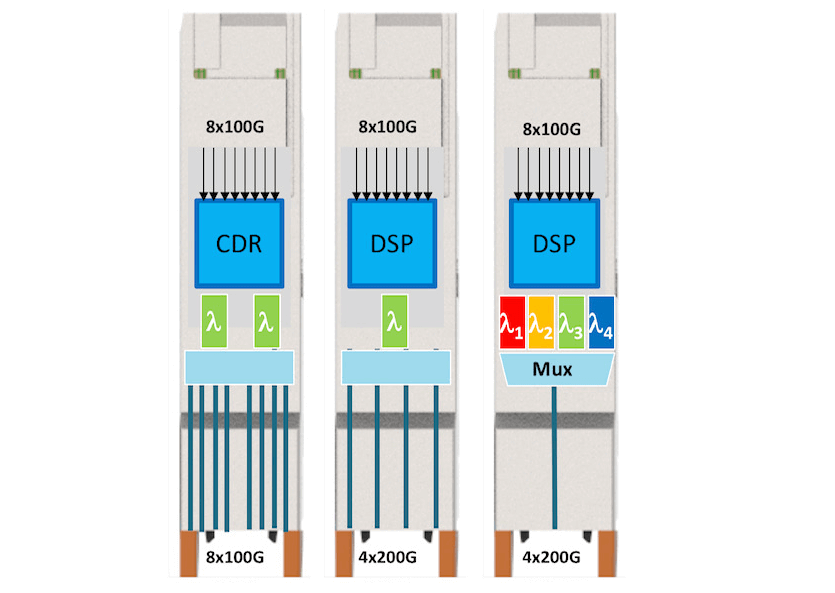
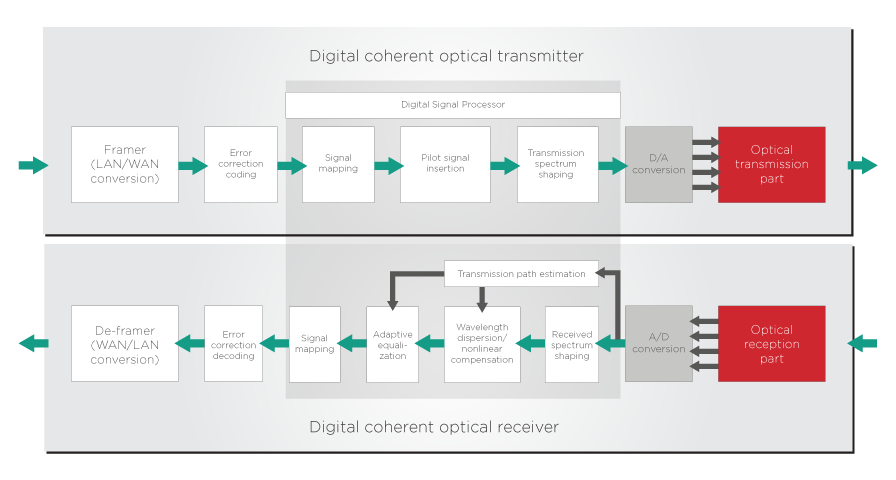
DSP-based Optical Modules place high-speed analog-to-digital converters and digital signal processing inside the pluggable transceiver. That design enables adaptive equalization, aggressive FEC and long reachable spans under challenging fiber conditions. All-analog Optical Modules use continuous-time clock-and-data recovery and analog equalization (for example Semtech’s Tri-Edge family) to condition PAM4 signals without power-hungry ADC/DAC loops, simplifying the signal path and lowering thermal load.
Power and thermal: the decisive operational metric
Power per port directly impacts cooling budgets, rack density and OPEX. Multiple 200G QSFP56 vendor datasheets show DSP-based Optical Modules with typical power dissipation in the 4–5.5 W range for SR/DR/FR variants.Analog PAM4 chipsets (Tri-Edge style designs) target sub-3.5 W for 200G Optical Modules and vendors report roughly 20–30% power reductions versus comparable DSP implementations, a meaningful savings at scale.
Because interconnects often number in the thousands per data center, a 1–2 W per-port delta compounds quickly. Lower per-port power reduces both electricity and cooling costs, and can enable higher switch density without exceeding a facility’s power envelope.
Latency: when every nanosecond counts
Latency differences are small in human terms but meaningful for high-performance clusters and financial workloads. DSP-based Optical Modules perform analog-to-digital and digital-to-analog conversions with buffering and algorithmic processing that can introduce tens to hundreds of nanoseconds of deterministic latency. Analog PAM4 Optical Modules remove heavy digital conversions and can achieve sub-nanosecond retiming in the optical front end, yielding materially lower link latency—an advantage where microsecond budgets are tight.
Reach and performance: where DSP still leads
DSP-based Optical Modules excel where link budgets are challenging: long single-mode spans, legacy fiber with impairment, or environments that require aggressive temperature tolerance and advanced FEC. Vendor FR/LR datasheets document DSP-based QSFP56 modules supporting 2 km to 10 km and beyond with PAM4 plus active DSP equalization.
All-analog Optical Modules have closed much of the gap for intra-data-center reaches: modern analog PAM4 chipsets support 100 m on multimode OM4/OM5 and can be architected for several hundred meters to a few kilometers on single-mode in certain designs. Still, for the most demanding long-reach SMF runs, DSP-based modules are the conservative choice today. Industry task forces and whitepapers also document the evolution of both approaches and help quantify realistic 100 m–10 km objectives.
Cost: BOM, module price and total cost of ownership
At the bill-of-materials level, analog architectures reduce component count by integrating CDR, TIA and driver elements on fewer chips, which can lower manufacturing cost and module BOM. That advantage translates to lower module price targets at scale. DSP-based Optical Modules amortize expensive DSP silicon and advanced process nodes into higher per-unit cost, particularly for long-reach parts. Industry blogs and whitepapers describe the economics and convergence trends as the analog option matures.
However, sticker price is only one axis. Total cost of ownership must include power (OPEX), cooling, spares and the operational risk of vendor compatibility. In many real networks a hybrid procurement—low-power analog Optical Modules for predictable short-reach tiers and DSP-based Optical Modules for edge and long-reach tiers—yields the best balance.
Interoperability and vendor ecosystem
DSP-based Optical Modules are resilient to marginal fiber plant conditions because their adaptive algorithms can mask impairments. Analog Optical Modules tend to be simpler and lower cost, but they can be more sensitive to system mismatches; rigorous interoperability testing with your switch silicon and fiber plant is essential before roll-out. Also verify DOM/DDM support and vendor compatibility lists during procurement.
Example TCO snapshot (illustrative)
Assume 1,000 200G ports in a leaf-spine fabric. If DSP-based Optical Modules average 5 W per port and analog Optical Modules average 3 W per port, the continuous power delta is 2 kW. At USD 0.10/kWh that equals ≈17,520 kWh/year or roughly USD 1,750 in electrical savings annually—excluding ancillary cooling reductions and the operational benefits of simpler thermal profiles. Scale that to tens of thousands of ports and the value of lower-power Optical Modules becomes highly visible.
Deployment checklist
-
Map actual link distances and fiber types per tier (TOR, EOR, spine).
-
Measure rack power headroom and cooling capacity.
-
Run on-platform interoperability tests for each candidate Optical Modules SKU.
-
Compare per-port power, expected module lifetime and warranty.
-
Start with a pilot: deploy analog Optical Modules in predictable short-reach tiers and DSP Optical Modules for edge/long-reach tiers.
Conclusion
The 200G transition is an inflection point where power, latency and cost converge. All-analog PAM4 Optical Modules offer a persuasive proposition for power-constrained, latency-sensitive, and extremely dense data centers; DSP-based Optical Modules remain the versatile option for extended reach and marginal fiber. A pragmatic hybrid approach—use analog Optical Modules where low power and low latency deliver the greatest ROI, and reserve DSP Optical Modules for the most demanding reaches—lets you optimize CAPEX and OPEX in parallel.
As a professional optical module Manufacturer, WOLON provide a full range of optical transceiver modules from 1G to 800G, support customized development, and are 100% compatible with mainstream equipment manufacturers, providing reliable optical interconnect solutions for data centers, telecommunication networks, and enterprise networks.

Contact our optical module experts now to get customized solutions for your network needs. Whether it is a standard deployment or a special application scenario, we can provide the best optical interconnection solutions to ensure your network performance, reliability and scalability.

Sources & references: vendor datasheets and technical whitepapers used for the analysis and numbers above include representative QSFP56 datasheets and Semtech’s Tri-Edge whitepaper.