
Introduction
Modern data centers demand a careful balance of cost, latency, power and reach when choosing interconnects. This comparison focuses on three dominant choices—DAC/AOC pairings (Direct Attach Copper and Active Optical Cables) and Optical Modules (standalone transceivers + fiber)—to help architects pick the right solution for spine-leaf and rack-to-rack links. I summarize practical performance, typical costs, power implications and recommended use cases, with real-world vendor data and published specs cited where relevant.
Executive summary
For very short links (typically ≤3–5 m) DAC/AOC direct-attach solutions are the most economical and lowest-power option. For medium distances (≈5–30 m) AOCs become attractive because they extend reach without adding transceivers. For longer, flexible, carrier-grade reach (100 m → multi-km), Optical Modules fitted to fiber provide the only practical path—at higher per-port cost and power. These tradeoffs show up consistently in vendor guides and product datasheets.
What each option is
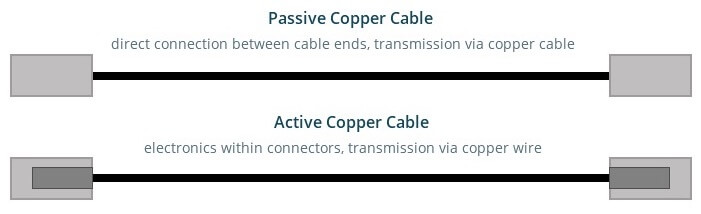
- DAC (Direct Attach Copper): a fixed copper twinax cable with transceiver ends—cheap, very low latency and power, limited reach (typically up to ~5 m for 100G passive DACs).
- AOC (Active Optical Cable): an optical cable with embedded transceivers at the ends—greater reach (meters to tens of meters, commonly 1–30 m or more), immunity to EMI, slightly higher cost and power than passive DACs.
- Optical Modules: independent transceivers (SFP28, QSFP28, QSFP56, etc.) plugged into ports with separate fiber patching—highest flexibility and maximum reach (multimode to single-mode options from 100 m to 80+ km), but highest CAPEX per link and higher module power draw.

Cost: CAPEX comparisons that matter
When you price a link you must compare (a) cable solution vs (b) two optical modules plus fiber and patching. Multiple vendor analyses show that a DAC link can be a small fraction of the cost of a transceiver+fiber link—often 20–40% of the transceiver solution for short (3 m) links—because DACs eliminate two pluggable modules and fiber patch costs. AOC sits between DAC and full transceiver solutions: more expensive than DAC for short links, but cheaper than two modules once you account for fiber and handling for medium runs. These relative deltas are well documented in cabling guides and vendor price tables.
Practical note: commodity 100G SR4 modules can be found at low-hundreds USD per unit (vendor listings show SR4 QSFP28 examples near US$99 in some catalogs), whereas branded long-reach modules (LR/ZR variants) climb into the thousands depending on optics and vendor support. That price gap drives many data center decisions toward DAC/AOC for short and medium ranges.
Power & thermal (why optics can raise OPEX)
Power per port matters in dense switches. Typical QSFP28 optical modules commonly draw ~3–4 W per module depending on optic type, while many passive DACs draw essentially negligible additional power (<0.3 W) because they contain no active optics. Active DACs and AOC endpoints add some power (often around 0.5–1.5 W for active twinax or AOC electronics), but they remain lower than many long-reach optical transceivers. Expect measurable OPEX differences at scale when comparing thousands of ports.
Latency, reliability and EMI
Latency: DACs provide the lowest latency (pure electrical path), then AOCs (optical conversion latency very small), then two-transceiver+fiber links (extra interface latency and possible re-timing). For most DC traffic the differences are microseconds or less, but high-frequency trading and some HPC workloads still prefer DAC.
Reliability / EMI: AOC and optical fiber are immune to electromagnetic interference and are preferred in electrically noisy environments and longer distributed cabling. DAC is fine inside clean rack interconnects.
Reach & flexibility — how far each approach goes
- DAC (passive): typically 0.5–5 m for high-speed 100G twinax; passive DACs are commonly sold in 1 m, 3 m, 5 m lengths. Active DACs and ACC variants can push to 7–15 m depending on data rate and AWG.
- AOC: commonly available from 1 m up to 30 m (and select models longer); ideal for longer intra-row or short inter-rack links where DAC is impractical.
- Optical Modules + fiber: multimode SR options cover 100 m+ on OM4/OM5; single-mode LR/ZR options cover kilometers to carrier distances. This is the only viable choice for campus, metro or cross-site interconnects.
Practical selection matrix (quick rules)
- If link ≤3–5 m, very dense rack, and you want lowest CAPEX & power → choose DAC/AOC: DAC (passive).
- If link ≈5–30 m or you need EMI immunity and flexible routing → choose DAC/AOC: AOC.
- If link >30–100 m or you need future upgrade flexibility, longer optics, or long-haul reach → choose Optical Modules + fiber.

Real-world caution: compatibility and vendor lock
Third-party DAC/AOC and optics may work but check vendor compatibility lists; major switch vendors sometimes restrict or qualify optics, which can affect support. Also remember that modal dispersion, lane mapping and host-level settings can matter when mixing cable and transceiver brands. Plan a small interoperability test before wide rollout.
Conclusion — pick with total cost of ownership in mind
There’s no single “correct” answer. For dense short-reach spine or top-of-rack fabrics, DAC/AOC solves the cost and power problem elegantly (DAC where possible, AOC where cables must be longer or routed). For flexible, future-proof, and long-reach links, Optical Modules remain indispensable despite higher per-port CAPEX and power. Combine these options intelligently: minimize module count where topology allows, and reserve optical modules for links that genuinely need fiber reach or vendor-grade optics.