
Choosing the right 100/400G optical module is a practical decision of fiber type, reach, density and cost. This article explains the engineering differences, the physical cabling and connector implications, performance characteristics, and real-world use cases so you can pick the right part for your network.
Quick summary: SR4 modules are short-reach, multimode solutions that use MPO/MTP ribbon connections and are optimized for cost-effective, dense data-center fabrics over OM3/OM4 MMF; DR4 modules are data-center reach, single-mode solutions (or single-mode MPO variants) that extend reach significantly and simplify longer links or future migrations.
What “SR4” and “DR4” mean
-
SR4 stands for Short-Reach, 4 lanes. In 100G/400G contexts it uses multiple parallel lanes (e.g., 4 × 25G for 100G-SR4, or 4 × 100G lanes in 400G SR4 variants) over multimode fiber using MPO/MTP ribbon connectors and short wavelengths (typically 850 nm VCSELs). SR4 is optimized for very high density inside a rack or fabric, where distances are limited.
-
DR4 stands for Datacenter Reach, 4 lanes. DR4 moves to single-mode optics (or single-mode MPO in 400G variants) and longer wavelengths/techniques (PAM4 on a single lambda for some DR/FR/LR family modules) to reach further inside and between data-center rooms without the higher cost of long-haul optics. DR4 is built to bridge between dense fabrics and spine/aggregation switches that require longer reach than SR4 can provide.
Optical medium, connectors and cabling differences
-
SR4 uses multimode fiber (MMF)—OM3/OM4 (and sometimes OM5) are common—connected via MPO/MTP 12- or 8-core ribbon assemblies. Typical published reach for 100G-SR4 is ~70 m on OM3 and ~100 m on OM4; for 400G SR4 variants reach may be shorter (many SR4 400G modules are specified for 50 m).
-
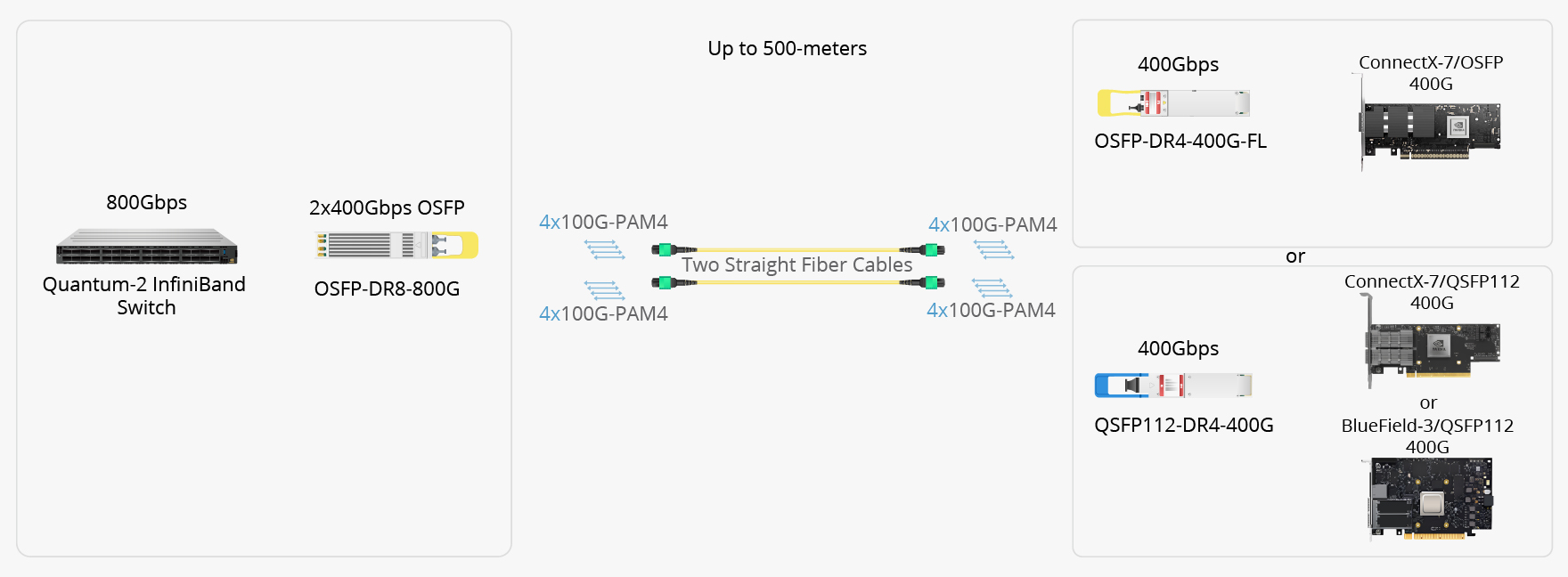
DR4 uses single-mode fiber (SMF)—OS2, often using 8- or 12-core MTP/MPO for parallel single-mode designs or duplex LC for single-lambda designs depending on the exact module family. DR4 reaches commonly span 100 m up to 500 m in datacenter contexts (vendor and optics variant dependent). This gives a practical mid-range between SR short-reach and LR/ER long-reach optics.

Performance vs. cost tradeoffs
-
Cost-per-port: SR4 optics and multimode cabling are typically lower capex per port — MMF transceivers and short OM4 trunks are cheaper than single-mode optics at equivalent datacenter throughput. That’s why SR4 remains attractive for dense leaf/spine fabrics where reach ≤100 m.
-
Future growth & reusability: Single-mode links (DR4) scale more cleanly to longer reaches and future generation optics; if you anticipate campus or cross-room links or want simpler duplex cabling later, DR4 (SMF) avoids early fiber replacement. Vendors often price DR4 higher, but it reduces risk for longer links.
-
Power and host compatibility: DR family modules sometimes include internal PAM4 gearbox logic (to convert 4 × NRZ to a PAM4 optical lambda) which affects power consumption and host compatibility; ensure your switch/router supports the optics you choose.
Practical deployment scenarios
Use SR4 when:
1.All connectivity is inside a single data-hall or adjacent racks and distances are <100 m.
2.You prioritize lowest optics capex and highest density (MPO trunking).
3.You have existing OM3/OM4 cabling and want straightforward 100G/400G port provisioning.

Use DR4 when:
1.You need links that span multiple rooms, adjacent halls, or campus closets where single-mode reach advantages (100–500 m) matter.
2.You expect future growth to require longer reach or simpler migration to higher speeds without recabling.
3.You’re connecting equipment that needs single-mode duplex or single-lambda interoperability.
Compatibility and migration notes
-
Transceiver form factors (QSFP28, QSFP56, QSFP112, etc.) matter: SR4 and DR4 exist in several form factors — check vendor compatibility and whether your ports accept SR4/DR4 optics without vendor lock. Arista, Cisco and major vendors publish compatibility matrices.
-
Polarity and patching: Multimode ribbon MPO installs require careful polarity management and MPO cassette planning. Single-mode DR4 MPO may use fewer cores (8-core) — double-check core mapping to avoid link errors.
Example numeric references (typical vendor specs)
-
100G-SR4: up to ~70 m on OM3, ~100 m on OM4 (QSFP28 SR4 datasheets).
-
100G-DR (single-lambda DR variants): vendor published reaches vary; some DR modules are specified to 500 m over standard G.652 SMF.
-
400G-SR4 vs 400G-DR4: SR4 multimode solutions are typically 50 m (400G SR) while DR4 single-mode options extend to 100 m or 500 m depending on the module family — check the exact QSFP112/QSFP-DD datasheet for the product.
How to decide
-
Measure actual longest distance between endpoints (use meters, not “short” or “long”).
-
Check existing fiber type (OM3/OM4 MMF or OS2 SMF). If you must recable, weigh capex now vs. future-proofing.
-
Confirm switch/router vendor compatibility for SR4 or DR4 form factors.
-
Consider operational complexity (MPO polarity, patch panels) and density needs.
-
Compare vendor datasheets for the specific module SKU (power, FEC requirements, reach) before purchase.
Final recommendation
If your fabric stays within a single hall and you want the lowest per-port cost at high density, SR4 optical module is usually the best choice. If you need reliable links beyond ~100 m, cleaner future upgrades and fewer fiber concerns over mid-range distances, DR4 optical module is the safer long-term pick. Always validate against the specific vendor datasheet for the exact SKU and test links in your environment before large rollouts.