Direct-attach copper assemblies remain the simplest, lowest-latency option for short 10GbE links. This guide tells you exactly what to check when buying a 10G SFP+ DAC cable, how to read specifications, and which selection steps eliminate deployment risk.
What a 10G SFP+ DAC Cable is?
A 10G Sfp+ DAC Cable pairs two SFP+ housings with a copper twinax conductor; it implements the SFP+ electrical interface defined in SFF-8431 and presents a 100 Ω differential channel to both hosts. This form factor supports 10.3125 Gb/s signalling and is intended for short, direct connections between SFP+ ports.
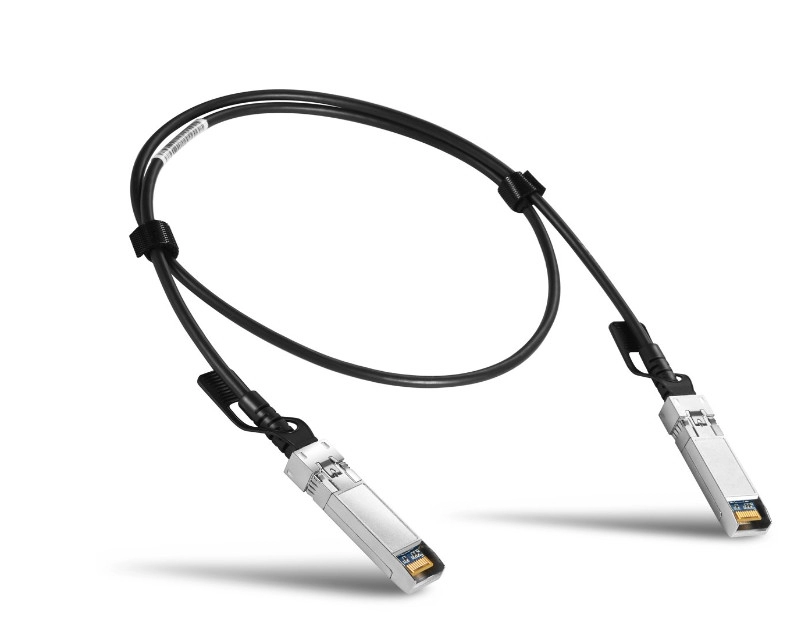
Passive vs. active — choose by required reach
-
Passive DACs contain no active electronics. They are commonly used for intra-rack and short rack-to-rack links and are typically reliable up to several meters in practice (many vendors specify passive up to ~3–7 m).
-
Active DACs (A-DACs) include signal conditioning (equalizers/CDR) in the connector housings to extend reach; manufacturers publish longer limits (often up to ~10 m or more depending on AWG and design). Always use vendor test data rather than generic limits.
Length and AWG — how they affect performance
Wire gauge (AWG) is the single most practical predictor of passive DAC reach: lower AWG numbers (thicker wire, e.g., AWG24) reduce attenuation and allow longer passive spans than higher AWG values (e.g., AWG30). Typical commercial lengths available are 0.5 m, 1 m, 2 m, 3 m, 5 m and 7–10 m; check per-length insertion loss (IL) curves from the supplier. For runs beyond a vendor’s passive specification, choose active DACs or AOC.
Mechanical details that matter
Check these physical attributes before ordering:
-
Connector latching and pull-tab design — robust latches reduce accidental removals.
-
Boot/profile — low-profile boots are preferable in high-density panels.
-
Strain relief — good molding at the connector prevents early fatigue.
-
Bend radius — follow vendor minimums (commonly ≥5× cable OD).
Mechanical failures are a frequent cause of field faults; prioritize build quality when choosing between two otherwise similar SKUs.
Electrical and thermal specs to verify
Confirm: differential impedance ≈ 100 Ω ±5 Ω, conductor attenuation per meter, and compliance with SFF-8431 electrical signalling. For active DACs, verify power draw and thermal limits — in dense deployments heat from many plugged-in modules can affect reliability. request the supplier’s electrical test data (VNA/TDR or eye measurements) for the specific length and AWG you plan to install.
Environmental and operating ranges
Commercial 10G DACs are commonly rated for operating ambient temperatures from 0°C to 70°C, with many industrial variants or specific OEM parts rated wider (e.g., −40°C to +85°C). Check the datasheet for the part you buy if your environment is outside standard data-center conditions. Also confirm jacket material (PVC vs LSZH) to meet facility fire-code or cabling policy.
Interoperability: MSA compliance and vendor coding
-
Prefer MSA-compliant assemblies (SFF-8431/SFF-8432 family) for broad interoperability.
-
Some switches enforce vendor EEPROM signatures or coded parts; if you use branded network gear (Cisco, HPE, Juniper, Arista), verify compatibility lists or request vendor-tested SKUs. When in doubt, ask the supplier for a compatibility matrix or tested switch list.
Required test evidence at purchase and on receipt
Demand factory test reports for each shipment showing at minimum:
-
Continuity and per-pair insertion loss vs length.
-
An eye-diagram or BER test at 10G (for active DACs additional functional tests).
-
Serialized labeling or lot traceability.
On site, validate links with a link-test or BER test and document results before accepting the installation.
Practical purchasing checklist (quick)
Use this checklist when evaluating SKUs:
-
Passive or active? (based on run length).
-
Exact length & AWG; request IL vs length curve.
-
MSA compliance and vendor compatibility confirmation.
-
Datasheet: impedance, insertion loss, operating temp, jacket type.
-
Mechanical sample or photo: latch, boot, strain relief.
-
Factory test reports and serialization.
-
Warranty and return policy (custom lengths usually non-returnable).
Real-world selection scenarios
-
ToR server → switch (≤3 m): Passive DAC, AWG28–AWG30 acceptable; choose low-profile boot for density.
-
Adjacent racks / short row (3–7 m): Use thicker AWG passive (AWG26 or 24) or active DAC where vendor IL data supports it.
-
Approaching 10 m: Prefer active DAC or AOC; require vendor BER/eye test for the exact length and AWG.
Conclusion
-
Determine required length and environment.
-
Choose passive for short intra-rack; active for extended near-10 m runs.
-
Select AWG that matches intended passive reach; request IL vs length curve.
-
Verify MSA compliance and switch compatibility.
-
Require factory IL/BER test reports and serialized labeling.
-
Inspect mechanical design and confirm warranty/returns for the SKU.
Following these ordered checks ensures the 10G Sfp+ DAC Cable you buy will function on first install and stay reliable in service. Remember to keep one or two spare, serialized assemblies that match your production parts for rapid replacement.
For sites standardizing on short-reach copper and high-density fiber, WOLON supplies factory-tested MPO trunks, MPO-to-LC cassettes, and MPO fan-outs that complement DAC deployments. WOLON assemblies are available in OM3/OM4 and OS2, come with per-unit test reports and polarity diagrams, and offer LSZH jacket options to match your data-center requirements.