
If you search for a network cable online today, you will be flooded with advertisements for “Ultra-Fast Cat 8 Ethernet cables” promising to eliminate your gaming lag or supercharge your home Wi-Fi.
Let’s speak strictly from an engineering perspective: Using a Cat8 cable for your home router or office PC is a massive waste of money.
Marketers push the highest number because it sells. But in the physical layer of network architecture, Cat6 and Cat8 were engineered for entirely different worlds. One is the undisputed king of the enterprise Local Area Network (LAN), and the other is a specialized, rigid, short-range weapon built exclusively for hyperscale data centers.
If you are wiring a new office building or upgrading your server racks, here is the technical reality of the cat6 vs cat8 debate, their exact speed limits, and how to choose the right copper infrastructure.
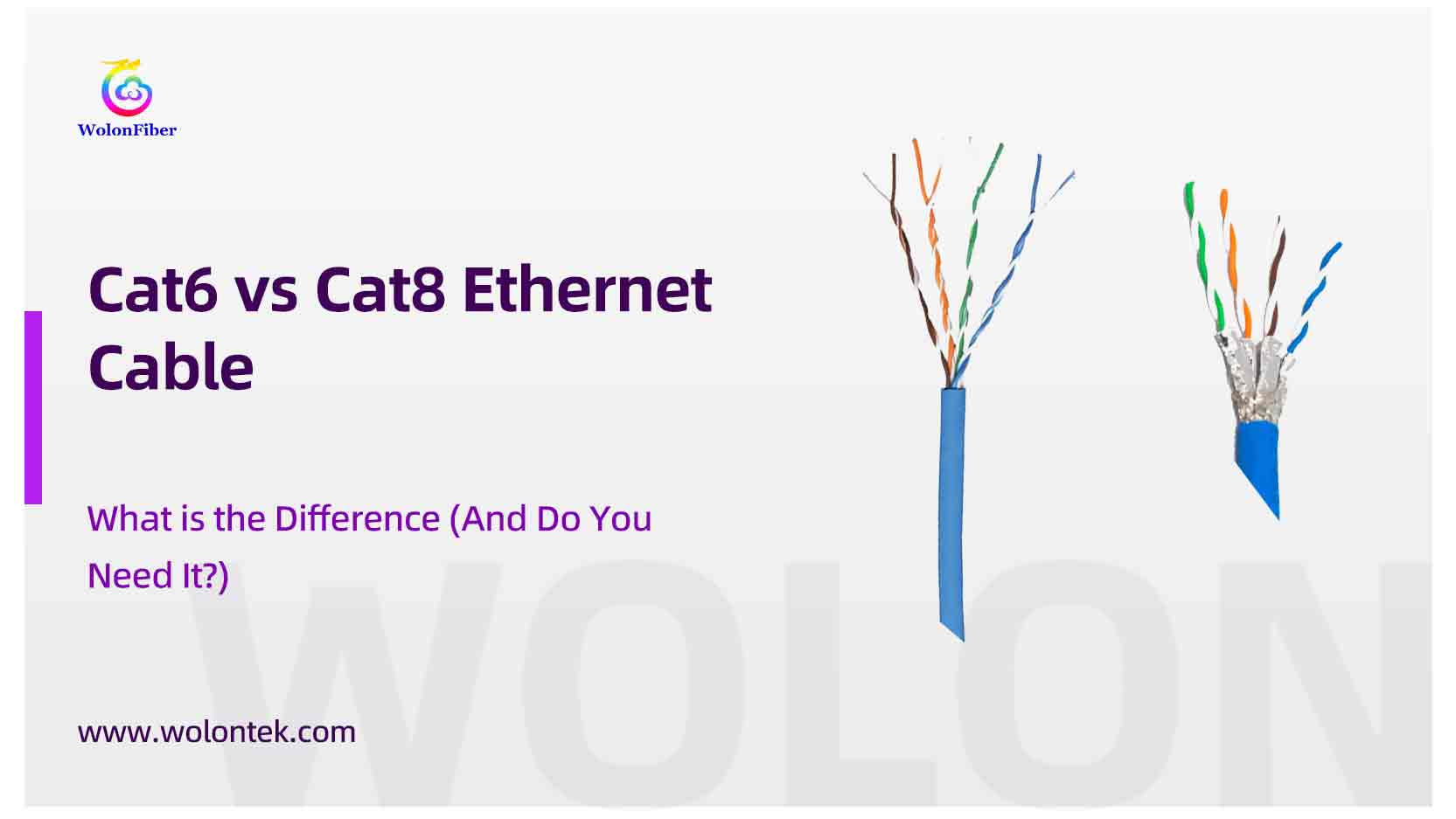
The Workhorse: What is a Cat6 Cable?
Category 6 (Cat6) is the current global standard for enterprise and residential networking.
Operating at a frequency of 250 MHz, Cat6 is designed to handle 1 Gigabit per second (Gbps) speeds up to a full 100-meter run. However, its true value lies in its headroom: a quality Cat6 cable can comfortably push 10 Gbps of data at shorter distances (up to 55 meters).
Because it is typically Unshielded Twisted Pair (UTP), Cat6 is flexible, easy to terminate with standard RJ45 connectors, and highly cost-effective. It is the perfect medium for connecting workstations, Wi-Fi access points, and Power over Ethernet (PoE) security cameras.
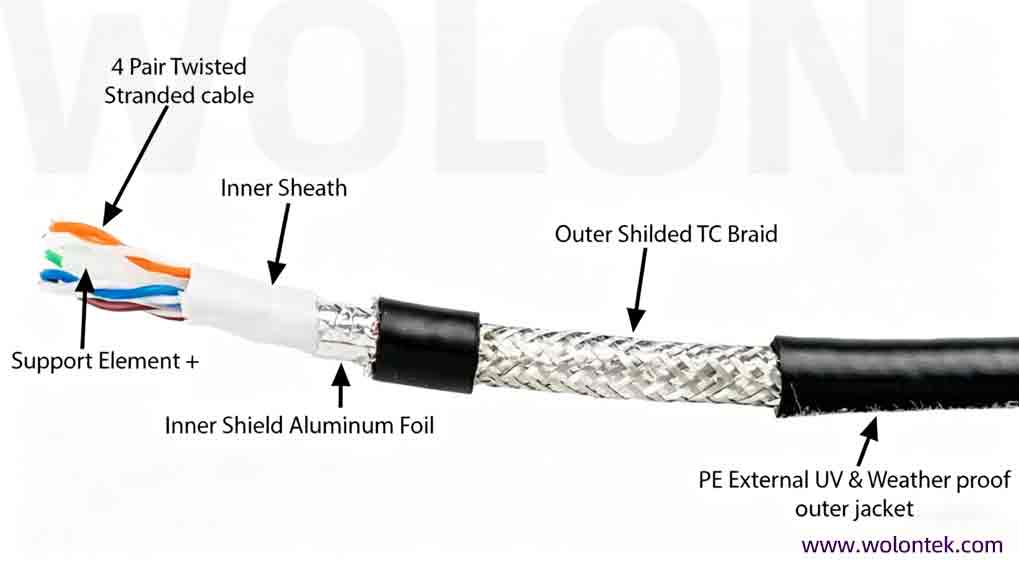
The Data Center Heavyweight: What is a Cat 8 Ethernet Cable?
Category 8 (Cat8) is not just an “upgrade” over Cat6; it is a completely different beast.
Approved by the TIA/EIA standards, a cat 8 ethernet cable is engineered to operate at a massive 2000 MHz frequency. It is designed to support 25 Gbps (25GBASE-T) and 40 Gbps (40GBASE-T) network speeds.
However, pushing that much data over copper creates extreme electromagnetic interference (EMI) and crosstalk. To combat this, Cat8 cables are strictly heavily shielded (S/FTP – Shielded/Foiled Twisted Pair). Every individual wire pair is wrapped in foil, and the entire bundle is wrapped in a metal braid.
This shielding makes the cable incredibly thick, stiff, and difficult to bend around corners. More importantly, cat 8 ethernet cable speed comes with a severe physical limitation: its maximum transmission distance is strictly limited to 30 meters (98 feet).
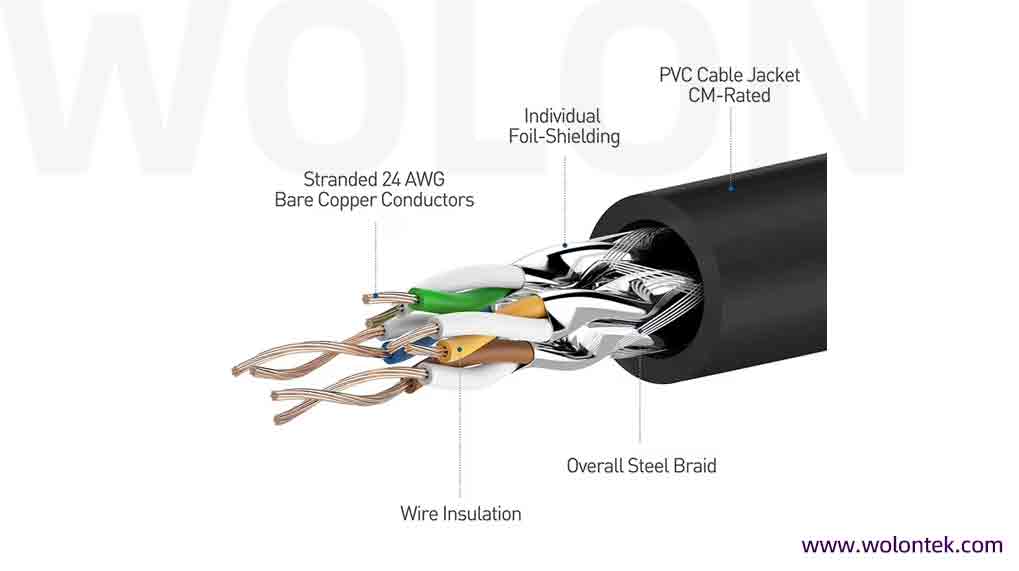
Difference Between Cat6 and Cat8 Ethernet Cable: The Engineering Breakdown
When you compare a cat 6 vs cat 8 ethernet cable, you must look beyond the theoretical speed limits. Here is the physical breakdown:
|
Feature |
Cat6 Ethernet Cable |
Cat8 Ethernet Cable |
|
Max Speed |
10 Gbps |
40 Gbps |
|
Max Distance (at Max Speed) |
55 Meters (180 ft) |
30 Meters (98 ft) |
|
Frequency (Bandwidth) |
250 MHz |
2000 MHz |
|
Shielding Requirement |
Usually UTP (Unshielded) |
Always S/FTP (Heavily Shielded) |
|
Flexibility |
Highly flexible, easy to route |
Thick, rigid, hard to bend |
|
Primary Application |
Office LANs, Home Networks, PoE |
Data Center Top-of-Rack (ToR) |
Cat6 vs Cat8 Ethernet Cable: How to Choose?
Choosing between these two cables is not about buying the “best” one; it is about buying the correct tool for your network topology.
When to choose Cat6:
If you are wiring a commercial office, a school, or a residential home, you use Cat6. It gives you the 100-meter reach you need to connect wall jacks back to the central IT closet. Even if you upgrade your switches to 10G in the future, your Cat6 runs (if under 55m) will handle the traffic flawlessly.
When to choose Cat8 Ethernet Cable:
You use Cat8 strictly in a server room. It was engineered specifically for Top-of-Rack (ToR) and End-of-Row (EoR) topologies. Network architects use short Cat8 patch cords (usually 1 to 5 meters) to connect servers directly to the switch in the same rack at 25G or 40G speeds, serving as a cost-effective alternative to Twinax DAC cables or fiber optics.
Sourcing Enterprise-Grade Copper Infrastructure
A network is only as reliable as the copper inside the jacket. Cheap CCA (Copper Clad Aluminum) cables will fail under heavy PoE loads, and poorly shielded Cat8 will suffer from crippling packet loss.
Since our establishment in 2010, Wolontek has been engineering the physical layer of modern networks. Operating out of our facilities in Wuhan’s Optical Valley, our dedicated workforce of 1000+ specialists manufactures strict-tolerance enterprise cabling.
Whether you need bulk reels of pure bare-copper Cat6 for a massive LAN deployment, or precision-tested shielded Cat8 patch cords for your 40G data center racks, we supply factory-direct infrastructure built to exact TIA/EIA specifications.
Stop paying distributor markups on your network deployments. 👉 [Contact the Wolontek Engineering Team for Factory-Direct Copper and fiber Cabling]
What is the difference between Cat6 and Cat8?
The main difference is speed and distance. Cat6 supports up to 10 Gbps over 55 meters and is flexible for office wiring. Cat8 supports massive 40 Gbps speeds, but is strictly limited to 30 meters and is heavily shielded, making it thick and rigid.
Is a Cat 8 ethernet cable faster than Cat6?
Yes, but only if your hardware supports it. A Cat8 cable can transmit data at 40 Gbps (2000 MHz), while Cat6 maxes out at 10 Gbps (250 MHz). However, plugging a Cat8 cable into a standard 1 Gigabit home router will not make your internet any faster.
Should I use Cat8 for my home network?
No. Cat8 is engineered for data center server racks where extreme speeds are needed over very short distances (under 30 meters). For home networking, gaming, and 4K streaming, Cat6 is significantly cheaper, easier to install, and provides more than enough bandwidth.