

If you are a network engineer or ISP owner in São Paulo, you know the drill. A critical 10G link goes down, or a new client needs a connection tomorrow. You check the local prices for SFP+ modules, and they are eye-watering.
In Brazil, you essentially have two options:
-
Buy Local (Pronta Entrega): Go to a distributor in Santa Efigênia or an official reseller. You get the product today, but you pay the “Brazil Price” (often 3x the global average).
-
Direct Import (Importação): Order from a factory like Wolontek in China. You wait 10-15 days, but you save massive amounts of CAPEX.
Which path should you choose in 2026? This guide compares the costs, risks (Anatel), and logistics to help you decide.
Option 1: Buying SFP+ Modules Locally in São Paulo (Distributors)
Best For: Emergencies, Small Quantities (<50 units), & Anatel Compliance.
If your network is down, you can’t wait for a plane from Shenzhen. You need stock now. São Paulo has a robust ecosystem of distributors, primarily clustered around specialized tech hubs.
Where to Buy?
-
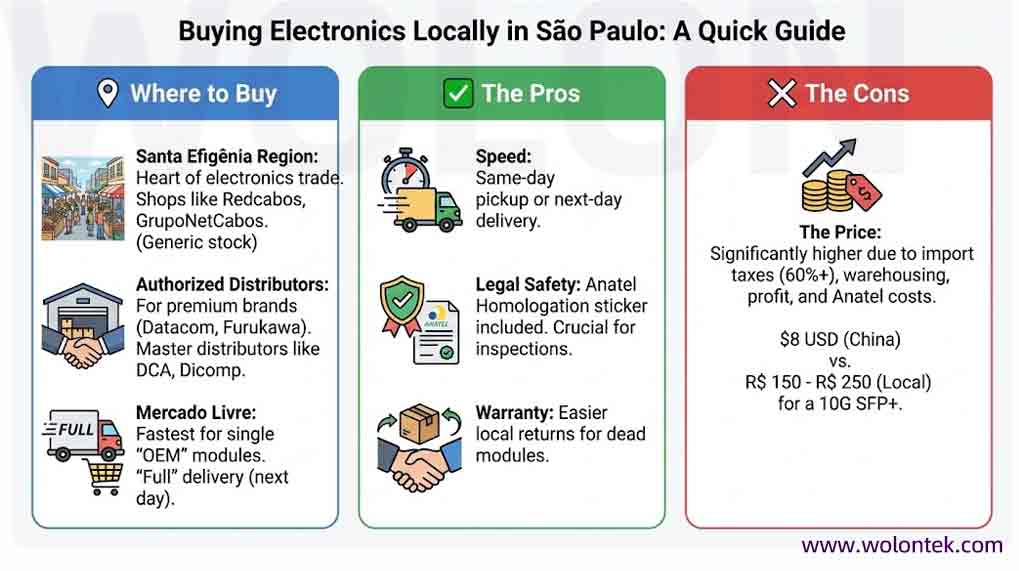
Santa Efigênia Region: The heart of São Paulo’s electronics trade. Shops like Redcabos or GrupoNetCabos often carry generic stock.
-
Authorized Distributors: For premium brands (Datacom, Furukawa), you rely on huge master distributors like DCA (Delta Cable) or Dicomp.
-
Mercado Livre: The fastest way to get a single “OEM” module, often shipped from local sellers with “Full” delivery (next day).
✅ The Pros
Speed: Same-day pickup or next-day delivery.
Legal Safety: Products bought locally should already have the Anatel Homologation sticker. This is crucial if you are inspected.
Warranty: Easier to return a dead module to a shop in SP than to China.
❌ The Cons
The Price: You are paying for the distributor’s import taxes (60%+), their warehousing, their profit, and their Anatel certification costs. A standard 10G SFP+ that costs $8 USD in China might sell for R$ 150 – R$ 250 locally.
Option 2: Direct Import from SFP+ Modules Factory (WolonFiber)
Best For: Planned Expansions, Distributors, & High-Volume ISPs (>100 units).
This is where the profit margin lies. Smart ISPs in Brazil don’t buy consumables (like transceivers and patch cords) locally; they plan ahead and import.
The Economics of Direct Import
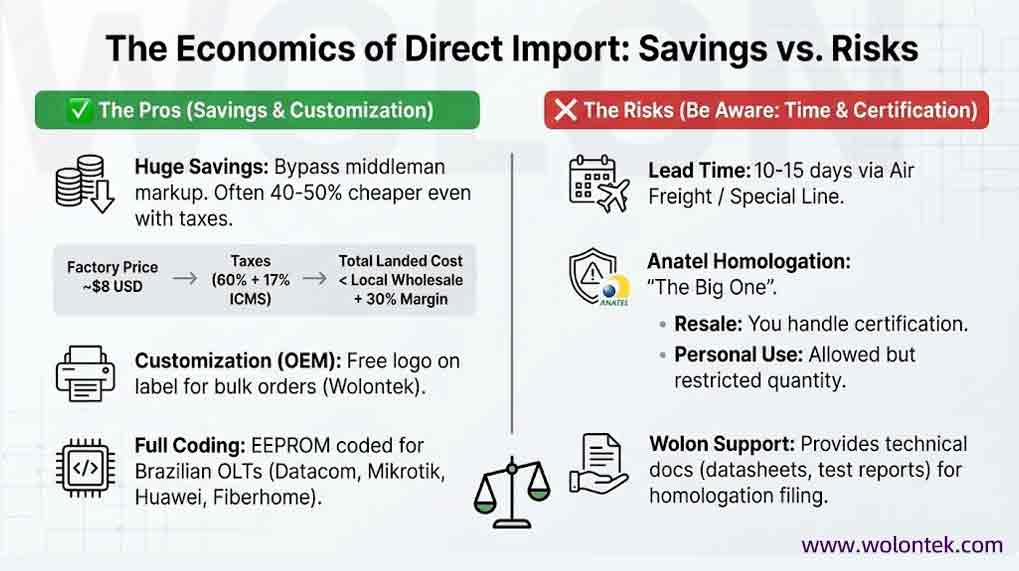
Even with the “Remessa Conforme” taxes, buying direct is often 40-50% cheaper.
Factory Price: ~$8 USD (approx. R$ 45) for a 10G SR module.
Taxes (60% + 17% ICMS): Yes, taxes are high. But do the math.
-
Total Landed Cost is still often lower than the wholesale price offered by a local Brazilian middleman who adds their own 30% margin on top of the taxes.
✅ The Pros
Huge Savings: Bypass the middleman markup.
Customization (OEM): Want your ISP’s logo on the label? Wolontek does this for free on bulk orders.
Full Coding: We code the EEPROM specifically for Datacom, Mikrotik, Huawei, or Fiberhome OLTs used in Brazil.
❌ The Risks (Be Aware)
Lead Time: 10-15 days via Air Freight / Special Line.
Anatel Homologation: This is the big one.
-
Direct import for resale requires you to handle Anatel certification.
-
Direct import for personal use (Uso Próprio) is allowed but restricted in quantity.
-
Wolon Support: We provide all necessary technical documents (datasheets, test reports) to help your engineering team file for homologation if you choose to become a distributor.
Comparison: Local vs Wolon Direct
Conclusion: What Should You Do?
Scenario A: “My OLT burned a port and I need a replacement NOW.” Drive to Santa Efigênia. Do not import. The downtime costs more than the module. Buy locally, pay the premium, and get your network up.
Scenario B: “I am expanding my FTTH network to a new neighborhood next month.” ✈️ Import from Wolontek. You have 30 days. Why pay R$ 20,000 for modules locally when you could pay R$ 10,000 importing them?
-
Order a sample batch first to test with your equipment.
-
Use the savings to invest in better OLTs or more fiber cable.

Importing to Brazil? We Made It Easy.
Don’t let “Receita Federal” scare you away from 70% savings.
We ship daily via Specialized Logistics Lines that handle customs clearance smoothly. You get the factory price; we handle the headache.
Commercial Invoice Support Available (CNPJ / Low Value).
FAQ: Importing SFP Modules to Brazil
Q1: Will I pay 60% import tax on my order?
A: Most likely, yes.
Brazilian customs (Receita Federal) strictly taxes electronics. However, the math still favors importing for bulk orders.
Example: Even if you pay $8 (Product) + $5 (Tax) = $13 total per unit, it is still significantly cheaper than buying locally in São Paulo for **$30-$40+ (R$ 150+)**.
Wolon Support: We provide a precise Commercial Invoice to ensure your taxes are calculated correctly and your package isn’t held up unnecessarily.
Q2: Are your modules compatible with Datacom and Mikrotik?
A: Yes. We know that Datacom switches and Mikrotik routers are the standard in Brazil. We have a specific EEPROM code library for these brands. Before shipping, we flash the modules to ensure they are recognized instantly (plug & play) without “unsupported transceiver” errors.
Q3: Does Wolontek offer “Boleto Bancário” or “Pix” payment?
A: Currently, for factory-direct orders, we accept USD payments via Bank Transfer (T/T) or PayPal. While we don’t accept Pix directly yet, many Brazilian clients use services like Husky or bank FX desks to pay us easily in USD.
Q4: How long does shipping take to São Paulo (GRU/VCP)?
A:
Express (DHL/FedEx): Typically 4-7 days.
Air Freight (Special Line): Typically 12-15 days. We recommend Express for samples and Air Freight for bulk commercial orders to balance speed and cost.
Q5: What about the warranty if I am in Brazil?
A: We offer a 3-Year Warranty. If a module fails (which is rare, <0.1%), you do not need to ship it back to China (shipping is too expensive). simply send us a video of the failure test, and we will send a free replacement with your next order.