
In the world of optical fiber, ADSS (All-Dielectric Self-Supporting) cable is unique. Unlike duct cables that sleep safely underground, ADSS hangs in the air, battling invisible enemies 24/7:
1.Wind & Ice (Mechanical Load)
2.UV Radiation (Aging)
3.High Voltage Electric Fields (Dry Band Arcing)
If a duct cable fails, you dig it up. If an ADSS cable fails on a 110kV power line, it can cause a catastrophic power outage, massive fines, and dangerous re-installation work.
Quality is not just a certificate; it is survival. As a leading ADSS cable manufacturer, Wolon knows that “cheap” ADSS is the most expensive cable you will ever buy. In this guide, we open our factory doors to show you exactly how we ensure zero-defect quality for aerial projects.
The Core: Aramid Yarn Quality (The “Muscle” of ADSS Cable)
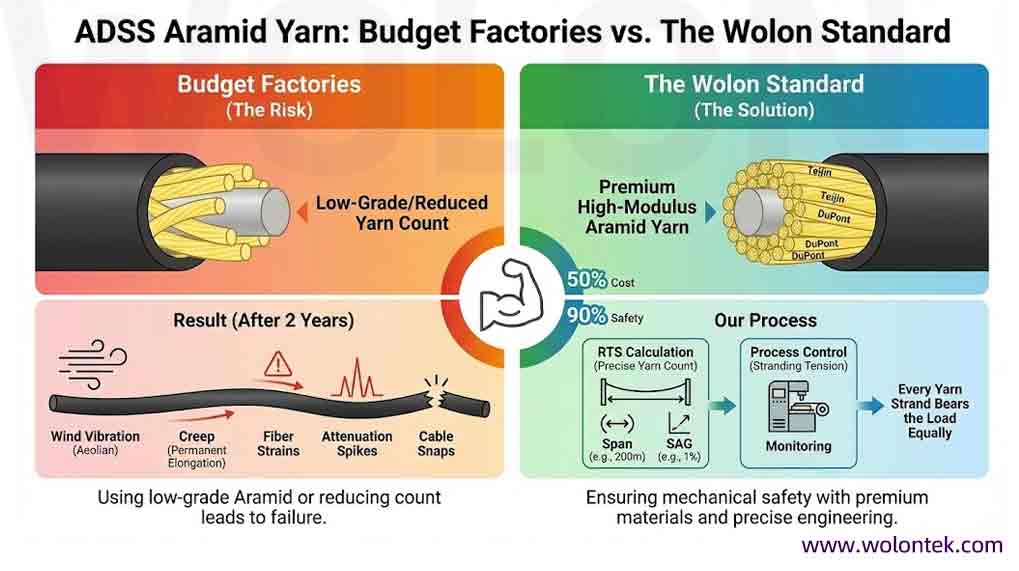
The “Self-Supporting” in ADSS comes entirely from the Aramid Yarn (Kevlar). This is where 50% of the cost—and 90% of the mechanical safety—lies.
The Manufacturer’s Secret: Many budget factories reduce costs by using low-grade Aramid or reducing the yarn count.
Result: The cable looks fine initially. But after 2 years of wind vibration (Aeolian vibration), the cable suffers from “Creep” (permanent elongation). The fiber strains, attenuation spikes, and the cable eventually snaps.
✅ The Wolon Standard:
-
We use premium high-modulus Aramid Yarn (brands like Teijin or DuPont).
-
RTS (Rated Tensile Strength) Calculation: We don’t guess. We calculate the precise yarn count based on your specific Span (e.g., 200m) and SAG requirements (e.g., 1%).
-
Process Control: We monitor the stranding tension to ensure every yarn strand bears the load equally.
Jacket Selection: AT (Anti-Tracking) vs PE
This is the most critical decision for High Voltage (HV) transmission lines.
What is “Tracking”? On power lines (>12kV), the strong electric field ionizes the air around the cable. When combined with moisture and dust, it creates small electrical sparks called “Dry Band Arcing.” These sparks burn tiny holes in standard Polyethylene (PE) jackets, eventually exposing the aramid and breaking the cable.
The Solution:
PE Jacket (Polyethylene): Use ONLY for distribution lines < 12kV or telecommunication poles.
AT Jacket (Anti-Tracking): Mandatory for transmission lines ≥ 12kV (typically 35kV, 110kV, 220kV).
✅ The Wolon Standard: Our AT sheath material is specially compounded with tracking-resistant additives.
-
Test Standard: We perform the IEEE 1222 Tracking Resistance Test. The sheath must withstand 2.5kV-6.0kV voltage for hours without eroding.
-
Visual Check: A real AT jacket usually has a duller, matte finish compared to the shiny PE jacket.
Manufacturing Process: Controlling “Excess Fiber Length” (EFL)
Why do fibers break inside the tube even when the cable doesn’t snap? Because of poor EFL control.
The Physics: When ADSS is pulled tight between two towers, the cable stretches. The optical fiber inside is glass; it cannot stretch.
The Trick: We manufacture the fiber slightly longer than the tube (typically 0.1% – 0.2%). This extra length fits loosely inside the tube like a spring. When the cable stretches under wind load, the fiber simply straightens out without breaking.
✅ The Wolon Standard: We use advanced OTDR monitoring during production to verify that the fiber has zero strain even when the cable is under its maximum working tension (MAT).
The “Zero-Defect” Testing Protocol
Before any drum leaves our warehouse, it must pass the “Torture Chamber.”
A. Mechanical Testing (IEC 60794-4-20)
-
Tensile Test: We pull the cable to its RTS (e.g., 15KN). The fiber attenuation change must be < 0.05dB.
-
Crush Test: Simulating the pressure of tension clamps (dead-ends).
-
Impact Test: Simulating falling tools or hail.
B. Environmental Testing
-
Temperature Cycling: -40°C to +70°C. Ensuring the gel doesn’t freeze and the jacket doesn’t crack.
-
Water Penetration: 1 meter of water head for 24 hours. Result: No leakage.

Packaging: The Often Ignored Detail
ADSS drums are heavy (often 2-4km per drum). A cheap “export drum” made of weak plywood will collapse during sea freight or trucking, crushing the expensive cable inside.
✅ The Wolon Standard:
-
Iron-Wooden Drums: We use reinforced wooden drums with an iron frame for heavy ADSS.
-
Fumigation: Fully compliant with ISPM 15 standards for global entry (USA/EU/AU).
-
Full Armor Protection: The drum is wrapped in polycarbonate sheets to prevent nails or forklifts from damaging the outer layer of the cable.
Buyer’s Checklist: How to Audit Your ADSS Cable Supplier
Don’t just ask for a price. Ask these 3 questions to filter out the traders from the experts.
1.”Can you provide the calculation sheet for RTS and MAT based on my span/weather conditions?”
Real Factory: Will ask for your NESC zone (Heavy/Medium/Light) and provide a detailed engineering sheet.
Trader: Will just give you a generic datasheet.
2.”What brand of Aramid Yarn do you use, and can I see the Certificate of Origin?”
This forces them to prove they aren’t using recycled waste yarn.
3.”Do you have an in-house High Voltage Tracking Test Lab?”
Essential if you are buying AT-jacket cables.
Conclusion: Safety is Priceless
An ADSS project is a 20-year investment. Saving 5% on cable cost today often leads to 200% replacement costs tomorrow.
At Wolontek, we don’t just sell cable; we sell Span Security. From the precise tension of the Aramid Yarn to the chemical formula of the AT sheath, we manufacture every meter to survive the toughest storms.
Stop Guessing Your ADSS Specs.
An aerial project lives or dies by the math.
Don’t risk a cable break. Simply send us your Span, Voltage, and Wind Speed. Our engineers will calculate the exact RTS (Tensile Strength) and jacket type you need.
Includes: Dead-end & Suspension Clamp Matching.
FAQ: ADSS Cable Quality
Q1: How do I know if I need Single Sheath or Double Sheath ADSS?
A:
Single Sheath: Typically for spans < 100m (cost-effective).
Double Sheath: Mandatory for spans > 100m. The double layer provides better protection for the Aramid yarn and prevents the cable from being crushed by the high tension of the clamps.
Q2: Can I use standard suspension clamps for ADSS?
A: No. You must use Pre-formed Helical Fittings (Guy Grips). These spiral grips distribute the gripping force gently over a long length of the cable to avoid crushing the optical fibers inside. Wolontek supplies matched fitting sets for every cable.
Q3: What happens if I use a PE jacket on a 110kV line?
A: The cable will likely fail within 6-24 months due to dry band arcing. The jacket will erode, water will enter, and the cable will break. Always use AT (Anti-Tracking) jackets for >12kV.